
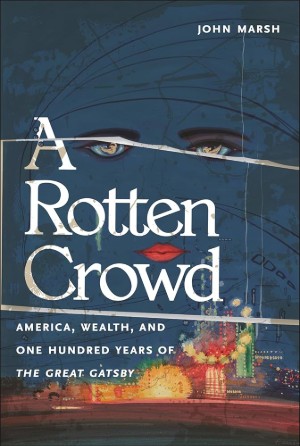
 John Marsh, A Rotten Crowd: America, Wealth and One Hundred Years of The Great Gatsby (Monthly Review Press 2024), 136pp.
The classic novel, The Great Gatsby provides fuel for reflections on the malign impact of great wealth in John Marsh’s A Rotten Crowd, finds John Westmoreland
One hundred years ago, F. Scott Fitzgerald penned the remarkable novel The Great Gatsby, a story about wealth, power and decadence. John Marsh’s A Rotten Crowd takes us back to Gatsby’s world and some of the themes Fitzgerald used to expose the capitalist class that he despised.
For readers who are not familiar with The Great Gatsby, or who need reminding, John Marsh sets out the shape of the novel in one thousand words at the start of the book. The story is told by Nick Carraway, a Midwesterner working in the bond market, and who gets to know and befriend the central character, Jay Gatsby.
Gatsby lives on the lakeshore opposite Nick’s house in a mansion famous for wild parties that advertised conspicuous leisure and conspicuous consumption. Nick came to the lake to live near his cousin Daisy who is married to the wealthy Tom Buchanan, a man born into wealth, or old money. Gatsby represents new money, made from bootlegging and crime, but now pitching for respectability. Gatsby loves Daisy, whom he met before going to serve in World War One, and he uses Nick to rekindle their relationship. It all ends badly with Gatsby being murdered by George Wilson, the husband of Tom Buchanan’s mistress, Myrtle Wilson.
Nick arranges Gatsby’s funeral, but none of the wealthy people who visited his mansion turn up. Disillusioned with the rotten crowd, Nick goes back to his Midwest origins to record the tale.
The filthy rich
John Marsh’s explanation for writing ‘a whole book about another book’ (p.15) is that, like Fitzgerald, he was a poor boy in a rich boy’s town, a poor boy in a rich boy’s school. He quotes Fitzgerald approvingly, ‘I have never been able to forgive the rich for being rich, and it has coloured my entire life and works’ (p.13).
The spectacular enrichment of the 1% today had its origin in that earlier era of robber barons who hoovered up dollars without regard for the consequences, and corrupted politics and social relations by what Marsh calls ‘the distressing proximity of millionaires’ (p.15)
Celebrity culture, then and now, creates norms and standards that the rest of us can only crave. Their fashionable clothes and finery are visible but out of reach, and their decadent, wasteful lives corrupt morality and turn social relationships into profitable contracts where ‘love’ is for advantage only.
For the super-rich, what you wear is what you are, or rather what you want to be seen as. Marsh explores the importance of clothes and accessories in The Great Gatsby to great effect. Firstly, for Gatsby, expensive clothes meant gaining access to bourgeois society. He used them to cover up his humble origins. They went with having a mansion and not having any work to worry about, carried through life by an army of servants and attendants.
He impresses Daisy and Nick by throwing expensive shirts onto his bed making Daisy ‘cry stormily’ (p.32). She blurts out through her tears ‘I’ve never seen such beautiful shirts before’, giving Gatsby the ultimate compliment. However, clothes were also his undoing. His pretence of graduating from Oxford College was blown by deciding to wear a pink suit. ‘An Oxford man!’ Tom roars. ‘Like hell he is! He wears a pink suit’ (p.34).
For the established rulers with old money, authentic clothes keep out the nouveau riche and their absurd pretensions, and Marsh updates the theme started by Fitzgerald by looking at the predilections of those who lord it over us today.
For example, a Casio watch bought for thirty bucks is functionally as good as a Rolex worth a million, but one has a plastic case and the other is cased in oyster steel. There can be no other explanation for such outlandish expense other than to affirm membership of the elite.
Particular mockery is reserved for the billionaires who fetishise casual wear like Mark Zuckerberg wearing hoodies, not forgetting that a designer tee shirt can cost five hundred dollars. Wearing casual clothes is yet another way of saying ‘I’m so rich, I don’t need to tell you how rich I am’.
And Marsh includes the low pay and long hours suffered by the one in six people who work in the garment trade as the base from which dress snobbery and the filtered-down copies for working-class consumption should be judged.
Ash heaps and millionaires
One of the titles Fitzgerald proposed for his novel was Among the Ash Heaps and Millionaires. ‘Among’ presupposes a connection between the two.
Marsh traces Fitzgerald’s use of the ash metaphor in the novel. Fitzgerald used to commute into Brooklyn past the city’s huge ash dump (Mount Corona), where Flushing Meadow is today. It was an inhuman place, a grey mountain shrouded by swirling dust. This is the waste that a consumer society leaves in its wake.
The pampered triviality of the elites may suggest a world without waste, where fashion and good taste can live without any consequence, and the ugliness of dumps like that near the Flushing River are just an anomaly. Marsh plucks this string to great effect. The adverts offer us consumer-choice as a right, and keep the exploitation, waste and chaos well away from the shop front. Those who cannot escape to lakeside mansions have to suffer the waste. Smell it. Live with it.
On Nick’s commute to Brooklyn, he crosses the train to avoid looking at the children who roam Mount Corona seeking something of value in the waste. Myrtle’s mechanic husband, George, was ‘of the dust’. Fitzgerald describes George looming out of the dust to kill Gatsby, ‘that ashen, fantastic figure gliding toward him through the amorphous trees’ (p.53).
Capitalism plunders the planet without a thought to regeneration, and covers up or exports to other countries the waste it generates. Mount Corona is now Corona Park and New York’s waste is managed but Nick’s final comments about Tom and Daisy hit the mark.
‘They were careless people. They smashed up things and people and then retreated back into their money or their vast carelessness or whatever it was that kept them together, and let other people clear up the mess they had made’ (p.62).
Wealth, corruption and alienation
Of all the characters in The Great Gatsby only Nick has any integrity. When Gatsby tries to embroil him in the sale of stolen bonds, Nick turns him down because he knew it was not an act of friendship, but to secure a service rendered: helping Gatsby to reunite with Daisy.
Marsh writes, ‘In The Great Gatsby a culture of wealth corrupts connections between human beings … Such relationships reduce others into objects to be used and then discarded, sent to the infamous ash heaps with the husks of other exploited resources’ (p.64). Everyone in the novel is using someone else for their own advantage except Nick.
Meyer Wolfsheim, who is the perfect blend of capitalist and crook, exemplifies someone who is an unapologetic user of people. He proudly shows Nick his cufflinks made from human molars. And Tom casually reveals that he fixed the 1919 World Series.
Wolfsheim plays the role of corruption facilitator to both Tom and Gatsby, and he knows only too well all the weaknesses that leave them open to suggestion and control. He says of Gatsby, ‘I made him. When he told me he was an Oxford man I knew I could use him good.’
Marsh brings some great insights into the novel that might be missed in a casual reading. He writes, ‘As it does in so many other respects, The Great Gatsby offers a warning. It illustrates what happens when our relationships become transactional, become this for that’ (p.79).
Racism and the novel
Cultural criticism has to deal with the biases of the author. If a character expresses a view that is unacceptable to the values of a modern reader that can viewed as a service to realism, or, if left unchallenged, a promotion of prejudice.
John Marsh comes down strongly in the latter camp. He writes, ‘A spectre haunts The Great Gatsby: racism. The novel has three or four scenes that will disgust contemporary readers, including a reader like me who has a charitable attitude towards the novel’ (p.81).
I felt he got this wrong despite his attempts to balance the argument by saying that we should perhaps distinguish between Fitzgerald the author and Nick the character.
At a dinner, Tom goes off on a rant about how immigrants pose a threat to civilisation based on a ‘scientific book’ that predicts racial degeneration. The book Tom refers to is probably The Rising Tide of Color: The Threat Against White World Supremacy (1920) by Lothrop Stoddard.
Marsh recounts the passage from the novel at length. Because Nick just listens, it could be seen as an endorsement of Tom’s rant. But Daisy quietly mocks Tom, ‘He reads deep books with long words in them.’ At crucial moments Daisy winks at Tom, which seems to be a mockery of Tom getting worked up about something silly (p.86).
There are other racist comments that Marsh flags up about ‘haughty Negroes’ and ‘sad-eyed South Europeans’, but in the company of characters described by Fitzgerald how could racist references not be made?
I think Marsh loses the plot when he writes that he wouldn’t expect Nick to join the Socialist Party, ‘Rather, the argument is that his racism prevents Nick from making common cause with immigrants and Blacks. Those prejudices limit his opportunities to do anything about the rotten crowds of wealth and whiteness’ (p.95).
No end in sight
A Rotten Crowd is a good book. It’s easy to read, entertaining and full of ideas that help us get to grips with the ugly reality behind capitalism’s gleaming façade. John Marsh is a progressive who seems to have written the book to bring home the lessons of The Great Gatsby to a world seething with anger and pain. It was probably a mistake to end the book with a chapter that grapples with where we go from here.
He wants to end the carnage that class society imposes on the mass of people. He looks at methods to redistribute wealth through the election of a government of progressive minds. However, he doesn’t argue with much conviction, and resorts to the final lines of the novel, that says we just have to keep trying:
‘Gatsby believed in the green light, the orgastic future that year by year recedes before us. It eluded us then, but that’s no matter – tomorrow we’ll run faster, stretch our arms further … And one fine morning -’
Before you go
The ongoing genocide in Gaza, Starmer’s austerity and the danger of a resurgent far right demonstrate the urgent need for socialist organisation and ideas. Counterfire has been central to the Palestine revolt and we are committed to building mass, united movements of resistance. Become a member today and join the fightback.

John Westmoreland
John is a history teacher and UCU rep. He is an active member of the People's Assembly and writes regularly for Counterfire.