
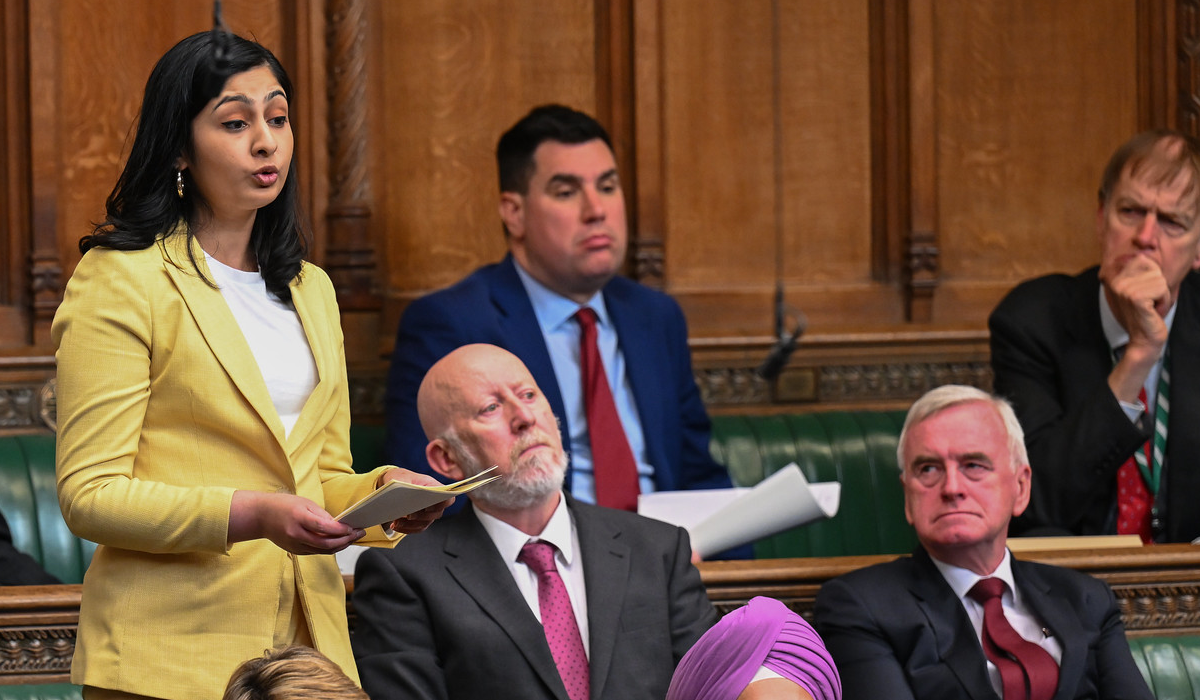
 Zarah Sultana MP debating Palestine in the Commons, April 2024. Photo: Flickr/House of Commons
Lindsey German on the lure of the ballot box and Starmer the statal bullyboy
Labour’s dreadful week came crashing to a close with the declaration on Thursday evening from Zarah Sultana MP that she was leaving Labour and joining the Independent MPs, setting up a new left party, which she would co-lead with Jeremy Corbyn. While Jeremy Corbyn has put a rather different angle on this process, no doubt reflecting different approaches to the possibilities of such a party, it is important to focus on the need for a left alternative and how we build it.
The announcement and Jeremy Corbyn’s speeches last weekend spoke to the sense of disillusionment and frustration which many on the left feel both over the relentlessly right-wing direction of Labour under Starmer and the failure of a left alternative to emerge. The electoral success of the far-right Reform has given an added urgency to the need to put forward an electoral alternative to the right and to Labour. There is also an urgency in the sense that nature abhors a vacuum, and if it does not develop, other forces will take up the potential support. Recent polling showed that a Corbyn-led party would take votes from both Labour and the Greens. At present, Zack Polanski is challenging for the latter’s leadership from the left, and some socialists have recently joined to support that. However, the Greens are less connected to the movements than a potential new socialist party, and to its right on questions such as Nato. And despite Labour’s left being in the doldrums, the big parliamentary revolt against Starmer will give left MPs heart that perhaps their fortunes can revive.
The need for a left alternative is obvious. Starmer’s first year in office has been a near complete failure. A sound cloud of those interviewed by LBC assessing his prime ministership showed the word ‘disastrous’ was the most used to describe it. His ratings are at record lows, and Labour as a party is trailing Reform in the polls. Labour are lucky that the opposition leader, Kemi Badenoch, is even more politically inept than Starmer.
The rebellion of Labour MPs against the disability benefit cuts was a complete defeat for the government – 49 Labour MPs still voted against its bill despite having won nearly all concessions. The anger over that issue has been cumulative, following the attacks on winter fuel allowance, the refusal to lift the two-child benefit cap, the cuts in public spending and the massive hike in defence spending. This is on top of bitter opposition to Starmer over his role in the Gaza genocide. Underlying all this is the worsening working-class living standards, and the decay of public infrastructure.
One of the reasons for Reform’s success is the near universal disillusionment with mainstream politicians and a sense of powerlessness in the face of these worsening conditions. This allows Reform to pose fake alternatives, like blaming migrants for the housing crisis, or scapegoating the Muslim community. The need for a left party which counters these arguments but also presents the possibility of a vote other than Labour, is growing all the time.
Hence the widespread welcome for Zarah’s statement and the considerable numbers who have signed up to the proposed project. However, this is some way from a finished product since it is at present an aspiration rather than a reality. The truth, however, is that something is likely to be set up in time for the local elections in 2026. There are a number of organisational questions about its membership and whether it should be individual or federal membership structures. But we need to look at the politics and organisational tasks of such a party.
Michael Lavalette, independent socialist councillor from Preston, has spelt out some of the challenges for such a party. It needs to be organised from below, rather than by small, self-selected groups, and it needs democracy which will allow activists on the ground to determine its direction. It also needs principles that it sticks to, and to be able to hold its elected representatives to account if they stray from those principles. These include supporting workers’ struggles against exploitation, fighting against all forms of oppression, and for genuine workers’ democracy.
Even here, however, the best political programme means little unless it is connected to organic struggle and tries to reach out not just to the existing left but to working-class people who might not vote or who might be tempted to vote for Reform. These are people abandoned by successive Labour governments who want a better life for themselves and their children but see it disappearing. One major weakness here is the unions, extremely weak in the private sector and largely comprised of older and often better off workers. One challenge is to strengthen and widen them, as well as other movements against war, austerity and over Palestine.
All of this requires a change for the left, because it means engaging in real struggles and building support in working-class areas, not simply moralising or writing off large sections of workers because they don’t agree on every issue. The success of any new party will depend on it taking that approach and on seeing its main orientation on struggles that can change politics, rather than relying on MPs and parliament to do so. It will also need members who see the role of the state as central to the exploitation and oppression that we face and who learn the lessons of the Corbyn years about how the unelected forces within capitalism undermine democratically-elected socialists.
Those are the tasks and they will be difficult, but they are necessary for the success of any project. The formation of a left party is being taken seriously by the right-wing media and Labour must be rattled by the prospect. Successful, a group of socialist MPs could make a real difference in pulling mainstream politics to the left and helping to marginalise Reform. In the process they would also deal a blow to Labour and open up the possibility of real change.
A step towards a police state?
Today, I will be outside Westminster Magistrates’ Court in London supporting Ben Jamal and Chris Nineham, facing charges of breach of the Public Order Act. Their trial is to be postponed maybe for months. I have never known a time when protesters are facing such an array of restrictions, and I have been demonstrating for over 50 years. It is now completely routine for police to put restrictive orders on peaceful protests, which makes it more likely that there will be arrests for actions which would not otherwise be criminal. Politicians are passing highly repressive laws, including last week the proscription of the direct action group Palestine Action under terrorism laws. Around 29 of its supporters were arrested the following day at a non-violent static protest by the statue of Mahatma Gandhi. These included an 83-year-old woman.
It was chilling to hear Met police chief Mark Rowley justify this on the grounds that there is no age limit on arrests. I’m not surprised however given his categorical refusal to engage with those who organise the mass Palestine protests, and his disdain for them came across in the interview. But this isn’t about one man. The state is becoming more pressive, the police are gaining more and more powers, and our freedom to protest is under attack. We need to vigorously oppose these developments – we are already heading towards a police state, presided over by the increasingly reactionary Keir Starmer and Yvette Cooper.
This week: I will be calling for the charges against Ben and Chris to be dropped, speaking for Glasgow Stop the War on Wednesday and mobilising for our next Palestine demo on 19 July. I also hope to spend a couple of days on the Oxford canal.
Before you go
The ongoing genocide in Gaza, Starmer’s austerity and the danger of a resurgent far right demonstrate the urgent need for socialist organisation and ideas. Counterfire has been central to the Palestine revolt and we are committed to building mass, united movements of resistance. Become a member today and join the fightback.

Lindsey German
As national convenor of the Stop the War Coalition, Lindsey was a key organiser of the largest demonstration, and one of the largest mass movements, in British history.
Her books include ‘Material Girls: Women, Men and Work’, ‘Sex, Class and Socialism’, ‘A People’s History of London’ (with John Rees) and ‘How a Century of War Changed the Lives of Women’.