
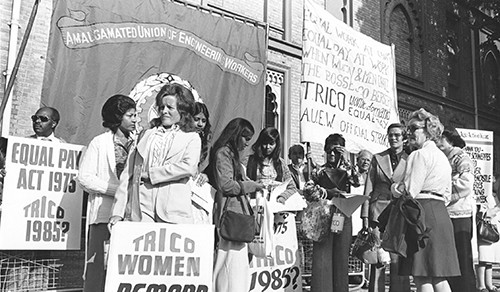
 Trico strikers lobbying TUC Brighton. Photo: London Historian's blog
Cici Washburn speaks to Sally Groves on the 50th Anniversary of the Trico factory strike, where women workers walked out for 21 weeks over equal pay
It’s the 50th anniversary of the Trico equal pay strike. What were the conditions around the time you went on strike and when did you realise you weren’t getting equal pay?
I went to work at Trico in 1975. I didn’t have office skills, shop work wasn’t paid as much, and factory work was plentiful: decent factory work, proper contracts. Two jobs were offered at the job centre: at Wall’s meat-processing factory in Acton and at Trico Folberth on the Great West Road in Brentford. I said ‘what time do they start?’ She said, ‘7.30 at Walls and 8 at Trico.’ I’m not very good in the mornings, so I said, ‘I’ll take the Trico one’. I was assembling the arms of windscreen wipers. Trico, an American multinational based in Brentford, West London, had a virtual monopoly of the motor-accessory business in Britain, notably windscreen wipers. It was supplying nearly all the main car manufacturers like Leyland, Ford’s and Chrysler and the British Motor Corporation. I joined the union almost immediately, because I’d always believed it was important to be a member of your trade union and the AUEW (the engineering union now part of Unite) was the main union at Trico with sole negotiating rights.
I don’t think there was that much awareness amongst some of the women about equal pay. Barbara Castle’s Equal Pay Act had come onto the statute book at the end of 1975. Government had given employers five years to put systems in place, which we could interpret cynically as five years for employers to find ways of avoiding it. There had been negotiations about equal pay between the company and the union for twelve months before the strike, but most people weren’t particularly aware of this. I don’t think there was much awareness by the union of needing to involve people at that stage. I wasn’t working in the department where the flashpoint for the strike happened. The trigger for the strike was the ‘famous five’ guys on night shift who were transferred on to days and were all put in the one department. This was the company’s biggest mistake ever. They were all put on the micro motor line with the women. The rest of the men from night shift had taken redundancy although there was a new ‘twilight’ evening shift set up. The explosion happened when the women realised that their wage slips at the end of the week were roughly £6.50 less than the men, doing identical work: that was a lot of money at the time.
What were the picket lines like – they looked very diverse for that time?
Yes, our strike was diverse, compared with the women at Ford’s, where I think there was only about one black person, we had much more of a mixture of people at Trico.
It all erupted at the meeting in Boston Manor Park behind the factory. There were two proposals that day: one was for a day of action, which the district committee had suggested, and there was a vote for a half-day stoppage. The other was the fact there’d been a failure to agree put in with the company about equal pay, which for some people was the first they realised it was happening. Roger Butler, our AUEW district secretary said, ‘I leave it now to the shop stewards and the members to decide what to do, because we’ve come to the end of the road.’ He went off to another meeting, and some people began to go back to work after lunch hour. Some of the women were furious about the difference in pay and stayed behind. The other women got called back and it started up again.
There were various proposals. The one for all-out strike action was put first. And there was this feeling, unlike a ballot, there was tremendous emotion about it all. The all-out strike was carried, unanimously. Suddenly you voted to be on strike and we were on strike. We all came out the factory, but it was sort of dazed because nearly everyone had never been on strike before. I remember coming out the factory because it was agreed we’d go home and come back the next morning to have a meeting. And one woman said, ‘oh, shall we clock out?’ because you always had to clock in and out of work. And the joke was that we didn’t know we would be clocking out for five months!
The feeling on the picket line was everyone was in it together. I think one of the main reasons that there was such strong unity was that people at Trico had known each other, and some been friends for a long while. People stayed in jobs, it wasn’t transitory at all, they had permanent contracts too. A lot of workers were from local council estates in Brentford and Ealing. Once we were out, there was a common cause, and new friendships were made because we all had in common that we were not going to go back until we got equal pay. People were telling us, ‘but you’ve got the Equal Pay Act, it’s yours by right now.’ Little did we know how you had to fight for it. Once it had become law, just before we came out in May ’76, it was portrayed as a new dawn for women, a new dawn of equality. This feeling really helped to spur us on.
Before the strike, a lot of women on the lines had stayed in their own groupings. Some of the Asian women would stay together, some of the white women and there were a lot of Irish and a lot from the Caribbean. Once we were on strike, we were all in it together. Practically everyone came out on strike, but there were a lot of women who came out and stayed out on strike but didn’t come down the picket line. There were many reasons for that. A lot were social and domestic reasons, and a lot of people had to care for children or relatives. There were a lot of older women at Trico, and most of those stayed at home, but didn’t cross the picket line. I would say out of about 400 initially, over the five months no more than maybe nearly fifty went back to work.
It’s hard to know exactly, but I think eighteen guys came out with us from day one because they had principles of supporting the union. Then about another 150 men came out, when it was made official by the National Executive, which took three weeks. It only took three days for the District Committee to make it official, but to get the support of the National Executive was another ball game as it was split between right and left-wingers politically.
It was a great novelty at first, the weather was a bit overcast, but then the heatwave started, the long, hot summer of 1976. It wasn’t for nothing that the picket line became known as the Costa del Trico! We had two marches around Brentford with union banners. It felt a bit like a carnival. It was a whole new experience.
People often talk about how being in struggle transforms people, when working-class people get a sense of their power, what was it like for you and the women taking part in that strike?
It did change you because once we had been out a short while, news of the strike got around our AUEW district and various trade unionists came down to the picket line and talked to us at mass meetings in Boston Manor Park. People started coming down the picket line to give us support because they believed as trade unionists, we must all stick together. It was a mixture of people: trade unionists and women’s movement people. The Working Women’s Charter was quite strong within the trades councils and they came down, women’s liberation groups came down, but most particularly it was the solid trade-union backing that was our lifeblood. Most people had never met other trade unionists because why would they? Not being a factory that had ever been involved in anything outside its four walls, it never took note of other strikes or campaigns going on, it was pretty inward looking up to that point.
It did completely change us meeting all these people who were there saying ‘we believe in you and you’re doing the right thing, and you’ve got every right to equal pay and keep up the struggle.’ Southall district committee, which was very influential because it covered a big area around West London with many factories and a large membership, organised a rota of trade unions and other groups to commit to one evening or day each week to come to the picket line. We had Brent and Hounslow Trades Councils, and factories like CAV in Acton, British Airways and Acton Rails. Women’s groups came, and the Gay Socialists; long before Lesbian and Gays Support the Miners were formed in 1984. It caused a slight flurry on the picket line because a lot of women were a bit scandalised by this, the average working person was quite traditional in their attitudes.
The pickets were stopping convoys of lorries from getting into the factory, there is a picture of you right in front of a massive lorry! The strikers received the full force of the police trying to let the lorries through, what was it like for you all seeing the police brutally work for the company?
Those convoys were incredible: massive convoys with all this scab labour in the vans, all coordinated by the company and the police to break through the picket lines. On one occasion, we were able to turn back the whole convoy because so many of us were on the picket line. But then the company decided to call the next attempt to break through at teatime. Many women had gone home to cook tea for families, and people who were coming down to support us hadn’t had time to come from work. So, it was quite a clever time to do it. Eileen Ward, our most intrepid leader, tried to stop one of the lorries and talk to them but she was dragged away by the police and about three people were arrested. And then I threw myself in front of the lorry, but luckily the lorry misjudged the entrance, and it stopped. Very lucky. The BBC came down with a camera crew and were roughly handled too. It was a bit of an eye opener for them, and it was all on the news. That proved very bad PR for the company. The strike was rightly seen as a women’s strike, so we couldn’t be labelled ‘greedy trade unionists’ just wanting more money. And it was all about the new Equal Pay Act, which most people thought was fair legislation to bring in. So after that, the company didn’t run any more convoys.
In August, Trico management went back to the Tribunal. It was the first time a company had taken out an application to the Tribunal rather than the aggrieved party thinking, well, this is our real trump card (relying on the loopholes in the EPA) and then we’ll be able to get the women to come back in. They were saying, ‘well, you’ve put up a good fight, but the tribunal has found against you, you don’t have a case for equal pay, but your job’s here.’ But by then, people were feeling the injustice so acutely that everyone had become even more determined to hold out. When you’re treated badly, it can make you just more determined to carry on. Most people felt, no way are we going back, not after all this.
We were advised that if we went to the tribunal, given how the EPA was being interpreted by the Tribunal at the time, we would certainly lose. In the first six month of the new EPA, 72% of cases that women were taking to the tribunal were losing. Unbelievable pro-employer bias. We were really lucky in our officials because they said, ‘We think it’s better we boycott the tribunal.’ And we agreed. If we’d gone to the tribunal and it had ruled against us, we couldn’t really have ignored it, could we?
We didn’t want equal pay in reverse, which was what Trico were offering as a solution to the five, the famous five operators; those guys would not receive any increase for what would have been several years until the women caught up, which was turning equal pay on its head. Just after our strike, Electrolux in Luton came out on strike, and they were members of the AUEW as well, so quite similar. But the crucial difference was that their shop stewards’ committee and local officials didn’t support them. That came down to politics.
You received solidarity from around the country and you all travelled around speaking at meetings to raise funds. How critical was it to your enormous victory?
No one had done anything like this before. it was incredible, we got together and went all over the country. People went up to Glasgow and spoke to about 500 engineering shop stewards. It was organised by Jimmy Reid. The Upper Clyde Shipbuilders’ work-in had only taken place a few years earlier, so he was very well known. The trades councils and factories up there were really powerful and they pledged huge support. I went to Sheffield around a lot of the steel-making factories. We did factory-gate meetings and then people went to British Leyland and to Ford’s and to the miners, of course, they gave a lot of support. Our local miners were in Kent, and they continued to support us throughout the strike. Some women’s groups and trades councils organised so that women strikers with their children could have holidays down on the south coast to give them a break, that was before we knew we were about to win. The local factories supported as well – Firestones was next to us and strikers Anne Fitzgerald and Phyllis Green would go wearing their hot pants because it was so hot. This weather was actually a blessing in our favour; my God, it was hot, right until just before we won equal pay, when the weather broke. Yes, the sun shines on the righteous.
Before the strike, people just went into work with their newspaper, and you watched telly and you met family and a few friends, but you didn’t ever meet people in the broader trade-union movement or the women’s movement. That was quite something really and it did change people. Even now, some of those of us who are still around say, I would do it all over again. That is something, because it was very hard, and people lost a huge amount of money for the principle of it.
Without the solidarity, I can’t see how we would have won. People found all sorts of creative ways to survive, from family and friends giving financial support, temporary jobs to some young Irish strikers even returning to their families in Ireland for the duration of the strike. But without the hardship money, I can’t see how we would have kept going. I think it was a combination of the solidarity of the women plus all the money raised from all over the country, which represented not only practical, but moral support. You know, the two go hand in hand. And then having a strong trade union behind us, and we were lucky because our local officials and our National Executive rep, Reg Birch, supported us to the hilt right through. That does not always happen. Quite often in a strike that goes on that long and has become so critical for the company too, there is some backroom deal done in the end to resolve it. Our officials held out against any backroom deal. This proved crucial. When we refused to go back after the tribunal ruled against us, and it was all on a knife edge, but suddenly the company caved in, laid off the rest of the shopfloor workforce who had been scabbing on us for months and began making new offers. How things can turn around if you hold your nerve.
What impact did the women’s movement and feminism have on the strike?
Most of the women involved wouldn’t have called themselves feminists, but the experience of the strike and meeting all the people who supported us, many of whom were women as well, did change people. A lot of us became more aware of the discrimination that women had been suffering all along, which you really hadn’t thought about before. I wouldn’t say really anyone in the factory would have said we’re a feminist before the strike. That wasn’t the sort of life they led, you know. And the Equal Pay Act itself did raise awareness. It was used against us, but it was a big moment for women, really.
Our strike contributed to the EPA being amended in 1983, to include equal pay for work of equal value, which wasn’t in the original act. We lobbied the TUC conference in the September, just after they’d laid off the rest of the workforce. A lot of people who spoke at conference raised the issue of Trico and that the Equal Pay Act needed amending, that it wasn’t working for women.
The strike was a form of direct action for equal pay, not going through the legal route, which we would have done if it looked like the Act would have been fair to us. We weren’t saying no one should go to the tribunal because if you haven’t got a union or it’s not very strong, you really have to use whatever you can. But we had a strong union, and we always said we will negotiate equal pay. And the union said throughout the strike, we’re here any time, day or night, to negotiate, sit down and negotiate a settlement to the strike, but the settlement has to be equal pay, not just another 50p. So, it was a combination of factors.
The strike went on for 21 weeks, but the momentum was never shaky. What was it like?
A lot of women had a very difficult time with male relatives crossing the picket lines. And a lot of the men, I think, who worked in the tool room in skilled jobs had always thought of the women in a rather contemptuous way, but it didn’t become apparent until the strike just what their attitudes were. It was eye opening and most people didn’t realise how discriminated against we were. The crazy thing was we now had an equal pay law, and yet we couldn’t get equal pay!
Some of the women had their partners or brothers still going to work and children to care for and some were widows living on their own. Some people managed to get other jobs. When someone treats you very badly, you may start off not quite as angry as you get later, and also, when you’ve stayed out quite a long while, It’s almost like, well, we can’t, we’re not going back in now. And people said, we’ll never go back in until we get equal pay. You go so far down the line, it’s like a war, you know. You can’t just suddenly back down.
I was asked to be the Press and Publicity Officer on the Strike Committee. We produced strike bulletins, the brainchild of Vernon Merritt, who was a supporter on Hounslow Trades Council, and Jack Dromey helped with them as well. It was Vernon’s idea to include the Fred Wright cartoons, the American cartoonist, so we could poke fun at the management. People loved them, because we had to do something to counter what we called ‘love letters from Sid’, the company managing director. These letters were being sent out all the time to employees full of disinformation and outright lies urging people to come back to work. We needed something to counter that, so it was the perfect way of getting union information out to people and getting a laugh at the company’s expense! I’m hugely indebted to Vernon and Jack for that. We used to go down Brent Law Centre and quite a lot of production was done there.
Tell us about your victory!
It was rather amazing: a negotiated settlement resulting in equal pay. There have been suggestions that Trico didn’t get all its demands, but we did because we got equal pay, in fact a little bit more! And once it had been negotiated and taken to the strike committee and accepted, then we had the final mass meeting and people were jubilant and voted to accept with a show of hands. It was a tremendous feeling. It increased women’s confidence in the factory and a lot more women came forward to be shop stewards and had a different consciousness really of our abilities and our rights. And it changed the union within the factory, because after the strike, the Shop Stewards’ Committee began to respond to appeals from other people in struggle all over the place. Some of us went down to Grunwick. We had a very close bond because of them coming out on strike in the August while we were on strike. Jack Dromey and people from Brent Trades Council and the Law Centre being so involved, told us what was going on and we met quite a few of them. I remember meeting Jayaben Desai sometime later after the strike. We felt a bond with people in those struggles because of our own experience.
We marched back in on the Monday. We received a telegram from the company, sent out to everyone, saying the dispute was resolved, report for work Monday. It was pouring with rain, so the heat wave was over. There were bottles of champagne and the press were there and we all marched back in as a group on the Monday morning. There were some big socials put on for us, including a celebratory one after the strike. We had that at Fulham Town Hall, and some of the Grunwick strikers came as well, so that was lovely. And later there was a play put on by the Women’s Theatre Group about Trico.
A lot of people would like the strike to be forgotten. I believe the establishment and mainstream media would have loved it if they could have said we were just a bunch of plucky women who stood up against a nasty employer, but also beat their union, or did it despite the trade union. They might have liked us then, but because it was a combination of us women and our union having one voice they weren’t too keen on us. I wonder if there’s an issue too around it having been a victory. Sometimes I think people generally, and on the left, see the ‘glorious defeats’ as more interesting than when you’ve had a victory!
It’s very difficult now to take strike action like we did. It was a very aggressive and successful push for equal pay backed by our strong union. We couldn’t now have come out the way we did because of the current balloting laws and we couldn’t also receive the support we got on the picket line because of secondary picketing laws. Ours was a spontaneous explosion, it had another kind of energy for being that way. It was a new world, it really was. We no longer had any restriction on who we met and of course you then meet the very best people, all your supporters, working-class women and men up and down the country.
It’s your 50th anniversary this summer. How do you see the differences between now and then?
Women in many respects have made great strides since then in terms of equality, but the overall scene and landscape, I would say, is rather bleak because trade-union membership has diminished hugely since we were on strike. And now the workforce and industry is largely deregulated and casualised. Even some people in skilled jobs in universities are on short-term and zero-hour contracts. We would never have believed that then because even in a semi-skilled factory job like ours you were on a proper contract. So the wider situation of industry is quite bleak.
Women, of course, continue to put up a fight for equality. However, given constant waves of restrictive labour legislation since Thatcher, continuing through the New Labour years, the main routes women are now taking to get equal pay are often multi-claimant litigation actions, with private law firms often representing women alongside trade unions. Many involve council employees, (including cooks, cleaners, teaching assistants) from numerous local authorities. And some of those have concluded successfully, but cost billions because those local authorities have often held out against them for a long time. So, women haven’t given up, but it’s changed. It’s not really strikes as such, or very few. The other main equal-pay battles taking place are in the supermarkets and retail, where there are some huge claims going on. A lot of women in the supermarkets are comparing themselves with warehouse operatives who are men. So, there’s some major actions going on, but the nature of them has changed a great deal.
At the time we were on strike in 1976, you could read a whole list of equal-pay strikes taking place. Now the climate is difficult, but women haven’t given up and never will. And where there’s an injustice, there’s going to be a fight, however challenging. I hope when people hear of the Trico strike, it gives inspiration to other women to take up the cudgels and to never give up, whatever route you take to achieve it.
What does international women’s day mean to you? And what gives you hope now for women’s liberation?
International Women’s Day represents the right of women to equality and justice and against exploitation, oppression and war in their lives. So it’s very broad, and it’s global as well, not just about us here but globally. The fight against exploitation is fundamental still for women.
My worry about International Women’s Day is how much, in recent years, it seems to have become corporate. There’s been a big push to sanitise and turn it into some sort of market brand. They’re trying to take away its real militant nature and character, arising from women’s role in the Russian Revolution. That is because it’s a real threat. Women are quite a threat when they get going! So, there are going to be counter attempts to tame us and stop us, but they’ll have trouble doing so. The fight for equality and liberation is ongoing. International Women’s Day needs to be a rallying cry for women to unite and have solidarity with each other like we did on the picket line at Trico. Because there’s nothing can stop you if you’re united and stand together and don’t give up.
Before you go
The ongoing genocide in Gaza, Starmer’s austerity and the danger of a resurgent far right demonstrate the urgent need for socialist organisation and ideas. Counterfire has been central to the Palestine revolt and we are committed to building mass, united movements of resistance. Become a member today and join the fightback.
