
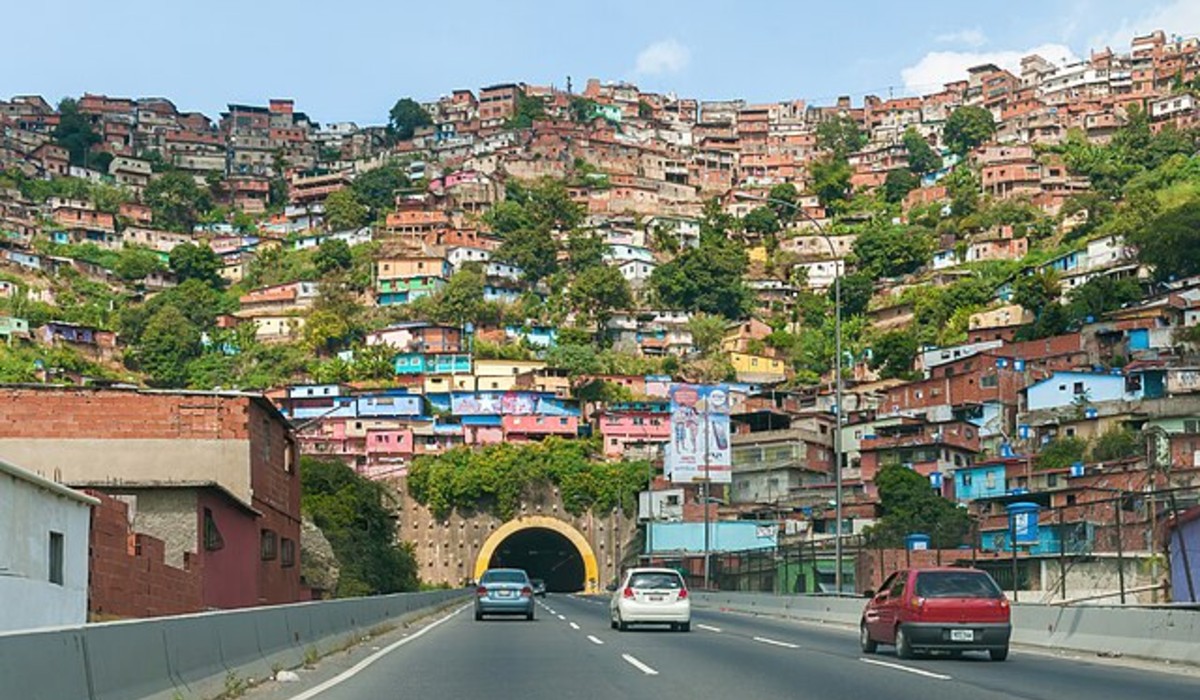
 El Paraíso tunnel main gate of Caracas. Photo: Wikimedia commons / Creative Commons Zero
Chris Bambery considers Trump’s plans for Venezuela since the ousting of Maduro
“Better the devil you know than the devil you don’t.” It’s an old adage but it seems to be US policy in Venezuela.
Trump has little or no interest in regime change, the policy of each of his predecessors from George W. Bush to Joe Biden.
The Venezuelan opposition clearly expected their leader, Nobel Prize winner, María Corina Machado, to be installed after Nicolas Maduro.
But Trump said in an interview regarding Machado, “She should not have won it,” while noting it “has nothing to do” with his decision on who will lead the nation next.
Instead, Trump has said he will work with Maduro’s handpicked Vice President, Delcy Rodríguez, who has since been named the country’s interim president. The rest of Maduro’s government remains in place.
Supporting Machado, in a country which is extremely polarised, would have required US military intervention. In the medium to long term, that is a ‘no no’ for Trump:
“[an] official said that the administration sought to avoid one of the cardinal mistakes of the invasion of Iraq, when the Bush administration ordered party loyalists of the deposed Saddam Hussein to be excluded from the country’s interim government. That decision, known as de-Baathification, led those in charge of Iraq’s stockpiles of weapons to establish armed resistance to the U.S. campaign.”
A CIA report, leaked to the Wall Street Journal and New York Times, advised:
“… that it was more advantageous to keep those loyal to the Chavista regime in power because they control the military and police forces. The intelligence report suggests that opposition leader María Corina Machado, who garnered significant popular support during the 2024 elections, would have difficulty controlling the Venezuelan government and military after several decades of Chavista rule.”
It went on:
“The CIA report… did advise that the leading officials of the Chavista regime — Rodríguez; Minister of Justice and Interior Diosdado Cabello; and Minister of Defense Vladimir Padrino — would be better positioned to lead a temporary government in Caracas and maintain short-term stability if Maduro were overthrown.
Trump decided to keep Rodríguez in power, along with a small group of advisors, after reading the CIA report…”
In the days since Maduro’s kidnapping last Saturday, Trump’s alternately praised Rodríguez as a “gracious” American partner while threatening a similar fate as her former boss if she didn’t provide the U.S. with “total access” to the country’s vast oil reserves.
He has also said that all oil revenues from the USA must be spent in the USA, and that Venezuela must cut economic and political relations with China, Russia and Iran. Rolling back China’s economic presence in Latin America is a key Trump goal.
Spain’s El País comments:
“… the reality is that the new Venezuelan administration remains silent in the face of the humiliating announcements by Trump and Marco Rubio, which indicate that all Venezuelan energy resources will fall under Washington’s control. The Venezuelan government has also silently accepted Trump’s announcement that the “interim authorities in Venezuela will send between 30 and 50 million barrels of oil to the United States of America.”
One thing no-one in Washington or Caracas has mentioned is elections, something the constitution mandates must take place within 30 days of the presidency being permanently vacated.
While the federal indictment revealed against Maduro after his seizure named several other senior officials in his government, Rodríguez’s name was notably absent.
Delcy Rodríguez has form here:
“Then Venezuela’s foreign minister, Rodríguez directed Citgo — a subsidiary of the state oil company — to make a $500,000 donation to the president’s inauguration. With the socialist administration of Nicolas Maduro struggling to feed Venezuela, Rodríguez gambled on a deal that would have opened the door to American investment. Around the same time, she saw that Trump’s ex-campaign manager was hired as a lobbyist for Citgo, courted Republicans in Congress and tried to secure a meeting with the head of Exxon.”
That came to nothing.
Elliott Abrams, who served as special envoy to Venezuela during the first Trump administration, says:
“Nothing that Trump has said suggests his administration is contemplating a quick transition away from Delcy. No one is talking about elections. If they think Delcy is running things, they are completely wrong.”
Some 50 people were killed in US Operation Resolve, including 32 Cuban guards protecting Maduro. Questions have to be asked why the US Delta Force succeeded so easily.
One Venezuelan leader looks likely to bear the burden:
“… the government leaked the name of its first high-profile arrest: General Javier Marcano Tabata. The military officer closest to Maduro was detained on Tuesday, labeled one of the great traitors, in the regime’s desperate search for scapegoats to explain why the radars failed to function or why the multimillion-dollar investment in fighter jets and communication systems proved useless — systems that weren’t even activated that night.
Until the day of his arrest, Marcano was the head of the presidential honor guard and director of the DGCIM, the Venezuelan intelligence agency.”
Reports from Colombian intelligence suggest that Marcano is accused of facilitating the kidnapping of Maduro by providing the US with the exact coordinates of where Maduro and First Lady Cilia Flores were sleeping, and identifying blind spots in the Cuban-Venezuelan security guard. According to these reports there were encrypted communications between the general and foreign intelligence agencies which had been detected weeks before Maduro’s abduction.
Marcano was arrested in the National Assembly chamber, leading to an exchange of gunfire on 6 January in front of Miraflores Palace, in which drones and soldiers fired on each other.
While I take it for granted we must stand by Venezuela in the face of naked imperialism that does not mean being uncritical of its government.
Back in 2006, after returning from attending the World Social Forum in Caracas, I wrote:
“In Venezuela people talk about a “revolutionary process”. But any process has a beginning and an end. Venezuela’s revolutionary process began with popular rebellions against neo-liberal assaults and the attempts by the capitalist elite to topple Chavez.
Today the new exists alongside the old. The new – ambitious social programmes and the beginnings of popular power – has been born. But the old – the state bureaucracy, the corrupt police and the corporate media – linger on. The new and the old can coexist for a while, but in the end one must vanquish the other.”
I also added:
“There is talk in Venezuela of people’s militias. An armed people can defeat the right, but this requires coordination. It also requires centralised direction to concentrate all the force of the movement to make a breakthrough, or, if necessary, to undertake an organised retreat.”
I recall on the first morning in Caracas walking with Chris Nineham into the city centre. We were warned to stay away from the unreformed police who were venally corrupt. The contrasts between the gated communities of the rich and the shanties in the barrios were striking. Huge neon adverts topped buildings advertising the mobile phone company of one of the key backers of the 2002 coup against Hugo Chavez.
Chris turned to me and said: “It doesn’t feel like the workers are in the saddle.” He was quoting George Orwell’s description of Barcelona in 1936. Bolivarian Venezuela was certainly not a workers state such as Soviet Russia was under Lenin. There were no Soviets with workers in control and the old state was not destroyed and replaced.
There was much that was good. Free medical care supplied by Cuban doctors (Venezuela paid for that), for instance, and there was no doubting the popular support for Hugo Chavez, who was openly anti-imperialist in a way Maduro was not.
But there was also too much that was bad.
The army was the thing that worked. It set up the marquees, chairs and PA for the Social Forum. But that left a worry in my head. It could not substitute for the masses and surely, the USA would see it as the crucial thing it needed to subvert.
The 2002 coup was defeated by a general strike and monster demonstrations, which freed the captured Chavez. We have not seen anything on that scale over Maduro’s kidnapping.
Indeed, many of the gains of the Bolivarian revolution have been hollowed out. Corruption, as well as inflation, are rampant with the so-called “Boligarchs” making fortunes.
Historic comparisons are never accurate but there are two I would make to explain what Washington wants to happen.
The first is the Thermidorian Reaction of 1794. Thermidor was the name for the period between the ousting of Maximilien Robespierre on 9 Thermidor II, or 27 July 1794, and the inauguration of the French Directory on 2 November 1795 – a committee of five men with executive powers. It in turn paved the way for the dictatorship of Napoleon.
Thermidor ended the Reign of Terror, removed much of the executive powers of the Committee of Public Safety, and marked a decisive turn from radical Jacobin policies to more moderate positions.
It also involved reaction against the radical wing of the revolution, including the First White Terror; the disbanding of the Jacobin Club and the repression of the sans-culottes.
Thermidor represents reaction clothed in the colours of revolution.
“What was really characteristic of the Thermidor was the fact that the government was formally controlled by the members of the same party. Part of the Jacobins, or quasi-Jacobins, destroyed the other part, the true Jacobins, by an appeal to open civil war. Bonapartism signifies the victory of the bureaucratic-military centralist power over all the various shades of Jacobinism. In the language of the class struggle, this means the gradual change of power from the sans culottes to the leisure class.”
Trotsky added that:
“… bloated Jacobins who became, in part, the support and the prime executive apparatus of the Thermidorean overturn in 1794, thus paving the road for Bonapartism.”
Now, I quote Trotsky here with care as he uses Thermidor to try and explain the rise of the Stalinist bureaucracy in the USSR, contending it too was acting as a bridge between the revolution of 1917 and the restoration of capitalism. In this he was wrong, Stalinism was the final destination; a counter revolutionary, state capitalist dictatorship.
But I think what Trump and the US wants are “bloated Bolivarians” to reign in what remains of the revolution and to do Washington’s bidding. They can likely do that with less opposition than María Corina Machado.
The second comparison I want to make is more recent and goes back to the “devil you know.”
The US was involved in Syria in both trying to topple the Assad regime and in fighting ISIS, having, along with Britain, initially armed and trained them.
But by the close of 2023 sanctions had done their work and the Syrian state was in a state of collapse. Saudi Arabia and Qatar had convinced Assad that if he ceased to rely on the Russians, Iran and Hezbollah he could come to terms with Washington
Instead, Washington backed Hay’at Tahrir al-Sham (HTS), led by Ahmed al-Sharaa, now Syria’s interim president, formerly known as Abu Mohammed al-Jolani. He is a former al-Queda affiliate and when he took office still had a US bounty on his head.
In Syria, Washington decided it was best to throw in its lot with a former Jihadist who would create an authoritarian state rather than dilly and dally over creating parliamentary democracy. That was not on the US agenda.
It also benefitted Israel by effectively partitioning Syria with HTS controlling a Sunni Muslim state, the Turks, Kurds and Israeli controlling other parts and the Alawites effectively taking control of much of north east Syria.
All such comparisons are never a perfect fit. The point is that Trump’s strategy seems not to be regime change, and certainly not state building. Instead, they want to seek out the devil they can trust to do their dirty work.
Some will take comfort in that Delcy Rodríguez is joined by seemingly hardline Bolivarians in her new cabinet. But many of those that led the Thermidorian reaction had been ardent revolutionaries. Come to think of it, that was true of Joseph Stalin too! We have to stand with Venezuela against US imperialism. I take that for granted. But there is a real danger that the Bolivarian Revolution will not be ended by US intervention but by bureaucrats clothing themselves in its colours.
Before you go
The ongoing genocide in Gaza, Starmer’s austerity and the danger of a resurgent far right demonstrate the urgent need for socialist organisation and ideas. Counterfire has been central to the Palestine revolt and we are committed to building mass, united movements of resistance. Become a member today and join the fightback.

Chris Bambery
Chris Bambery is an author, political activist and commentator, and a supporter of Rise, the radical left wing coalition in Scotland. His books include A People's History of Scotland and The Second World War: A Marxist Analysis.