
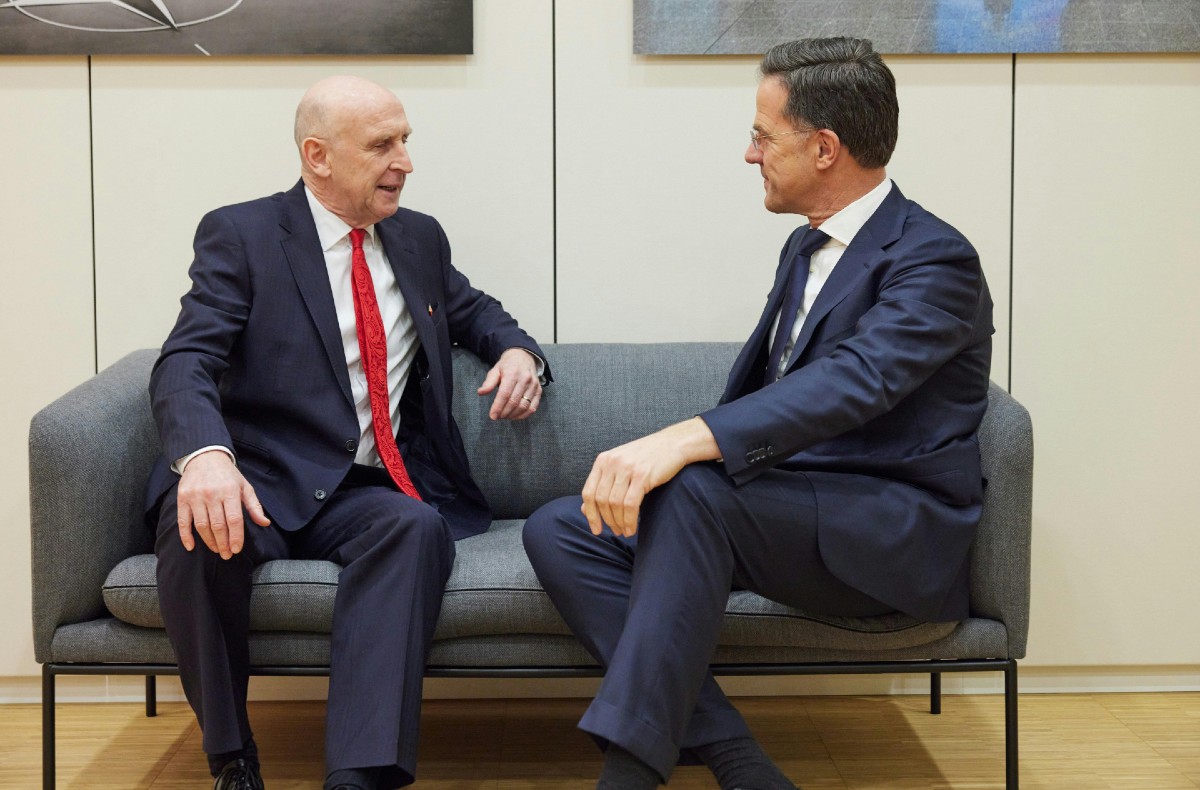
 NATO Secretary General Mark Rutte meets with new Chancellor John Healey, then Secretary of State for Defence, 12 Feb 2025. Photo: Nato / CC BY-NC-ND 2.0
Sam Colclough outlines why Andy Burnham cannot commit to both welfare and warfare
As with any reset in the Labour Party and any new Labour Prime Minister, there is hope among some that Andy Burnham will prove a success. As a reminder, this is a man who voted for the Iraq War, served as a government minister for much of the New Labour era, chose Jeremy Corbyn’s time as Labour leader as the moment to leave Westminster, and proved a great ally of property developers during his time as Manchester Metro Mayor.
Still, the question of what kind of Labour Prime Minister Burnham will be is an open one, and if people remain hopeful after so many years of national decline, who can really blame them? But it’s important we develop a proper assessment of Burnham’s prime ministership so we can intervene in the most effective way. To that end, we can explore whether Burnham will be a welfare prime minister or a warfare prime minister and why that dichotomy exists.
Ministerial Appointments
So far, the signs aren’t particularly promising for those who hope to see a meaningfully progressive turn under Burnham. The former Defence Secretary, John Healey, who left Keir Starmer’s government on the stated grounds Starmer was insufficiently committed to investment in arms and munitions, has been appointed Chancellor of the Exchequer. His replacement in the Ministry of Defence is the arch Zionist Wes Streeting.
Given Burnham has restated Labour’s commitment to balancing current account spending, any additional funds directed towards weapons will have to come out of the budget of other departments. Goodness knows how far Healey wants to go to committing to arms expenditure, but given his reason for resigning only a matter of weeks ago over this very issue, we can expect he’ll push Burnham to go further than his predecessor. And this is a government which has already committed to increase defence spending from 2.6% of GDP to 3.5% by 2035, a commitment Burnham has confirmed he will maintain.
Meanwhile, Streeting chose an arms exhibition this week as the place to assert a new direction: greater conviction in supporting defence. In typical Streeting fashion – just as when he brazenly told a room full of private healthcare providers that he’d get away with fragmenting NHS services far more than any Tory Health Secretary because people trust Labour to protect the NHS – he acknowledged in his speech that extra defence spending would mean less money for other departments. Where do we think that money will be coming from?
Military Keynesianism?
There’s every chance the government will try to spin extra defence spending as the key to reinvigorating the economy. If defence spending can create a sufficient number of new jobs and sufficient levels of economic growth, so this argument would go, tax revenue would increase to such a level the government could maintain or even increase welfare spending despite – or rather because of – the increase in defence spending. Is this plausible?
The argument about economic gain from spending on armaments is well worn, including, regrettably, in some sections of the trade union movement. In reality, though, there are very few sectors that produce a worse return on investment than defence, when measured in terms of jobs and economic growth. If the government was truly motivated by investing to stimulate economic activity, it could scarcely pick a worse sector.
Why More Arms?
Fundamentally, we don’t need to spend more on arms. Depending on which ranking system you use, the UK is either the 5th or 6th biggest arms spender in the world. So, this begs the question: what’s it all about? It’s a commitment to a geopolitical and economic model that is rooted in imperialism abroad and exploitation at home. It’s impossible to separate support for defence from opposition to welfare except analytically, because they’re two sides of the same political coin. The only reason to support more arms spending in the UK is to prop up an imperialist model that prioritises Western military power so it can use force to bring the rest of the world into its orbit and align it with its own goals. The other side of that ideology is to seek to extract as much as possible from the population at home.
Commitment to warfare and welfare are negatively correlated. Parties and governments in the UK that prioritise investment in weaponry are invariably less inclined to support welfare provisions. It’s no coincidence arms spending is a longstanding priority for the right – the same people who oppose welfare spending the most. Similarly, Corbyn’s Labour, the most left-wing Labour Party for decades, was far more sceptical of foreign policy orthodoxy and more supportive of welfare than that party has been under most other guises, even if they still didn’t go far enough on either issue.
And herein lies a cautionary tale for socialists hoping the Green Party will prove to be the vehicle for radical transformation in Britain. That party is currently reported to be experiencing significant internal tensions as senior figures seek to position the Greens as supportive of greater militarisation of the UK, including through the rollout of military apprenticeships, even while others within the party strongly oppose this slip into militarism. For those wanting to see a pivot towards greater spending on working class needs at home, then it’s critical we demand this government reverses its decision to increase arms spending. It’s always been our view that if pro-warfare and anti-welfare positions are mutually entailed, those who support either anti-war or pro-welfare positions ought to combine their struggles. We can’t win one position without simultaneously winning the other. That’s why we say welfare not warfare. Burnham’s government can support one or the other, but it can’t support both.
Before you go
The ongoing genocide in Gaza, Starmer’s austerity and the danger of a resurgent far right demonstrate the urgent need for socialist organisation and ideas. Counterfire has been central to the Palestine revolt and we are committed to building mass, united movements of resistance. Become a member today and join the fightback.
