
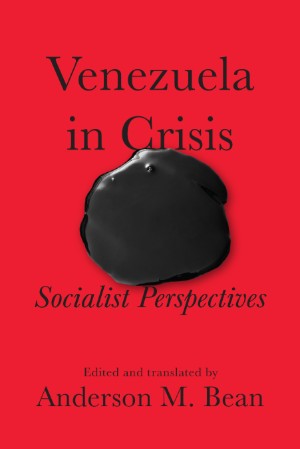
 Venezuela in Crisis: Socialist Perspectives, ed. and trans. Anderson M. Bean (Haymarket Books 2026), 332pp.
A new collection of essays about Venezuela provides a timely corrective to discussion about the country, writes Kevin Crane
Donald Trump’s attack on Venezuela’s capital city and kidnap of the country’s president is a world-historic shock which we are all still processing. The sheer and open illegality of the action would be alarming on its own, but the bizarre and unprecedented outcome of the incursion is also leaving people’s heads spinning. America has deposed a leader that they have been denouncing as a crazed communist dictator for well over a decade, only to leave his government and state structure basically intact. This has confused America’s allies and opponents more or less equally.
On the political right, you have stunned disbelief that the USA didn’t immediately move to install a government ideologically aligned with them, particularly after wrangling the Nobel Peace Prize for the rabidly pro-Trump Venezuelan opposition leader María Corina Machado. She’s as confused as anyone as to why she isn’t president now. But many on the international left are just as baffled, and essentially for similar reasons: for most of this century so far, Venezuela had been held up as a country that had substantially broken with capitalism, run by a radically anti-imperialist government. This is a narrative that is essentially incompatible with the reality of the United Socialist Party of Venezuela (PSUV) responding to their leader’s abduction – to say nothing of the deaths of dozens of their citizens – by sheepishly announcing that they were pretty much just going to accept their loss and make nice with the aggressor.
If you are presented with extraordinary events, you need to seek a good explanation for them. Haymarket Books’ new offering here, Venezuela in Crisis, is an anthology of essays that make for a decent starting point at making sense of the apparent chaos. The timing of the book is obviously no accident, since Trump had been illegally attacking Venezuelan civilian boats for some months leading up to the assault on Caracas and was clearly going to do something. Like the rest of us, the authors would probably not have been able to predict exactly what that action was going to be. The outcome of Nicholas Maduro’s ouster is probably considerably less curious to these writers, however, due to quality of their overall analysis and understanding of Venezuela as country.
An optical illusion of socialism
Although the various contributors to this book differ on certain issues – primarily about how they characterise the events in Venezuela during the fifteen-year-long rule of its previous president Hugo Chavez – they all agree on one very important thing about Maduro’s Venezuela: it is not socialist, nor even significantly anti-colonialist, in any way at all. The writers, mostly Venezuelans who were heavily involved in the country’s left at a variety of levels, go into great detail to make this absolutely clear.
The statistics are damning: the Venezuelan working class has been reduced to levels of dire poverty in the past decade and a half, with basic goods and staple foods being absolutely unaffordable to people on normal wages, creating a society where patchy state aid and organised crime are necessary aspects of day-to-day life and millions of people have become poverty refugees. The PSUV government, and some of its apologists on the international left, try to handwave the overwhelming evidence of crippling destitution as the result of American sanctions. This simply doesn’t work because the sanctions were originally a late-period Obama policy, and the rise of mass poverty in the country precedes that by some years.
The truth is that Venezuela’s economic model was an unsound bet on the value of a single export: oil. For a long period, the country had been in a fool’s paradise of apparently limitless income from its very large oil reserves and had little appreciation of how much that large income was obscuring deep contradictions and weaknesses in their economy and society. The crash back down to reality began in 2012, when China experienced its first significant setback in economic growth since the 1990s and the price of oil consequently dropped hard.
Maduro came to office the year after this, when Chavez succumbed to cancer. That timing creates a tragic coincidence that invites a tempting, but invalid, narrative that the latter had been a rightly guided revolutionary whose legacy was then wrecked by the pure incompetence and treachery of the former. The problem with wanting to see Hugo Chavez as some anti-colonial King Arthur is that Maduro was a completely authentic member of Chavez’s leadership team, the problems that Maduro’s government had to deal with were all ones that had existed latently before Chavez died, and the anti-democratic methods Maduro used were mostly built on a political machine Chavez created.
As the contributors to Venezuela in Crisis make clear, Venezuela’s solipsistic economy was and is completely dependent on resource exportation and never had any provision for what happens when the market prices of these resources fluctuate. There are multiple long discussions about the nature of this model of ‘extractivism’, and even if some of the theorisation might edge toward being redundant, I do think that a case is well made that this was never likely to benefit the working class in the long run. In Venezuela’s case, extractivism is now barely even benefiting a conventional capitalist economy. Attempts to diversify their exports into gold and other minerals have been almost monopolised by criminal enterprises, and a staggering fifth of Venezuela’s GDP is in the crime sector.
The Venezuelan national income shrank to a fraction of its former size in the 2010s and the PSUV quite simply made the workers pay for it. Radical aspects of the country’s constitution that Chavez wrote, including the obligation of the state to enforce living wages, have become absolute dead-letter laws. The same goes for trade-union rights, which have been abolished in all but name, alongside a previously strong commitment to democracy and free speech.
Much has been made over the decades about the Venezuelan right-wing opposition being subject to repression, but significantly less has been said about the persecution of the Venezuelan left. Essentially, all parties of the left that began to be critical, or even just questioning, of the PSUV found themselves subject to ever-increasing levels of harassment, leading ultimately to being banned. An extreme case has been the Communist Party of Venezuela (PCV), the oldest party in the state and a long-time partner in Hugo Chavez’s governing coalition. The PSUV has effectively abolished the PCV and created a fake replacement from its own supporters to pretend to still be in coalition with it!
A complex, and bittersweet, history
The PSUV is emphatically not a party of the Venezuelan working class: it is best understood as a party of the political-military elite that arose during the successful phase of Chavez’s government. They view the continued rule of the PSUV as essential to maintaining their privileged positions and are also neck-deep in the crime and corruption that is rampant in the country. This is ultimately why the PSUV has become so viciously anti-democratic, because the class it represents would both lose their livelihoods and be facing serious prosecutions if it lost power.
The party is actually semi-open about its class position at times, producing sporadic propaganda about the need to have a new patriotic capitalist class, as opposed to the traditional oligarchy of the country, this being essential to establishing a sovereign and prosperous nation. Despite this, many people on the international left have maintained a wilful ignorance about the nature of the PSUV, and the authors note in particular that influential figures in the Democratic Socialists of America frequently make very misguided and easily falsifiable claims about Venezuela being in a much better state than it actually is.
No small part of the reason why a radical left image of the PSUV has been allowed to be so persistent is that there is a lingering nostalgia for the days of Hugo Chavez’s rule. It might seem odd to anyone who is currently under the age of around thirty, but during the 2000s, Venezuela was a source of massive excitement to the left worldwide. In Britain, I remember this being particularly true of the Labour Left networks around then-mayor of London Ken Livingstone, who invited Chavez himself over to the city for a highly publicised mass rally, much to the annoyance of establishment politicians. The specific appeal of Chavez to that version of socialist politics was easy to see. Livingstone and his people saw themselves as using elected office to build a progressive alternative to neoliberalism under the very nose of imperialism, and the idea that an entire country could do the same was felt like confirmation. The Livingstone project also came unstuck in 2012, of course, another coincidence.
The events that they were getting excited about were not, however, pure nonsense, as Venezuela in Crisis goes into. Chavez’s presidency did go through a profoundly radical phase, ironically as a direct result of a failed American intervention. In 2002, after his government had been in office for four years, the CIA triggered a coup attempt against Chavez, to be lead by right-wing politicians from the old order. To their horror, a massive working-class uprising broke out in the poorer areas of Caracas and government buildings and media institutions were swarmed by angry protestors. This lead to key sections of the army defecting from the coup and ultimately allowing Chavez to get released back into power within just three days.
Such a direct blow against the George W Bush government’s wishes, at a time when America had initiated its ‘war on terror’ and was gearing up for its attack on Iraq, sent shockwaves around the world. It brought Chavez, previously an obscure and excentric, although also very charismatic, populist politician, to the attention of millions as a rare example of a leader who had both the will and the wherewithal to stand up to the USA. It also triggered a series of radicalising processes within Venezuela.
Both Chavez and his mass base recognised that it was the mobilisation of ordinary people that had stopped the coup, leading to a genuine growth of mass organisation in defence of ‘the revolution’, which Chavez sought to encourage but also co-opt. Things deepened when the struggle between the old order and the new got into the workplaces. Knowing that Chavez’s programme of robust welfarism was dependent on state revenues, the capitalist class resorted to shutdowns of businesses, particularly the oil sector, with the collusion of the old corrupt trade-union movement. Pro-Chavez workers then developed their own workers’ organisations to keep the economy moving, constructing for themselves a new trade-union movement in the process. Chavez rewarded this by providing a raft of new workers’ rights and a version of worker co-management in many sectors.
These events were legitimately thrilling at the time, but as the writers in the book stress, they need to be taken with the full context, as well as acknowledging that they were gains that have been lost in full. Even at the mid-2000s height of radicalisation, this was a ‘revolution’ in which the fundamentals of capitalism were not challenged. Venezuelan capitalists screamed blue murder about how terribly they were suffering under ‘communism’, but in reality, the percentage of the Venezuelan economy that was in private ownership actually increased during this time. Working-class living standards were sharply rising, and inequality dropping, but capitalists were also doing well. If it all seemed too good to be true, that is because ultimately Chavez was simply using the proceeds from a long oil boom to keep social and economic contradictions under control.
The failure of Chavismo in the context of colonialism
The authors in this book debate exactly how the project failed, but not that it failed. Things were already adrift by the late 2000s. Chavez founded the PSUV in 2007, consolidating what had previously been a lose coalition of diverse left-wing organisations into a centralised political party. This was mildly controversial at the time – several significant socialist groups in Venezuela declined to join – and did also represent a step back from the community- and workplace-based organising that had flourished earlier in the decade. An early sign that this new strategic approach was not fully going to plan was when Chavez called a constitutional referendum and not even all the people who’d signed up to join the PSUV as members bothered to vote. It was already starting to degenerate into an elite vehicle, not a working-class one.
We do not know what Chavez’s long-term response to the oil bust would have been. One possibility is that he’d simply have been speed-running the career of a leader like Colonel Ghaddafi. What we do know is that although Maduro inherited a mess once he got into office, his responses to it were all appalling. His policies have been so utterly capitalistic that, as one contributor to Venezuela in Crisis put it, they differ from the policies of the right-wing opposition only in so far as Maduro wanted to do deals with Russia and China, not just the USA.
With an understanding that today’s PSUV is a government that bears only superficial similarity to its predecessor project of two decades ago, we can understand that it is not absurd that Trump has opted to keep it office. He is confident that it will now just do what he says. It’s hardly the first time that a formerly radical party has made its peace with imperialism and now just carries water for it. The Global South is littered with similar examples.
Venezuela in Crisis isn’t perfect: a consequence of the speed with which this book has been commissioned and edited is that there clearly wasn’t time to get contributors to avoid repeating each other, and there is a quite a lot of space given over to them presenting arguments based on the same evidence. Consequently, I think readers would probably benefit more from selectively dipping in to earlier chapters than reading each one.
The later parts covering more of the history of the country are very useful, such as the chapter discussing the long-running territorial tensions between Venezuela and Guyana. The actual dispute is unlikely, in fact, to go anywhere but it provides some handy background into how American imperialism was intervening in the region of Caribbean South America in the twentieth century. This is good context for Chavez’s rise.
Generally, I think this book is a good resource. The specific intent by its authors is to try to undo some of the damage that they believe has been done to left discourse by desperately trying to characterise Venezuela as a socialist state, and that is a worthy goal in itself. I think it could also be argued, however, that debates in the book about extractivism are only going to increase in relevance in today’s world.
Before you go
The ongoing genocide in Gaza, Starmer’s austerity and the danger of a resurgent far right demonstrate the urgent need for socialist organisation and ideas. Counterfire has been central to the Palestine revolt and we are committed to building mass, united movements of resistance. Become a member today and join the fightback.
