
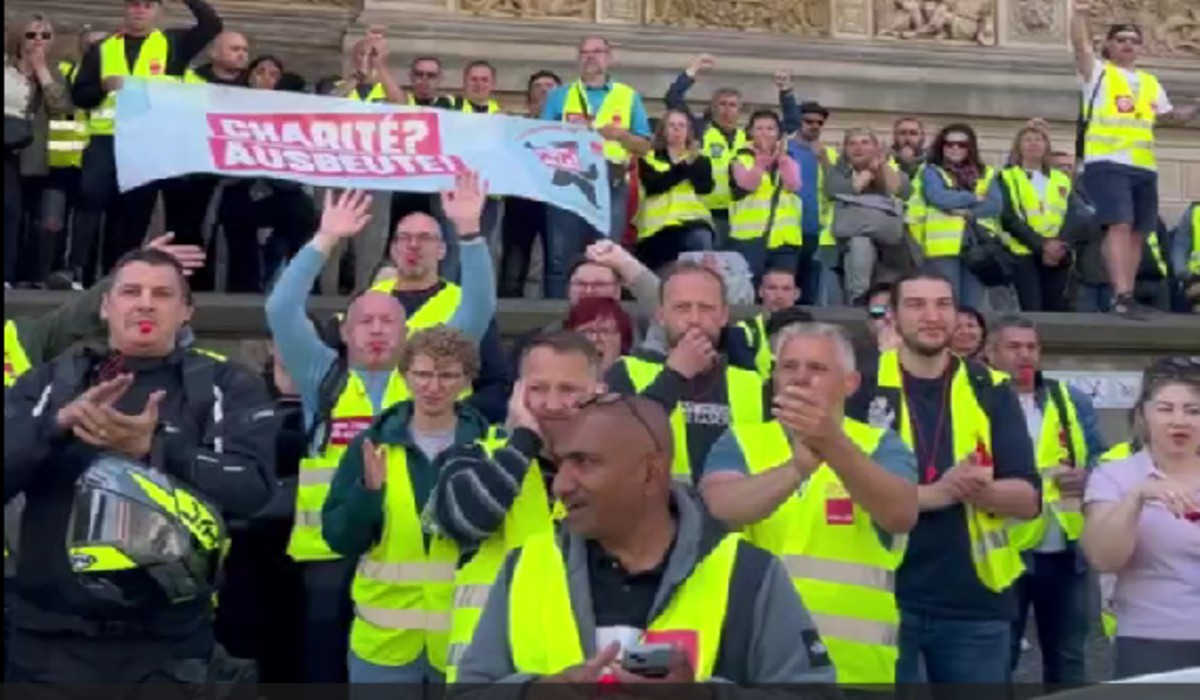
 Striking hospital workers demonstrate outside Berlin state parliament, 2 June. Photo: Kolja.
Hospitals workers in Berlin have won an important victory, reports Robert Dale
After three months of strikes, ancillary workers at Berlin’s teaching hospitals have secured hefty wage increases. Pay will be raised in stages, to reach 100% of the general public-sector scale by 2030.
Ancillaries do the non-medical work required to keep the hospitals running: cleaning, kitchens, security, transport, technical services, stock-keeping, sterilisation, and administration. Although they are essential, their jobs were outsourced in 2005 to a subsidiary, Charité Facility Management (CFM). This meant that their pay and conditions were considerably worse than those of colleagues employed directly by the hospitals, who fall under the general public-service pay agreement. According to the union Verdi, the pay gap was up to €700 per month.
One factor that brought the dispute to a head this year was the inflation shock of 2022–3, which cast a stark light on the pay shortfall. Another was Berlin Mayor Kai Wegner’s broken promise. After a determined political and media campaign by union activists, Wegner had committed to reversing the outsourcing. He has the power to do so, as the city owns the hospitals. But during his first two years in office, he did nothing.
CFM employs 3,500 workers. Of those, 3,200 were affected by the dispute. About half the workers at CFM are members of the public-sector union Verdi. After a series of shorter stoppages in March, an indefinite strike began in early April. It was to continue for eight weeks.
The number of individuals on strike at any one time was seven or eight hundred. That is one very notable thing about this dispute. It was conducted successfully by a (large) minority of the workforce. As it turned out, having a quarter of the workforce on strike was enough to disrupt normal operations. Operations had to be cancelled due to inadequate cleaning or a lack of sterilised instruments.
So, what were the keys to success? I spoke with works-council member Sascha Kraft, who has been building the union at CFM since 2008. Preparation was crucial. Union activists had been building for this for years, gathering strength through a series of smaller disputes over pay and conditions. In the nine months leading up to the big strike, Verdi recruited 900 new members, bringing the total to 1,500. The strike began with a 99.3% vote to walk out.
As he told me, active participation was central, with striking workers manning the picket lines. Frequent strike demonstrations were held, for example, to rally outside the offices of the responsible city officials or the hospitals’ executive board.
The strikers were fully involved in decision-making. Many matters were voted on at mass meetings, especially when it needed to be fast. There was also a system of sector reps to make decisions on a broader basis and ensure that information flowed in both directions. The negotiating committee itself was composed of active striking workers.
Unity and solidarity
Unity was essential, of course. Sascha mentioned that the strike involved workers from eighty different nations. Verdi activist Agnieszka spoke to a conference of strike supporters about her experience building for the strike: ‘I found that we are all the same really, that we often have the same troubles, the same dreams. No matter what country we come from, what languages we speak, what colour our skin is, or what god we believe in.’
Nurses were being pressured to do cleaning and transport work, and Sascha said it would have been nice if the union had called a couple of hundred out in solidarity. Under the specific circumstances, picketing other workers out was not on the cards. In effect, CFM staff who chose not to join the strike were left in peace. Some were persuaded to join as the strike continued.
Solidarity was necessary, too. The strike fund was urgently needed to make up the shortfall between strike pay and regular pay. Verdi’s normal strike pay is 60%. Because these workers’ current pay is so low, even the decision to raise strike pay to 90% still left a gap (not to mention losing weekend bonuses and the like). Fellow workers within the hospital group collected donations, as did staff at other Berlin hospitals. Altogether €60,000 was collected across Germany.
Supporters also attended the picket lines and demonstrations, and links were cultivated with other workers in dispute in the city (public-transport workers and the general public-service pay round). As Sascha said, coordinating to strike together would have been good, but that did not really work out.
The employers caved in early June, and union members approved the settlement in a vote two weeks later. The main result is that pay will be increased in increments to reach 100% of the general public-sector agreement by 2030, including any increases taking effect in the interim. And pay will be increased to 88% with immediate effect, plus a one-off payment of €300. The immediate increase in monthly income will be between €100 and €800.
The final vote saw 78% in favour of the deal. That suggests that it is broadly regarded as acceptable, but that a significant minority were up for a longer fight.
Conditions and grading are the fly in the ointment, as the settlement does not foresee general application of the relevant parts of the public-sector agreement. Also, the workers’ demand for the right to full-time employment has not been satisfactorily resolved. As strike leader Sascha said, ‘We’ll have to fight on for that.’ And he hopes that this dispute ‘could spark a blaze in Germany’. Similar grievances are certainly on the table.
At Helios Berlin-Buch, about fifty therapists began an indefinite strike in mid-May. This was a very similar outsourcing story. They are also employed by a subsidiary (Helios Therapie Ost), and their pay was up to €1,500 per month less than colleagues doing the same work for the same employer. They also demanded equality of pay and conditions. After 76 days on strike – 43 of them consecutive – their employer agreed to their most important demands. Their pay will be increased in stages, to reach 100% of the applicable union agreement by 2027.
Thousands of outsourced ancillaries at Berlin’s other publicly owned hospitals (Vivantes group) are preparing for action over the same issues. The union’s campaign has started, and strike action is expected early next year. As Sascha told me, CFM workers will support them, and they intend to donate what remains in their strike fund.
Hopefully the strike at CFM will serve as an inspiration for others. As Ganimete, a CFM cleaner and union activist, put it: ‘When we strike, I feel my strength. And the strength of my workmates.’
Before you go
The ongoing genocide in Gaza, Starmer’s austerity and the danger of a resurgent far right demonstrate the urgent need for socialist organisation and ideas. Counterfire has been central to the Palestine revolt and we are committed to building mass, united movements of resistance. Become a member today and join the fightback.
