
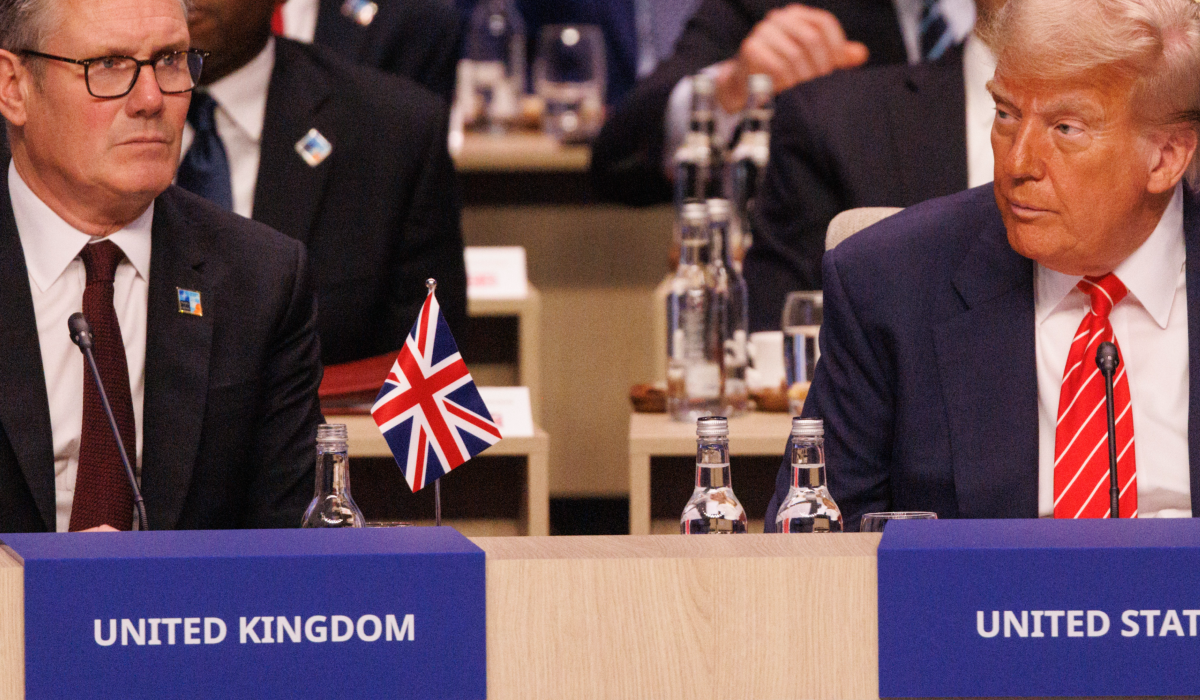
 Sir Keir Starmer and Donald Trump at The Hague, June 2025. Photo: Flickr/Simon Dawson
Alex Snowdon on a vortex of ruling class crisis
There are many things that can be said about the ongoing political crisis around Peter Mandelson – and the revelations about his appointment as British ambassador to the US. There are two things that, for me, really stand out though.
One is how extraordinary it is that Keir Starmer appointed Mandelson, despite everything known about him, in the first place. The other thing is how remarkable it is that Starmer still has his own job, despite the Mandelson scandal adding to everything that already makes this a deeply unpopular and crisis-ridden government.
Mandelson was an obviously risky and controversial figure to be associated with. This is someone who twice had to resign from Tony Blair’s government – in 1998 and 2001 – and who came to symbolise the close (and sometimes rather dubious) relationships between New Labour politicians and figures in high finance and business. Yet he was brought back into high office by Blair’s successor Gordon Brown in 2008 – and would later be courted by Starmer during his time as Leader of the Opposition.
Brown and Starmer had roughly the same reasons for courting Mandelson, despite the past scandals and their impact on his public reputation. He was regarded in their circles as embodying the rightwards shift in the Labour Party, having been a key pioneer of Blairism.
As a senior Labour apparatchik brought in by Neil Kinnock in 1985, and later extremely close to Blair, he was associated with defeating the Left, making Labour ‘business friendly’ and delivering a series of three general election victories. He even co-wrote a book called ‘The Blair Revolution’ in the mid-90s, outlining the ideology of New Labour.
All of this made him an asset from the perspective of Starmer and those around him. Such people see themselves as the heirs of Blairism. Their obsessive determination to repudiate and destroy Corbynism made Mandelson a symbolically potent figure.
Not only that but Mandelson’s reputation as a master of ‘dark arts’ made him strangely attractive in the era of Trump. Starmer’s team no doubt saw him as the ideal person to relate to the obnoxious and amoral Trump administration.
This leads us on to the second big question – why is Starmer still in office? The scandal has raised very serious questions about the prime minister’s integrity, as it seems barely believable that he could have not known that Mandelson failed security checks. It exposes a terrible lack of basic judgement that he appointed Mandelson. There is also the reputational damage of being linked, however indirectly, with the multi-faceted scandal of Jeffrey Epstein and friends.
Starmer is not under pressure just because of this issue. It dovetails with a wider crisis of legitimacy because of Labour tanking in the polls, with widespread speculation that the 7 May council elections will be the final straw for Starmer’s leadership.
Labour’s difficulty, though, is the lack of a credible alternative. Its front bench is made up of Starmerites who are complicit in the many mistakes and disasters since Labour took office.
This is a deeply unimpressive layer of senior politicians shaped by the struggle to defeat Corbynism and the Left, rather than anything that might prepare them for government. For most of them, Blairism was politically formative. They have no broader horizons. Starmer’s decision to block Andy Burnham from standing in a recent by-election also illustrated the absolute refusal to countenance any challenge from that direction.
Labour is faced with choosing between sticking with a remarkably unpopular prime minister or replacing him with someone unlikely to make much difference.
Trump in trouble
The effects of Donald Trump’s disastrous war on Iran continue to reverberate. Trump’s actions in the global sphere can frequently appear to be erratic and chaotic, even unhinged. Unsurprisingly, there has been widespread speculation about what is politely termed ‘cognitive decline’ together with suggestions that he is mentally unstable.
There is more than a grain of truth in regarding Trump as the problem – and seeing him as personally unstable. It is obvious that much of his most extreme behaviour is done without wider consultation. We can easily imagine his own aides and advisers reacting with exasperation at his bizarre social media post appearing to compare himself to Jesus Christ, or his intemperate attack on Pope Leo. As one Republican politician dryly observed last week, it is rarely wise for politicians to attack the Pope.
Trump’s actions have alienated many of his own supporters – most obviously US Catholics, but many other Christians too. They have contributed to sharp divisions in his own MAGA (Make America Great Again) base. However, these tensions are so serious because Trump is already alienating many of his supporters by bombing Iran and planning to ramp up military spending.
However, the psychological prism does not take us very far. While such imperialist adventures can develop a logic of their own, unforeseen by their initiators, they do have to be understood as part of a wider conscious strategy. Indeed the US published its National Security Strategy last November. But to what extent does the official strategy document guide what is now unfolding?
Trump’s introduction to the strategy document boasts of $1 trillion investment in the US military, but also emphasises getting US allies to pay more, persuading ‘Nato countries to raise defense spending from 2% to 5% of GDP’.
He also refers to the US achieving economic independence by increasing energy production and to imposing tariffs on other countries. Both of these developments are significant economic trends, giving a sense of how foreign policy is explicitly tied to American economic interests – in particular this notion of a more self-sufficient, independent America.
US energy self-sufficiency enables Washington to feel more bullish about launching wars in the oil-rich Middle East. There is less risk involved because it is no longer as dependent on the region for energy supplies. There has, though, been some serious mis-calculation here, with a failure to grasp how much economic dislocation Iran could cause via its control of the Strait of Hormuz.
We have also seen the limits of Trump’s exaggerated and hubristic claims about Nato allies ramping up their military spending. He has been reduced in recent weeks to making bad-tempered attacks on supposed allies – especially the UK, with derision and humiliation for Keir Starmer – for not making more of a contribution to the war effort. This points attention to a certain gap between rhetoric and reality in that European states are a long way from achieving those 5% targets.
Washington desperately wants its allies to ‘share the burden’, but it has no interest in actually involving them in decision-making. Trump’s unilateralism – an expression of the more ‘independent’ stance indicated above – does not involve patiently building alliances or taking time to persuade others of a course of action.
This has backfired spectacularly over Iran, with deep reluctance from most European allies to get involved. The economic shocks being caused by the war are making political leaders even more unhappy with Trump’s ‘go it alone’ arrogance.
In November’s strategy document, Trump also referred to how the US had ‘obliterated Iran’s nuclear enrichment capacity’. This indicates a naive overestimation of existing success in relation to weakening Iran, which partly explains why the Trump administration embarked on its very reckless attack on the country.
The war on Iran has in some ways followed the broad outline of the national security strategy. It was an expression of the new indifference to global alliances and showed a willingness to act independently. It reflected the crudeness of the security strategy: an unashamed preparedness to do whatever works for elite US interests, regardless of international law or institutions.
Then again, the targeting of Iran has deviated from the security strategy in as much as the strategy outlined a more focused approach to foreign intervention, with stronger prioritisation. Where the US had previously gone wrong, it claimed, was in over-reaching and trying to intervene where there was little or nothing to be gained for US interests.
It might also be surprising that Trump launched a major military assault in the Middle East, given that only a page and a half of the 33-page strategy document was devoted to that entire region. The document noted that previously the Middle East has been the foremost focus for US intervention for three reasons: the region’s energy supplies, it being a ‘prime theater of superpower competition’, and finally the tendency for conflicts in the region to spill out more widely (e.g. being a breeding ground for anti-US terrorism). It goes on to say that the first two factors are no longer relevant.
As for Iran specifically, it refers to the country as ‘the region’s chief destabilizing force’. Yet it also claims that Iran has been ‘greatly weakened’ by Israel’s actions since October 2023 and by US attacks on Iran in June 2025.
There is evidently an awareness in Trump’s team that they have got in too deep. Hence the willingness to negotiate on terms that might seem humiliating for the US.
We can only guess at what all this means for future US foreign policy. What we do know is that it has set a region on fire, triggered a global economic crisis, put alliances under massive strain and created an unprecedented domestic backlash.
Before you go
The ongoing genocide in Gaza, Starmer’s austerity and the danger of a resurgent far right demonstrate the urgent need for socialist organisation and ideas. Counterfire has been central to the Palestine revolt and we are committed to building mass, united movements of resistance. Become a member today and join the fightback.

Alex Snowdon
Alex Snowdon is a Counterfire activist in Newcastle. He is active in the Palestine Solidarity Campaign, Stop the War Coalition and the National Education Union. He is the author of A Short Guide to Israeli Apartheid (2022).