
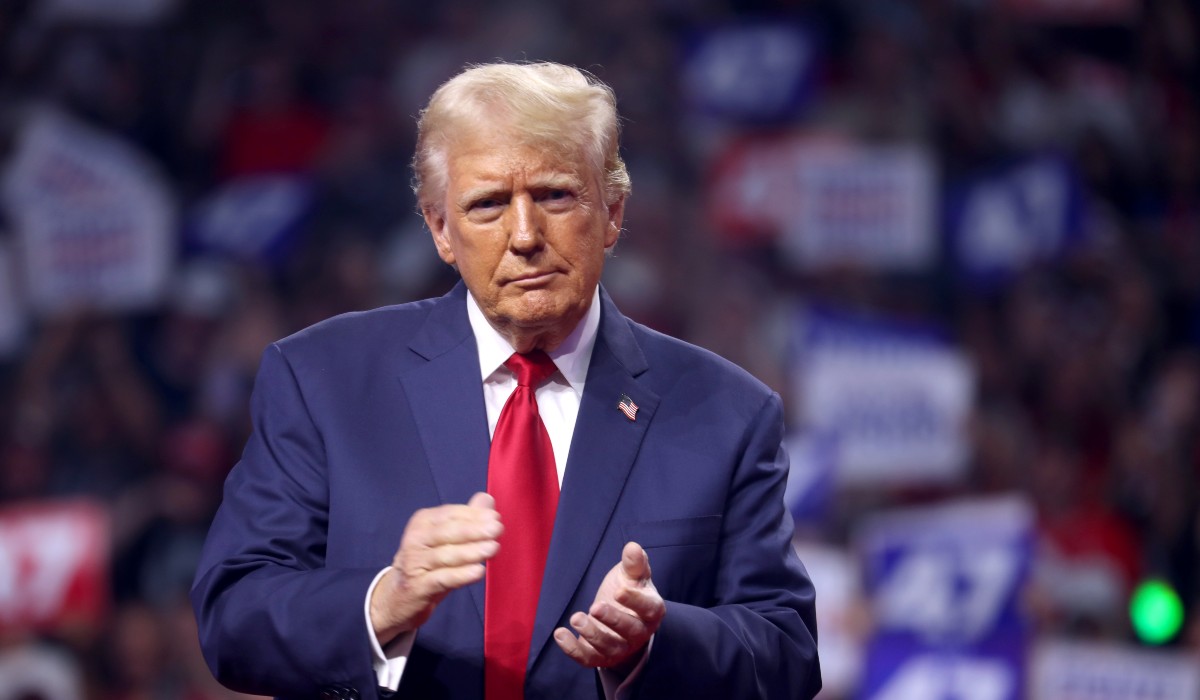
 Donald Trump. Photo: gageskidmore / Flickr / CC BY-SA 2.0
The current impasse in the US Congress and the resulting government shutdown is having a devastating impact across the States argues John Clarke
The ‘government shutdown’ in the US continues to drag on and, as CTV News notes, with ‘the two parties at a standstill, the shutdown, now in its 33rd day, appears likely become the longest in history.’ The impacts of this political deadlock now includes a severe disruption of the allocation of benefits for tens of millions of people who are forced to rely on ‘the Supplemental Nutrition Assistance Program, or SNAP.’
On 3 November, Common Dreams reported that in ‘response to lawsuits filed by state attorneys general, municipalities, nonprofits, and labor groups, federal judges in Massachusetts and Rhode Island on Friday ruled against the US Department of Agriculture’s (USDA) refusal to use a contingency fund for at least some of November’s $8 billion in SNAP benefits, often called food stamps.’
Faced with these court orders, the Trump administration had seemed to agree to a partial measure of redress, claiming that there is ‘a total of $4.65 billion in the contingency fund for November SNAP benefits that will all be obligated to cover 50% of eligible households’ current allotments.’ This would have alleviated but not prevented a crisis for many of the almost 42 million people who rely on Snap but it now appears that even this inadequate response may be withheld.
On 4 November, however, Trump declared on social media that ‘SNAP BENEFITS, which increased by Billions and Billions of Dollars (MANY FOLD!) during Crooked Joe Biden’s disastrous term in office (Due to the fact that they were haphazardly “handed” to anyone for the asking, as opposed to just those in need, which is the purpose of SNAP!), will be given only when the Radical Left Democrats open up government, which they can easily do, and not before! Thank you for your attention to this matter.’
Hunger crisis
With the issuing of even a meagre portion of the benefit in doubt, the undermining of Snap has already begun to produce a major hunger crisis, as people turn to private charity in large numbers. On 1 November, ABC News reported that people ‘across the country formed long lines for free meals and groceries at food pantries and drive-through giveaways Saturday, after monthly benefits through the federal Supplemental Nutrition Assistance Program, or SNAP, were suddenly cut off because of the ongoing government shutdown.’
The Rev. John Udo-Okon, who works at a food pantry in New York City, explained that the suspension of Snap had created a situation where ‘people from all walks of life’ were seeking food assistance. ‘The pantry is no longer for the poor, for the elderly, for the needy. The pantry now is for the whole community, everybody. You see people will drive in their car and come and park and wait to see if they can get food,’ he said.
Whatever perfunctory expressions of concern Trump officials may make in this dire situation, it is clear that no effort is being made to ease the hardship that has resulted from the interruption of the food programme. On the contrary, as another report from Common Dreams explains, Trump’s ‘Department of Agriculture sent a warning to grocery stores not to provide discounts to the more than 42 million Americans affected.’
This warning was issued in response to the fact that several ‘grocery chains and food delivery apps have announced in recent days that they would provide substantial discounts to those whose … benefits have been delayed.’ With considerable irony, this step was taken under an ‘Equal Treatment Rule’ so that offering ‘discounts or services only to SNAP-eligible customers is a SNAP violation unless you have a SNAP equal treatment waiver.’
There is no doubt that this measure will be effective in preventing discounts for hungry people. The article notes that ‘a store caught violating the prohibition could be denied the ability to accept SNAP benefits in the future. In low-income areas where the SNAP shutdown will have the biggest impact, getting thrown off SNAP could mean a store is no longer financially viable.’
It also appears that police departments are preparing to deal with the prospect of desperate people stealing food in order to survive. In a CBS report, we learn that police in Barstow, California posted on Facebook that to ‘help ensure the safety of residents, customers, and business owners, officers will be conducting extra patrols around local grocery stores, convenience stores, and shopping centers.’
The crisis generated by the government shutdown is unfolding, moreover, in a situation where brutal social cutbacks have already greatly exacerbated poverty and hunger in the US. Earlier this year, Trump’s ‘Big Beautiful Bill’ (characterised by opponents as the ‘Big Ugly Law,’) had a devastating impact in this regard and greatly weakened the already badly compromised social infrastructure.
A fact sheet issued in August by Brendan Boyle, a Democratic Party representative on the House Committee on the Budget, took stock of some of the impacts of the Bill. It notes that families ‘already struggling to make ends meet lose the most. Households in the lowest income decile, making $24,000 a year or less, lose about $1,200 every year, mostly due to deep cuts to Medicaid and food assistance.’ The available resources generated by the cutbacks were then transferred to the wealthiest members of US society, mainly through ‘the tax provisions in the bill.’
Targeting the poor
Trump’s war on the poor in the US is only a particularly sharp and brutal version of a strategy that has been pursued internationally ever since the turn to neoliberal approaches in the 1970s. The decades-long drive to undermine systems of social provision, in particular income-support programmes, has played a central role in the effort to tilt the balance in society in the interests of capitalists at the expense of working-class populations.
As I argued in an article I wrote for Counterfire in January of 2019, that focused on austerity measures in Canada and the UK, the ‘central objective has not been, as is generally claimed, to save money but rather to ensure a level of desperation that drives people into low wage precarious work and depresses the level of real wages.’
In line with his highly authoritarian approach, Trump is augmenting his attack on systems of social provision with a systematic drive to criminalise the poor. His infamous immigration raids and mass deportations very obviously target the poorest communities disproportionately. In the climate of fear and intimidation that the raids are generating, the vulnerability of poor and struggling migrants has been intensified greatly.
In August, an article in Cal Matters described the situation that has been generated in Los Angeles. ‘What remains are places that used to be: a shuttered restaurant, empty benches on weekends at MacArthur Park and even an abandoned taco stand, meat still on the grill hours later. The silence is the point. Beneath that silence, behind locked doors, is a population in hiding. They were dishwashers and garment factory stitchers. They sold fruit on the street. This is the echo of the city they left behind.’
Trump’s crackdowns, however, are not confined to immigrant communities. An executive order issued by the White House in July claimed that: ‘Endemic vagrancy, disorderly behavior, sudden confrontations, and violent attacks have made our cities unsafe.’ Based on this, the order ominously suggested that ‘the appropriate use of civil commitment will restore public order.’
Precisely in a declared effort to comply with Trump’s order, the state of Utah ‘… is building a massive facility that housing advocates warn will function as an “internment camp” where the unhoused will be subject to forced labor.’ The camp will accommodate 1,300 people and ‘more than 300 of the beds in the facility are slated for involuntary commitment. Other homeless people will be sent there for substance abuse treatment “as an alternative to jail” and will “receive care in a supervised environment where entry and exit are not voluntary”.’
An assault on poor communities is a key element of Trump’s attack on the US working-class. He seeks to degrade massively already inadequate systems of social provision, in order to create enormous hardship and a climate of desperation that can be used against workers and their unions. In place of social benefits and other supports, his alternatives are immigration raids, police crackdowns, prisons and internment camps for homeless people.
Trump’s war on the poor is an integral part of his reactionary and authoritarian political agenda and should be resisted as such by a united working-class movement that mobilises to challenge and defeat his dangerous and destructive presidency.
Before you go
The ongoing genocide in Gaza, Starmer’s austerity and the danger of a resurgent far right demonstrate the urgent need for socialist organisation and ideas. Counterfire has been central to the Palestine revolt and we are committed to building mass, united movements of resistance. Become a member today and join the fightback.

John Clarke
John Clarke became an organiser with the Ontario Coalition Against Poverty when it was formed in 1990 and has been involved in mobilising poor communities under attack ever since.