
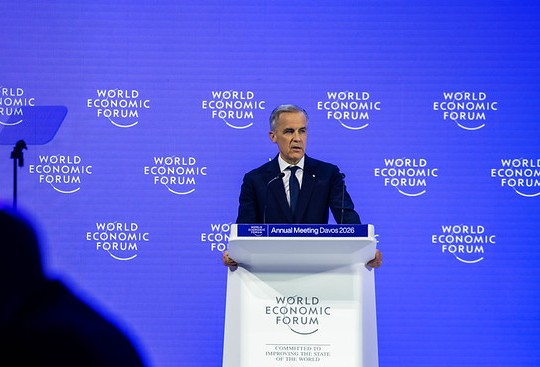
 Mark Carney at the Forum Annual Meeting 2026. Photo: World Economic Forum / Flikr / CC BY-NC-SA 4.0
The Canadian government’s response to Trump’s economic aggression involves major austerity, and as with European re-armament, we need working-class resistance, reports John Clarke
Following his well-publicised speech at Davos and, in the wake of a recent trade mission to China, Mark Carney is back in Donald Trump’s bad books and the threats and retaliatory measures are coming thick and fast from Washington.
Last week, the BBC reported that Trump had decided to withdraw his invitation to Carney to be part of the oligarchic Board of Peace that the US is establishing, in order to take control of Palestinian dispossession and the process of ‘reconstruction’ in Gaza. Though Trump didn’t spell out a reason for this move, it is easy to suppose that he intended it as a punishment for the Canadian PM’s insufficiently submissive attitude.
On the heels of this development, the US is also threatening to send fighter jets into Canadian airspace if the Carney government decides not to go ahead with the purchase of 88 Lockheed Martin F-35 warplanes.
As an article in the Independent shows, the Trump administration is saying that, should Canada acquire its fighter jets from Sweden instead, as has been suggested, it will be using ‘an inferior product’ and undermining collective defence efforts. This would lead to an arbitrary modification of the ‘decades-old North American Aerospace Defense Command deal with Canada’ and stepped-up US flights into Canadian airspace.
More tariffs
The sharpest expression of Trump’s disapproval, however, was directly related to Carney’s pursuit of trade diversification and his decision to include negotiations with China in this initiative. During a recent trip to Beijing, Carney and the Chinese leadership agreed on the substantial easing of tariff measures and established a ‘strategic partnership’ to increase the flow of trade.
As Global News reports, Trump responded to this development by posting on Truth Social that: ‘If Governor Carney thinks he is going to make Canada a “Drop Off Port” for China to send goods and products into the United States, he is sorely mistaken. China will eat Canada alive, completely devour it, including the destruction of their businesses, social fabric, and general way of life.’ The aggrieved US president then threatened to impose 100% tariffs on Canadian goods.
The Canadian government has denied that it is in ‘pursuit of a free trade deal with China, calling the recent talks a resolution of specific tariff-related issues.’ It also stresses that it is complying with ‘its current commitments such as the Canada-U.S.-Mexico Agreement (CUSMA).’ This may well be true but, from the standpoint of Trump’s ongoing effort to impose harsher terms on those powers that have functioned as junior partners of the US, it is of very limited relevance.
When he addressed the global exploiters and their key functionaries who had gathered at Davos, Carney set out some perspectives that troubled the Trump administration. His musings on the death of the ‘rules-based international order’ and on the selectivity and hypocrisies of that arrangement were not the problem. What raised hackles in Washington were the notions that were advanced with regard to how ‘middle powers’ like Canada might respond to the changed situation.
Carney suggested, a little provocatively, that ‘if great powers abandon even the pretense of rules and values for the unhindered pursuit of their power and interests … Allies will diversify to hedge against uncertainty.’ He went on to set out recent efforts by his government to increase the capacity of Canadian capitalism to generate profits, even as it is being squeezed by the dominant power.
‘In the past few days, we have concluded new strategic partnerships with China and Qatar,’ Carney told his audience. ‘We’re negotiating free trade pacts with India, ASEAN, Thailand, Philippines and Mercosur … To help solve global problems, we are pursuing variable geometry — in other words, different coalitions for different issues based on common values and interests.’
It must be stressed here that the impacts of a more pragmatic pursuit of immediate US interests, which is the essential feature of the America First turn, is particularly devastating for Canada. The country shares a very long border with the US and has developed a level of trade dependency and highly regulated economic integration with it that is massively problematic in the present context.
A report compiled by Scotiabank finds that, in 2023, trade ‘between the two countries accounted for 77% of total Canadian goods exports and 63% of Canadian goods imports, but only 18% of total US goods exports and 14% of US goods imports … Exports to the US were responsible for roughly 19% of Canadian GDP.’ Trump’s indignation and Carney’s bravado notwithstanding, it’s clear that Canada’s efforts to diversify face a very long road ahead to say the least.
As, under the presidency of Donald Trump, the US refocuses its role as a global hegemon and demands increased tribute from its former allies, efforts to escape or even mitigate the impacts, such as those that Carney advanced, are decidedly unwelcome. That the Canadian pursuit of diversified trade included the removal of some restrictions on its trading relations with China, the prime rival of the US, was especially annoying to Trump and his cohorts.
Carney’s plans
Undoubtedly, the Carney government will be making conciliatory approaches to its US counterparts but the message for public consumption is more stalwart. CMP News reports that the PM used a speaking event in Quebec City to expand on his remarks in Davos, now rather grandly referred to as the ‘Carney Doctrine’.
‘Canada cannot solve all the world’s problems, but we can show that another way is possible: that the arc of history isn’t destined to be warped towards authoritarianism and exclusion, it can still bend towards progress and justice,’ Carney stated. He also responded to Trump’s wilting claim that ‘Canada lives because of the United States’ by asserting that ‘Canada and the United States have built a remarkable partnership. In the economy, in security and in rich cultural exchange. But Canada doesn’t live because of the United States. Canada thrives because we are Canadian. We are masters of our home. This is our country.’
Along with this flow of patriotic rhetoric, however, Carney was careful to point out that the response of his government to the new realities that Trump has ushered in include a focus on ‘economic resilience’. From the standpoint of the working class in Canada, this element of the Carney message is the decisive consideration.
For all the talk of a common ‘national interest’, it is already abundantly clear that, whether less favourable trading terms with the US have to be accepted or diversification efforts are pursued with major results, the profitability and increased competitiveness of Canadian capitalism is Carney’s prime concern.
Global News reported, on 23 January, that almost ‘10,000 federal public servants have received notices in the past week warning them that their jobs may be cut, say the unions representing them.’
Global Government Forum further notes that this move is in line with the much bigger objective of a ‘reduction of around 10% in the overall public service headcount’ and an effort to ensure that all ‘federal departments and agencies … cut their overall spending by 15%.’ We may also be sure that Canada’s provincial, territorial and municipal governments will take comparable austerity-based approaches, adding considerably to the scale of the carnage.
In an article written for Midnight Sun, Mostafa Henaway, an active participant in migrant-justice struggles in Montreal, recently argued that, far from accepting Carney’s assurances that ‘we are all in this together,’ the ‘strategic question now is how to build a mass, multiracial, working-class resistance to Carney at the scale required, capable of sustained confrontation.’
The more Trump piles on the pressure, the more vigorously Carney and the rest of Canada’s ruling establishment will seek to impose the burden on workers and communities. In this situation, mass working-class resistance is indeed the decisive and urgent question.
Before you go
The ongoing genocide in Gaza, Starmer’s austerity and the danger of a resurgent far right demonstrate the urgent need for socialist organisation and ideas. Counterfire has been central to the Palestine revolt and we are committed to building mass, united movements of resistance. Become a member today and join the fightback.

John Clarke
John Clarke became an organiser with the Ontario Coalition Against Poverty when it was formed in 1990 and has been involved in mobilising poor communities under attack ever since.