
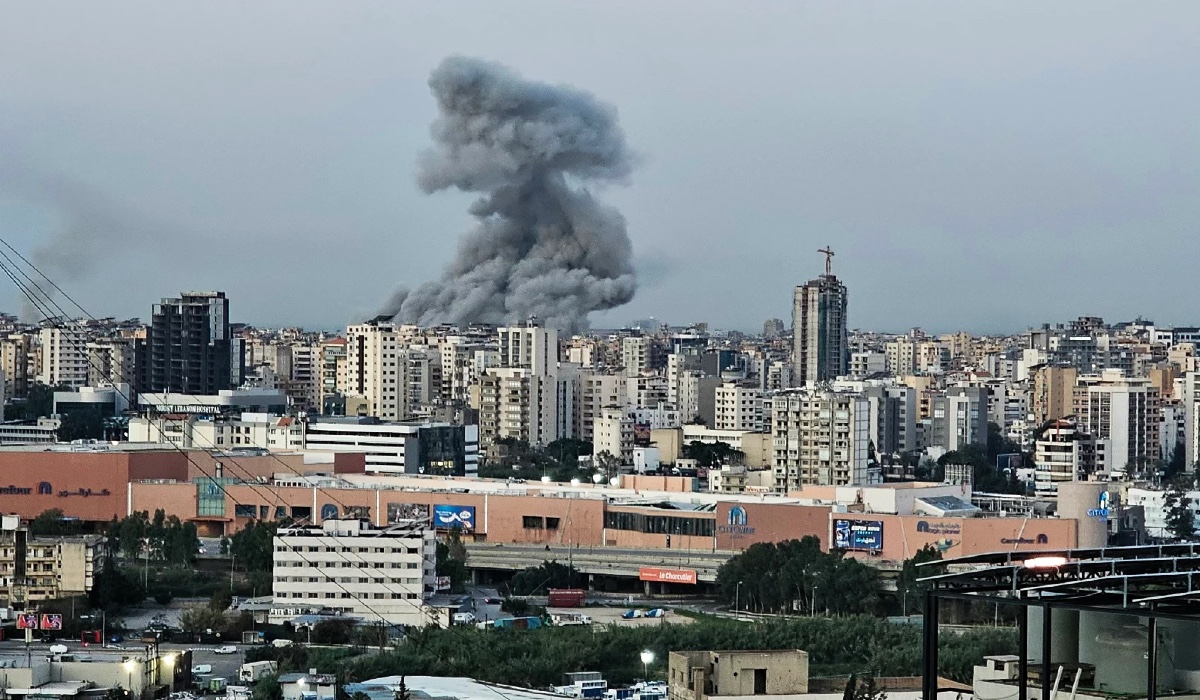
 Israeli attacks on Lebanon in 2026/ This image is openly licensed via CC BY 4.0 (AFP image)
Israel’s criminal war on Lebanon is part of its strategy of regional destabilisation which conflicts with US aims to achieve a compliant Middle East safe for US profits, argues John Clarke
As the US and Israel’s attack on Iran unfolds, a major assault on Lebanon is also underway, with Israel inflicting massive levels of destruction and heavy casualties on the civilian population. This war within the war reveals a great deal about Israel’s regional objectives and how these are by no means entirely aligned with US aims and intentions.
According to Al Jazeera, ‘Israeli forces have attacked the Qasmiyeh Bridge, a key crossing linking Lebanon’s south to the rest of the country.’ This attack is part of a process of destroying ‘civilian infrastructure’ and it follows an order by Israeli defence minister Israel Katz ‘to destroy all crossings over the Litani River and homes close to the border between the two countries.’
Lebanon’s president, Joseph Aoun, has suggested this devastation is a ‘prelude to ground invasion [and] an attempt to sever the geographical connection between the southern Litani region and the rest of Lebanese territory.’ This would, moreover, ‘establish a buffer zone along the Israeli border, solidify the reality of the occupation and seek Israeli expansion within Lebanese territory.’
‘Only begun’
Israel’s Lieutenant General Eyal Zamir has indicated that the attack on Lebanon ‘has only begun’ and that it would be ‘prolonged’. ‘We are now preparing to advance the targeted ground operations and strikes according to an organised plan,’ he declared.
The present Israeli assault on Lebanon, which has already resulted in over a thousand deaths and the displacement of more than a million people, began on 2 March, ostensibly in response to the firing of rockets into northern Israel by Hezbollah.
It should be noted that Israel has a very poor case when it seeks to use the Hezbollah rocket attack to justify its renewed assault on Lebanon. Its own violations of the ceasefire that followed its last major assault on the country in 2024 were massive and ongoing. Al Jazeera reports that, in January, the Lebanese government filed a complaint with the UN that ‘included three tables detailing Israeli violations of Lebanese sovereignty on a daily basis during the months of October, November and December 2025. The number of these violations amounted to 542, 691 and 803 respectively, totalling 2,036 violations.’
Israel is demanding that the Lebanese government ensure the disarming of Hezbollah but it knows very well, as +972 Magazine explains, that the Lebanese army, funded mainly by the US, has only been allowed the most meagre military capacity. It is in no position to disarm Hezbollah, with its considerable fighting capacity and major popular base of support.
No doubt, Israel does wish to neutralise Hezbollah but its present attack on Lebanon is linked to a regional strategy of ongoing military aggression and an effort to weaken neighbouring countries to the point where their stability and cohesion are called into question.
At present, +972 Magazine suggests, ‘Israel’s renewed destruction of Lebanon is creating a humanitarian crisis at a scale not seen in decades. At the same time, there are growing fears of internal conflict, and possibly even a civil war involving Hezbollah. In this context, it seems reasonable to conclude that Israel’s ambitions in Lebanon extend beyond weakening or eliminating Hezbollah.’
Regional destabilisation
While Israeli leaders may talk of liberating populations from oppressive governments or advance calls for ‘regime change,’ the thrust of the strategy it is pursuing, as ‘a state in permanent search for its next war,’ is to ensure maximum levels of disruption and dislocation throughout the region. In the present case, it ‘just wants an ongoing conflict, internal pressure, and chaos — and to see the Lebanese state collapse as much as possible.’
Several generations into its colonial project, the Zionist state is on a brutal and utterly uncompromising trajectory. Despite the horror of the Gaza Genocide and other atrocities leading to increased isolation for Israel, its key Western sponsors have continued to enable its crimes. However, a reckless determination to advance its objectives regardless of the consequences is in evidence at the highest political level in Israel.
A 2 February article in Mondoweiss points to Netanyahu’s contention that ‘Israel would need to become a “super Sparta” — a highly militarized warrior state with a self-sufficient military industry, capable of defying international pressure and arms embargoes because it no longer has to rely on American military beneficence.’
The notion that Israel could maintain its destructive and belligerent role in the Middle East without imperial sponsors and, specifically, US weaponry and diplomatic cover, is hardly a realistic proposition. However, that Netanyahu gives a voice to such sentiments, playing to his base of support in the process, is revealing.
The Spartan model that is advanced here, however, isn’t merely wishful thinking or political posturing. Within the Zionist political establishment, the question of how far Israel can assert its own interests and act without the support of the imperialist powers is a major consideration. The Mondoweiss article details Israel’s strenuous efforts to boost arms manufacturing and to increase its role as an exporter of weaponry.
This course of action, moreover, reflects a situation where ‘military aggression and territorial expansionism are the mechanisms through which the Israeli economy now seeks to reproduce itself. As a result, Israel’s governing coalition rests on permanent securitization. The war economy has become the organizing principle of political survival and regime insurance.’
As it works to destabilise the region and weaken its potential adversaries, the prospect also arises of major territorial acquisition. Certainly, the aim is formally to incorporate the Palestinian Occupied Territories into Israel but the prospect of a ‘Greater Israel’ that seizes territory beyond historic Palestine is also being raised.
Last August, as Al Jazeera reported, Netanyahu outraged the governments of surrounding Arab countries with his open endorsement of the concept of a Greater Israel that would include parts of Lebanon, Syria, Egypt and Jordan. He told an Israeli journalist that he was ‘very much’ connected to this expansionist vision.
On 23 March, Israeli finance minister, Bezalel Smotrich, stated that the present attack on Lebanon should result in a major and permanent takeover of a part of south of the country. According to The Times of Israel, he declared that the ‘current war in Lebanon must end with a radical change, beyond the vanquishing of the terror group Hezbollah … The Litani [River] must be our new border with the state of Lebanon, just like the “Yellow Line” in Gaza and like the buffer zone and peak of the Hermon in Syria.’
There are striking differences between the perpetual war and regional destabilisation approach that Israel is advancing and the goals of the US. Last November’s US National Security Strategy document, while it advocated increased efforts to dominate Latin America and a strategy to contain the rising power of China, actually argued for reduced US resources being deployed in the Middle East.
Trump’s strategists very mistakenly suggested that the region ‘is no longer the constant irritant, and potential source of imminent catastrophe, that it once was. It is rather emerging as a place of partnership, friendship, and investment—a trend that should be welcomed and encouraged.’
To say the least, such hopes for a pacified and safely dominated region from which profits could be drawn at relatively low cost have proven to be unfounded. Trump imagined that Israel’s aims and that of his administration could be aligned with a quick application of the ‘Venezuelan option’ in the case of Iran. This has, of course, quite literally blown up in his face and his administration is in disarray, while the entire region is in turmoil.
The very much less than radical Carnegie Endowment for International Peace, in an article issued on 20 March, captured the differences between US and Israeli objectives very well. It suggested that Trump calculated that a show of strength and some selective assassinations would result in the US ‘aligning with a pragmatic regime insider and accessing vast oil reserves and other resources.’
On the other hand, ‘Netanyahu favors a fragmented and weakened Iran that can no longer challenge Israel and can be subjected to continuous intervention.’ Thus, while ‘the United States and Israel are closely coordinating in this conflict, their ultimate endgames appear to be diverging.’
Whether Trump cuts his losses or sinks deeper into the quagmire he has created, the Iranian debacle will have lasting implications for the Middle East but also for the present US administration’s objective of a ‘peace through strength’ that is based on obtaining compliance from targeted countries without major and extended military deployment.
Clearly, the Middle East can’t be both Israel’s battlefield and the picture of lucrative stability the Trump administration wishes it to be. As the assault on Iran fails spectacularly and Israel inflicts yet more death and destruction on Lebanon, the misalignment of interests and objectives between the Zionist project and its prime imperial sponsor is quite unmistakable. The implications of this will certainly play out in the period ahead.
Before you go
The ongoing genocide in Gaza, Starmer’s austerity and the danger of a resurgent far right demonstrate the urgent need for socialist organisation and ideas. Counterfire has been central to the Palestine revolt and we are committed to building mass, united movements of resistance. Become a member today and join the fightback.

John Clarke
John Clarke became an organiser with the Ontario Coalition Against Poverty when it was formed in 1990 and has been involved in mobilising poor communities under attack ever since.