
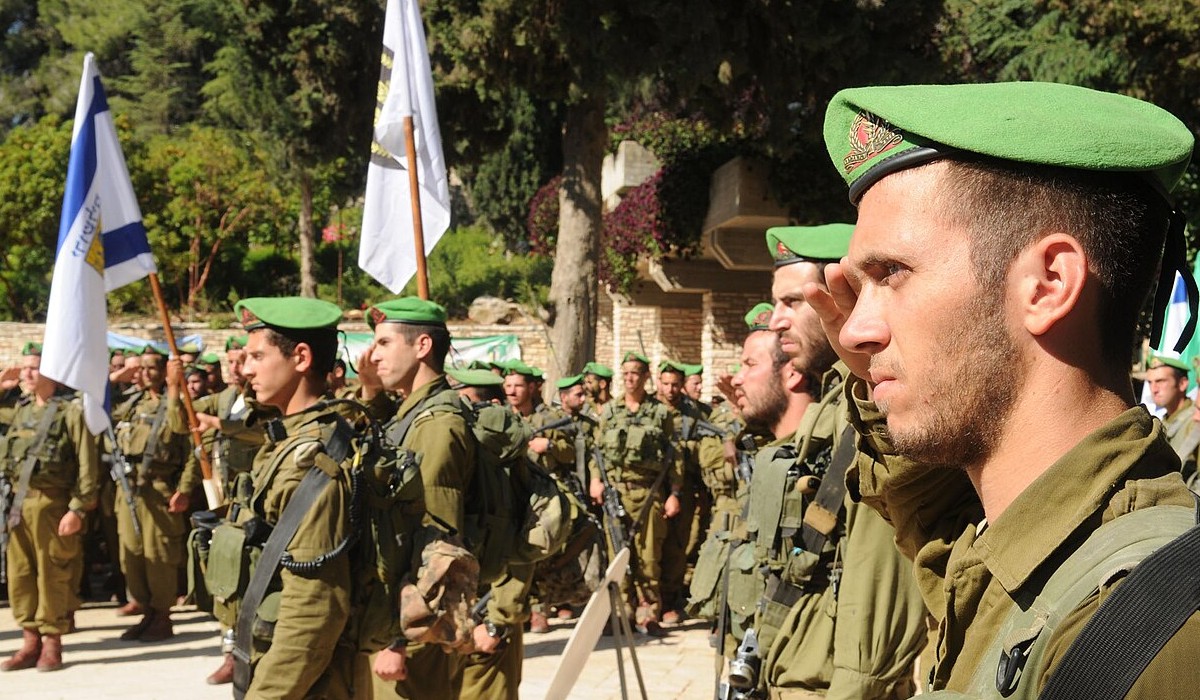
 Israel Defense Force soldiers. Photo: Israel Defense Force / Wikimedia Commons / CC BY 2.0
The virtual state of being at permanent war has had a major impact of the Israeli economy. Chris Bambery outlines some of the structural problems facing the Israeli state
Once, long ago, my father, a life long Labour voter, told me of the wonders of Israel; how it had made the desert bloom and how the kibbutzim were the living reality of socialism. Back then, prior to the 1967 Six Day War, the majority of the British population favoured Israel.
By the time my father died in 1991 all that was changing, and his views on Palestine certainly had. Today, of course, most people in Britain view Israel as a pariah state.
At this stage I want you to imagine you are an Israeli LGBT man in your early 30s working in financial technology in Israel or a young Israeli feminist running their own small business.
Your view of the Palestinians is dreadful. You have no contact with them and don’t care about their fate. But you do care that if you’ve business in Europe no one wants any record of meeting you or if you go on a cruise in the Mediterranean you’ll be met by protests on the Greek islands or on a visit to Paris abuse on the streets.
You did not vote for Netanyahu and his coalition, and fear he is tearing up Israeli democracy (democracy for Israeli citizens only, and not even full democracy for Arab citizens).
More ominously you are very aware that his allies, such as the finance minister, Bezalel Smotrich, and the National Security Minister, Itamar Ben Gvir, not only want a greater Israel including Gaza, the West Bank, southern Lebanon and tranches of Syria, Egypt and Jordan (not something you favour but not a big problem) but they also want a Jewish theocratic state.
Smotrich has said he had “a problem with LGBTQ+ culture” and likened same-sex marriage to incest. His position on women is clear:
“Get married and have a lot of children for Israel’s sake.’
To cap it all you are now sitting in an air raid shelter as Iranian missiles penetrate Israel’s Iron Dome defence system. Back in June you saw the damage those missiles did in Tel Aviv.
Plus, you face being called up as a reservist into the Israeli Defence Force (IDF).
At the end of all that the conclusion you would reach is to join the hundreds of thousands of Israelis who have left the country since the Gaza war began. Since the 7 October 2023 attacks, over 550,000 Israelis left the country and did not return within the first six months, With access to an EU passport, Greece is calling. You’ve friends among the more than 10,000 Israelis who’ve settled there and you can run your business from there with far fewer problems.
Yes, I know your heart bleeds.
Economic impact
More than 46,000 businesses have gone bankrupt since the start of the Gaza war. Capital flight, particularly in the high tech sector, is a reality while many middle class Israelis have salted their money abroad to avoid inflation and to prepare for exit. Foreign firms who have invested in Israel are also leaving.
The high tech sector is the main casualty. Before the Gaza war it was regarded as the primary economic engine, accounting for more than 40 percent of the country’s GDP growth between 2018 and 2023. Around 400,000 people were employed in the high-tech sector, which accounted for one-fifth of Israel’s total GDP.
The Israeli economic researcher and BDS activist Shir Hever notes:
‘Since October 2023, Israel has faced a convergence of economic shocks. Tens of thousands of residents have been displaced from border regions in the south and north as a result of hostilities with Hamas and Hezbollah, while hundreds of thousands of reservists were pulled out of the workforce for extended periods, leaving key sectors short-staffed and productivity depleted. Public services, education, and healthcare have deteriorated as state spending was diverted to the war, and almost 50,000 businesses have gone bankrupt.
Capital flight — particularly in the high-tech sector — together with a growing reliance on foreign loans has added significant strain to the economy, with debt expected to reach 70 percent of GDP in 2025. Israel’s international standing has also weakened: Once-stable trade partners are turning away, sanctions and boycotts are expanding, and major investors are beginning to look elsewhere.
An annual poverty report published 8 December by the Israeli NGO Latet underscores the depth of the social crisis. Household expenses have risen dramatically since the war, nearly 27 percent of families and over one-third of children now experience “food insecurity,” and about a quarter of aid recipients are “new poor” pushed into hardship over the past two years.’
This flies in the face of a booming stock market, held up by Israel’s supporters as a token of its economic resilience, but Shir Hever points out:
‘…there are other reasons for this, one being that Israel changed its rules about how much it pays reservists, to the point that now they’re paid NIS 29,000 per month — more than double the average market wage in Israel and more than four times the minimum wage. Some career army officers even left the army so they could rejoin as reservists to make more money.
These reservists didn’t have anything to spend all this money on because they’re in Gaza, so they’ve invested it in stocks, or put it in some kind of trust fund through a bank, which means that again, it goes into stocks. This keeps funneling more and more money into the stock market — so of course the stock market is high. The important question is where does this money come from?’
Merchants of death
So, what is the engine if Israel’s economy today. The answer is simple – arms exports.
‘… the military industry has been carrying the economy ever since Israel experienced a level of global isolation that decimated most other sectors over the past two years. The result? Israel now has an additional structural incentive to be in a perpetual state of war.’
In 2023, defence exports reached approximately $13 billion, and in 2024 they climbed further to around $14.7–15 billion, setting successive records.
This is what lay behind Netanyahu’s speech in September of last year when he announced that Israel needed to become a “super Sparta” — a highly militarized warrior state with a self-sufficient military industry, capable of defying international pressure and arms embargoes because it no longer has to rely on American military beneficence.
For those Israelis who are not settlers, religious zealots or far right thugs Sparta is hardly an attractive society – encouraging paedophilia for instance (the name Jeffrey Epstein is ringing in my ears as I write that). But leaving aside the rhetoric it rests on a new economic reality:
‘Economically, this means that military production will become central to Israel’s long-term industrial strategy, diverting capital, labour, and state support toward weapons manufacturing rather than civilian recovery, a strategy that is untenable during wartime. This also embeds Israeli firms deeper into global security supply chains, even as the state itself becomes diplomatically isolated.’
This impacts on Israel’s permanent war position:
‘As civilian sectors stagnate, the war economy provides growth, foreign currency earnings, and political insulation. This creates a structural incentive for permanent mobilization: war sustains demand, shields the government from accountability, and reinforces a worldview in which force is treated as the primary currency of international relations.
In this configuration, military aggression and territorial expansionism are the mechanisms through which the Israeli economy now seeks to reproduce itself. As a result, Israel’s governing coalition rests on permanent securitization. The war economy has become the organizing principle of political survival and regime insurance.’
Weapons sales are not simply about showing up with a glossy catalogue or running a stall at some arms fair. Israel is, literally, selling weaponry off the back of genocide.
Yet, Israel is now such a pariah state how many arms fairs does it get invited to?
Arms sales are part of long term military and diplomatic alliances. Few states will be rushing into entering those with Tel Aviv. Currently major customers include the U.S., UAE, Germany, Greece, India and Azerbaijan. The Europeans will be under domestic pressure to stop buying Israeli weapons. The UAE will not want this to be publicised, while India is looking to become self-sufficient in its own arms supply.
Israel’s ability to sell arms also rests on its supposed invincibility. That is not looking to be such a certainty.
Meanwhile, Israel’s economy relies on supply chains which, as the Houthis proved, are very vulnerable, particularly through the Red Sea and Gulf of Aden. To try and get round that Israel has recognised Somaliland, one of the few states to do so.
To return to my starting point. Israel is now a state permanently at war and a merchant of death. There are still those who claim it is the only democracy in the regime, a home to a vibrant LGBT community, a socially liberal paradise and so on. That flies in the face of harsh reality and it is going to become a growing problem for apologists for Zionism, adding to Israel’s growing isolation.
Before you go
The ongoing genocide in Gaza, Starmer’s austerity and the danger of a resurgent far right demonstrate the urgent need for socialist organisation and ideas. Counterfire has been central to the Palestine revolt and we are committed to building mass, united movements of resistance. Become a member today and join the fightback.

Chris Bambery
Chris Bambery is an author, political activist and commentator, and a supporter of Rise, the radical left wing coalition in Scotland. His books include A People's History of Scotland and The Second World War: A Marxist Analysis.