
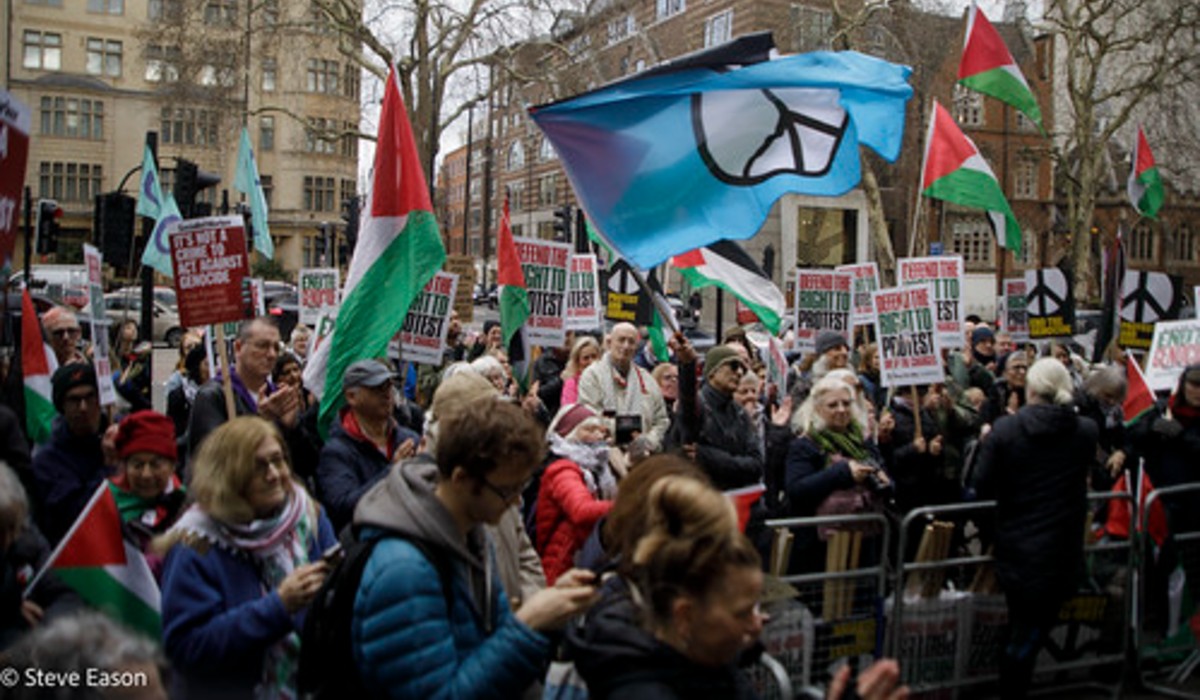
 Solidarity rally outside the trial of Chris Nineham and Ben Jamal. Photo: Steve Eason
Feyzi Ismail and Des Freedman report on the first day of the trial at Westminster Magistrates Court of Chris Nineham and Ben Jamal
The first full day of the trial of two leaders of the pro-Palestine movement for breaching public order conditions was held this week and was dominated by the prosecution. The defendants, Ben Jamal, director of the Palestine Solidarity Campaign, and Chris Nineham, vice chair of Stop the War, both deny the charges, which relate to allegations that they respectively incited and organised protesters to defy a police ban on marching to the BBC during the 22nd national protest for Palestine on 18 January 2025.
Prosecutor Kevin Dent KC used his lengthy opening statement to try to make the case that both Ben and Chris purposefully encouraged protesters to stray beyond the zone imposed by police under the Public Order Act. Dent argued that the Metropolitan Police Service refused permission for the demonstration to either start or end at the BBC in order to protect the safety and security of worshippers at the Central Synagogue, some 200m from Langham Place, the organisers’ proposed assembly point.
The core of the prosecution’s argument was that the lead-up to 18 January was significant: first, it provided an adequate rationale for the decision to impose conditions; second it constituted that the defendants were aware of the conditions; and third and most importantly, that the defendants were engaged in a concerted campaign to oppose the conditions, because they had suggested that the police were yielding to unacceptable political pressure by the synagogue, and that the commander should consider what would happen if thousands of people ignored the conditions. There was, of course, merit in both of these arguments made by the defendants.
Dent stated that police commander Adam Slonecki had been made aware that sections of the Jewish community felt intimidated by the demonstrations and noted that many of the protesters were hostile to Israel and, by extension, he claimed, supportive of Hamas and the eradication of the Israeli state.
These claims were part of the case made that the Jewish way of life was being seriously disrupted by protests, a case that was made very forcibly to the police at a number of meetings with pro-Israel Jewish groups.
The Commander noted that he was aware that concerns of intimidation were expressed by only a section of the Jewish community and that other Jewish people had regularly participated in the demonstrations themselves.
Nevertheless the commander claimed that in refusing the protestors the right to go anywhere near the BBC or the Central Synagogue, and effectively imposing a static protest, he had struck an appropriate balance between the competing interests of the Jewish community to worship, and opponents of a genocide to protest.
This was despite proposals from the Palestine Coalition, the organisers of the national demonstrations, to establish an exclusion zone around the synagogue, or to move the assembly time to later in the day to accommodate the timings of the synagogue and in particular the Sabbath, or to reverse the route.
The prosecution was particularly keen to emphasise the so-called cumulative impact of the demonstrations on both Jewish worshippers and local businesses. This is a justification for the use of police powers that was actually quashed by the court of appeal in May 2025. Liberty has argued that the concept of ‘cumulative impact’ ultimately allows police to undermine the right to protest: ‘The problem is zero accountability and transparency in the use of their powers to restrict or limit protests’ according to its campaigns coordinator.
Yet at the time, the Met decided that it was necessary to impose these restrictions, in order, as Dent claimed, to deal with the ‘intransigence’ of the Palestine Coalition. This is despite the fact that, as the prosecution acknowledged, the organisers had agreed to move a demonstration originally planned to assemble outside the BBC on 30 November 2024 to a later date in January.
Dent referred to the many meetings between Slonecki and march organisers which resulted in the Met’s eventual decision to impose a static protest in Whitehall on 18 January and an exclusion zone around the BBC. The court was played a compilation of video evidence that the prosecution claimed clearly demonstrated that Ben and Chris had no intention of respecting the police conditions.
This showed footage of the small delegation of people – a combination of Palestine Coalition leaders and protest speakers – walking up Whitehall through a series of police cordons. The court was told that this delegation were determined to lay flowers either outside the BBC or at the feet of the police if they were prevented from reaching the BBC to demonstrate the complicity of both organisations with genocide. Curiously, the footage stopped immediately before the violent arrest of Chris by a group of police officers.
Speaking for the defence, Mark Summers KC vigorously dismissed the prosecution’s case, suggesting they the conditions imposed were unlawful and that neither defendant knowingly breached conditions given that they were directed to pass through the police cordons. Summers suggested that the policing operation was marked by confusion, with video evidence proving that, far from deliberately trying to break through police lines, the small delegation was trying to negotiate with the police about how best to proceed up Whitehall. In fact, there was no communication from police at the time about whether and how the conditions were being breached.
Summers provided a very different interpretation to the prosecution’s ‘tortured reading’ of events, putting the blame squarely on the police for presiding over a chaotic situation, which one officer on the ground described as a ‘massive clusterfuck’. For Summers, this was further evidence of a ‘panicked, seat-of-the-pants exercise, a scene of abject chaos.’ ‘How could it plausibly be said to look otherwise?’ he asked the Court.
Summers ended his opening summary by disputing the social media traffic leading up to 18 January, on which the charge of incitement partly rests: he argued that the prosecution’s incitement charge was hopeless because Ben did precisely the opposite. In fact, in a carefully worded speech, Ben declared that the intention had been to march but instead flowers were now being laid, and that he did not ask the crowd to follow the delegation. The significance of this trial is that it tests whether the police have the right to use alleged protection of the right to worship and claims of cumulative disruption to severely limit protest rights. The trial continues on Monday.
Before you go
The ongoing genocide in Gaza, Starmer’s austerity and the danger of a resurgent far right demonstrate the urgent need for socialist organisation and ideas. Counterfire has been central to the Palestine revolt and we are committed to building mass, united movements of resistance. Become a member today and join the fightback.
