
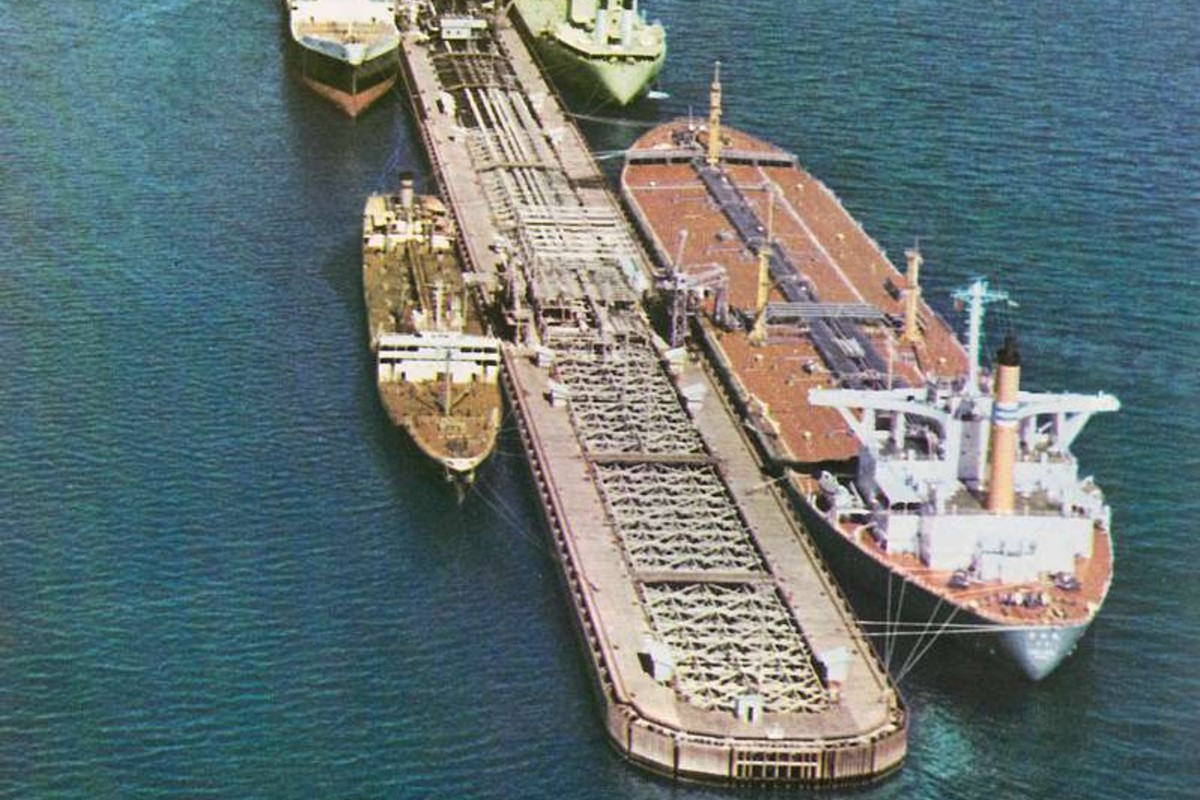
 Large tankers loading at Kharg Terminal. Photo: Oil and Economic Development of Iran / Cropped from original / Public Domain
The US attack on Iran’s Kharg Island is an escalation which could provoke Iran into a response that would be devastating for the whole region, explains Chris Bambery
With the hikes in gasoline (petrol) prices and Liquid Natural Gas threatening the already fragile global economy, and rising prices at the pump feeding opposition to the Iran war in the US, you wonder what bright spark in the US command decided to target Kharg Island, Iran’s main terminal from which close to 90% of Iran’s oil exports are dispatched.
In the early hours of Saturday, 14 March, Kharg Island became a crucial target in the US-Israel war on Iran, after President Donald Trump announced that his country’s air force had bombed military facilities on the Iranian island. On Truth Social, Trump stated: ‘For reasons of decency, I have chosen NOT to wipe out the Oil Infrastructure on the Island. However, should Iran, or anyone else, do anything to interfere with the Free and Safe Passage of Ships through the Strait of Hormuz, I will immediately reconsider this decision.’
The US claimed it took out missiles and mine stocks, obliterating military targets. Iran says those were not destroyed and the oil installations were not hit.
Iran is not going to stop attacking shipping in the Persian Gulf or the Gulf States. If they did, they would be effectively giving in. So Trump will have to ‘reconsider’ his decision. You do not need to have a crystal ball to know how Iran will respond to any attack on the oil installations on Kharg Island.
Across the Persian Gulf sit hundreds of big, fat targets, the oil and LNG installations of Saudi Arabia and the Gulf States. Iran can use short and medium-range missiles and drones against them, confident that the missile defences of those states are badly depleted. That would be a huge escalation in this war and would impact on the global economy very seriously. The usual focus is on oil prices but LGN is vital to the global economy.
The Economist pointed to the global importance of LNG: ‘“This will bring down the economies of the world,” warned Saad al-Kaabi, Qatar’s energy minister, on March 6th. It was not hyperbole. Days earlier QatarEnergy, which makes a fifth of the world’s liquefied natural gas (LNG), shut down its production and export facilities after some were hit by Iranian strikes. Unable to extract, process and, because the Strait of Hormuz is blocked by the fighting, ship its LNG, the firm has declared force majeure on its contracts. The price of LNG has ballooned on world markets. Customers around the globe, who use it to generate electricity, heat homes and make things like fertiliser, are scrambling to respond.’
What we are talking about here is not just rising oil and LNG prices but actual shortages. I am old enough to remember the oil embargo imposed by Arab states in the wake of the 1973 war between Israel and Egypt and Syria. Britain was on a three-day week, electricity was shut off each day and petrol was in very short supply.
As I write, the major oil storage facility in the region, at the port of Fujairah in the United Arab Emirates has been shut down after a major fire caused by debris from a downed drone.
The attack on Fujairah and the missile strikes which hit Israel today refute the US and Israeli boasts that they have degraded Iran’s military arsenal so much that missile and drone strikes are falling through the floor.
Water war?
Even the BBC’s Frank Gardner has to admit: ‘Two weeks into this war it [Iran] still has the capacity to launch large numbers of low-cost, high explosive drones at its Gulf Arab neighbours as well as at shipping. It could, potentially, expand those targets to include vital infrastructure like desalination plants that provide drinking water to millions.’
Any attacks by the US, Israel or Iran on desalination plants would create a humanitarian crisis on a massive scale. The Gulf States would become unlivable but Saudi Arabia, Iran and Israel also rely on these plants. The Gulf States have more than 400 desalination plants along their coasts.
One report underlines what’s at stake if they are targeted: ‘Cities such as Dubai, Doha, Kuwait City and Abu Dhabi rely overwhelmingly are massively dependent on desalination plants.
‘For instance, 70% of Saudi Arabia’s drinking water comes from desalination plants. In Kuwait and Oman the figure is 90%. Without desalination plants, large parts of the region’s modern urban systems would struggle to exist.
‘Yet this technological achievement has quietly produced a new form of strategic vulnerability. The Gulf‘s water security depends on a relatively small number of massive coastal plants – industrial complexes that operate as the lifelines of entire cities.
The current military conflict has begun to expose this.’
In Iran, declining river flows, prolonged drought and over extraction of groundwater have already left dams running dry. Desalination has become the backbone of urban water systems.
Demand for water in Israel outstrips what is available from conventional water resources. Israel relies for about half of its water supply from unconventional water resources, including reclaimed water and desalination of sea water. Most drinking water comes from desalination plants extracting sea water from the Mediterranean. The Ashkelon desalination plant provided potable water for roughly 15% of Israel’s daily consumption in 2010.
Already desalination plants have been hit. Earlier this week, Iran’s foreign minister accused the US of striking a desalination plant on Qeshm Island off the coast of Iran in the Strait of Hormuz. The strike reportedly cut off the water supply to thirty villages. Just 24 hours later, Bahrain said an Iranian drone had caused material damage to one of its desalination plants near Muharraq.
Trump needs to find an off ramp for a war which already exceeds the initial military timetable and which is becoming more and more unpopular on the domestic front, even before gasoline prices surge. By effectively destroying Kharg Island, he could proclaim victory. The problem he has is that Iran is in no mood for quitting.
Before you go
The ongoing genocide in Gaza, Starmer’s austerity and the danger of a resurgent far right demonstrate the urgent need for socialist organisation and ideas. Counterfire has been central to the Palestine revolt and we are committed to building mass, united movements of resistance. Become a member today and join the fightback.

Chris Bambery
Chris Bambery is an author, political activist and commentator, and a supporter of Rise, the radical left wing coalition in Scotland. His books include A People's History of Scotland and The Second World War: A Marxist Analysis.