
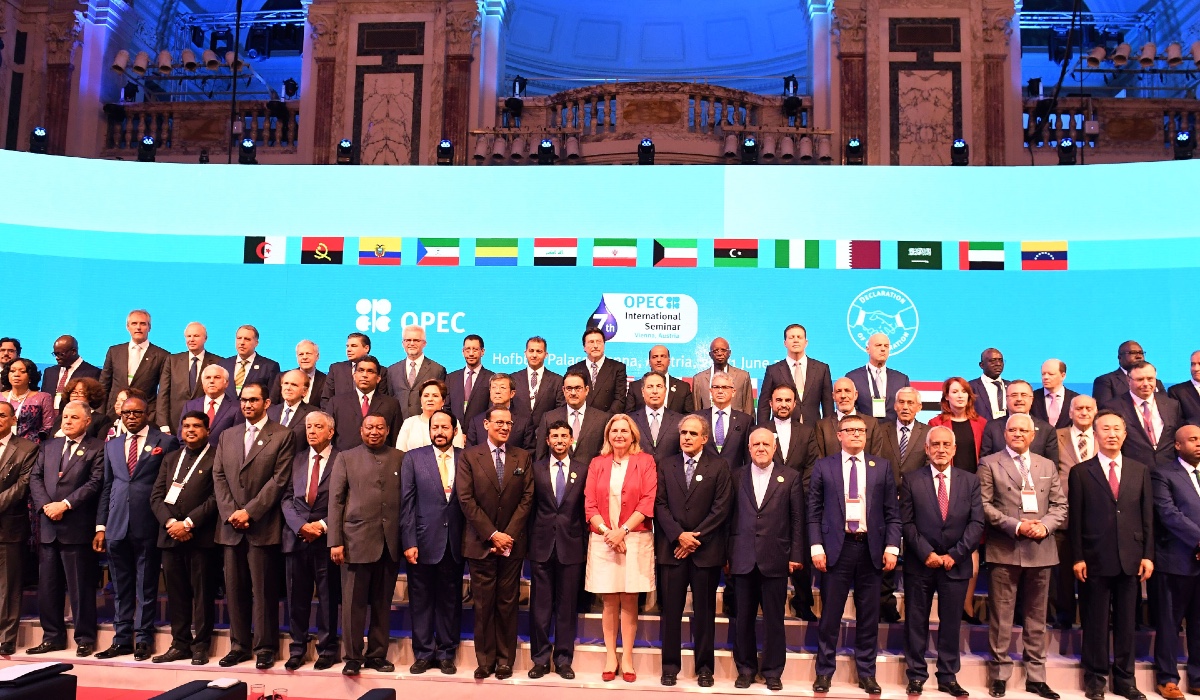
 OPEC International Seminar in Vienna, 2008/ Bundesministerium für Europa, Integration und Äußeres, CC BY 2.0 via Wikimedia Commons
The fracturing of the oil-producers’ cartel was caused by the ramifications of US imperial decline and will increase, even more, the volatility of the Middle East region, argues John Clarke
The decision of the United Arab Emirates (UAE) to pull out of Opec has an enormous bearing on the oil cartel itself, along with major regional and global implications. It must also be stressed that it occurs at a highly volatile time, brought to fever pitch, by Trump’s ill-advised assault on Iran.
On 29 April, Al Jazeera offered an analysis of the rupture within Opec that draws some important conclusions. It points out that the ‘UAE’s decision to quit comes after years of open dissatisfaction with the oil cartel’s policy of capping members’ production as a way to control prices and stabilise the market.’
This longstanding tension has grown, as the UAE’s productive capacity has increased. ‘Before the start of the [Iran] war, the UAE’s production capacity had grown to 4.8 million bpd, but under its OPEC agreement, it was only allowed to produce 3.2 million bpd.’
The immediate impact of the UAE’s new freedom to boost oil production is, of course, presently constrained by the closing of the Strait of Hormuz and the conflict that underlies this. However, should ‘traffic return to pre-war levels … the UAE could potentially flood the market with its 1.6 million bpd of extra production – equivalent to about 1.5 percent of global oil supply – enough to give it a serious edge in the global energy market, experts say.’
If Trump is able to reach an accord with Iran and unimpeded passage through the Strait is resumed, the UAE will want the ability to maximise production so as to sell as much of its oil reserves as it can. Its leaders wish to leave as little of their productive capacity in the ground as possible in the event that a long-term transition away from fossil fuels undermines the markets upon which they rely. The environmentally destructive results of this approach are entirely obvious, of course, but they are of no concern to the Gulf autocrats and the fossil-fuel companies.
Opec’s decline
The emergence of the Organisation of the Petroleum Exporting Countries (Opec), in 1960, represented an effort by oil-producing nations to exert some power in the face of major oil companies based in the imperialist countries. As the BBC explains. In 2016, the eleven members of Opec joined forces with ten other oil countries, including Russia, to form Opec+ so as to increase the capacity ‘to defend the interests of major oil exporters by coordinating production to ensure steady revenue for its members.’
The effort to assert oil producers’ interests in this way has had a major impact but it has been a difficult undertaking that has not always succeeded. Opec has often had trouble ensuring that its member states stick to their agreements with regard to levels of production. The UAE has been particularly prone to pushing oil production beyond levels it had committed to and its decision to leave the cartel obviously reflects a desire to be free of all such constraints.
It is also true, that the pursuit of new sources, many of them obtained by accessing forms of ‘dirty oil,’ such as Canada’s oil sands or in the widespread resort to fracking, has reduced the power of Opec. Al Jazeera notes that, in the 1970s, the cartel’s productive power ‘accounted for half of the global oil market. Today, as other countries – such as the US and Norway – have become big oil producers themselves, OPEC’s share is lower at 33 percent of the global market.’ Opec remains a major force but there is no doubt that rift with the UAE, its third biggest producer, weakens it very significantly and hastens its decline.
The divisions and conflicting interests that underlie the departure of the UAE from Opec are playing out under conditions of the greatest uncertainty for global oil markets and Trump’s Iranian debacle has brought this to a head. Beyond this, however, the jockeying for position and the assertion of self-interest that we see in the rift within Opec reflect the instability of a global order that is dealing, more and more, with the relative decline of US hegemony. The America First strategic turn of the Trump administration both reflects and intensifies this trend.
The UAE expresses with particular clarity the trend towards developing a capacity for regional influence that has advanced under the nose of a weakened US. The Middle East Policy Council offers an appraisal of the UAE’s drive ‘to become a key player in the ever-shifting Middle East.’
Washington can only have been deeply concerned when satellite imagery ‘from the International Institute of Strategic Studies (IISS) from July 10 revealed that China and the UAE began their second joint military exercise in the Xinjiang province, which included a number of Western-made aircraft.’ Indeed, the ‘UAE has become more closely intertwined with China in recent years despite pressure from its major western allies, particularly the United States.’
At the same time, the UAE leaders have made sure to take a collaborative approach with both the US and Israel in working to broker a ceasefire deal in Gaza and a longer-term agreement that would impose bitter terms on the Palestinians and further their dispossession. This has even involved ‘a recent secret meeting between Abu Dhabi, Washington and Jerusalem.’
When it comes to the brutal and massively destructive conflict between military factions in Sudan, the UAE’s complicity is well established. In pursuit of its own regional ambitions, it has provided support to ‘the rebel Rapid Support Forces, who have been accused of genocidal acts against “non-Arab groups”.’ The UAE’s rulers display a growing ability and readiness to manoeuvre to their own advantage.
Iran War
The attack on Iran that the US and Israel undertook and the protracted deadlock that has ensued under a tense ceasefire have raised new challenges for the UAE and other autocratic Gulf States, as they seek to find their place in a highly uncertain but rapidly changing world order.
A 1 May article in the Conversation is appropriately headlined: ‘The Iran war has brought many old Gulf faultlines to the fore – and is creating new ones.’ With regard to relations between the UAE and Saudi Arabia, it notes that the ‘two countries have also recently become serious economic competitors. And although both states have been hit hard by Iran in the current war, the conflict seems to have accelerated their rivalry.’
Within a complex web of competing strategies, Saudia Arabia has taken a relatively conciliatory approach towards Iran and has placed considerable emphasis on deepening co-operation with Pakistan. The UAE, on the other hand, has bitter territorial disputes with Iran and has cultivated close links with the Modi regime in India. The UAE, moreover, has chosen to go even further than its Saudi rival down the path of ‘normalisation’ with Israel.
Very notably, the ‘UAE’s announcement to leave Opec coincided with a meeting of the Gulf Cooperation Council in the Saudi Arabian capital Riyadh, where members sought to find common ground on the Iran war. This was a major affront to the Saudis.’
In context of the America First recalibrating of the US global role, the ‘reckless US-Israeli attack on Iran has thus opened up old faultlines, and could create new ones between states around the Gulf. It is also undermining the few avenues of regional cooperation that remain. This makes a fragmented and dangerous region even more so.’
The declining capacity of US imperialism to regulate and broker stability in the Middle East has been an accumulating factor in the region for some time and the competing pursuit of independent objectives by the Gulf State autocracies expresses this very clearly.
The strategic shift by the Trump administration has been an enormous additional destabilising factor and this is all the more true, given the erratic and incompetent conduct that has marked the process. As the Iranian debacle unfolds, the tensions are compounding within the Gulf region and the Opec cartel has suffered a major rupture. These are two powerful indications of the volatility of the period that has opened up before us, as the post-war US-led ‘rules-based’ order recedes into the past.
Before you go
The ongoing genocide in Gaza, Starmer’s austerity and the danger of a resurgent far right demonstrate the urgent need for socialist organisation and ideas. Counterfire has been central to the Palestine revolt and we are committed to building mass, united movements of resistance. Become a member today and join the fightback.

John Clarke
John Clarke became an organiser with the Ontario Coalition Against Poverty when it was formed in 1990 and has been involved in mobilising poor communities under attack ever since.