
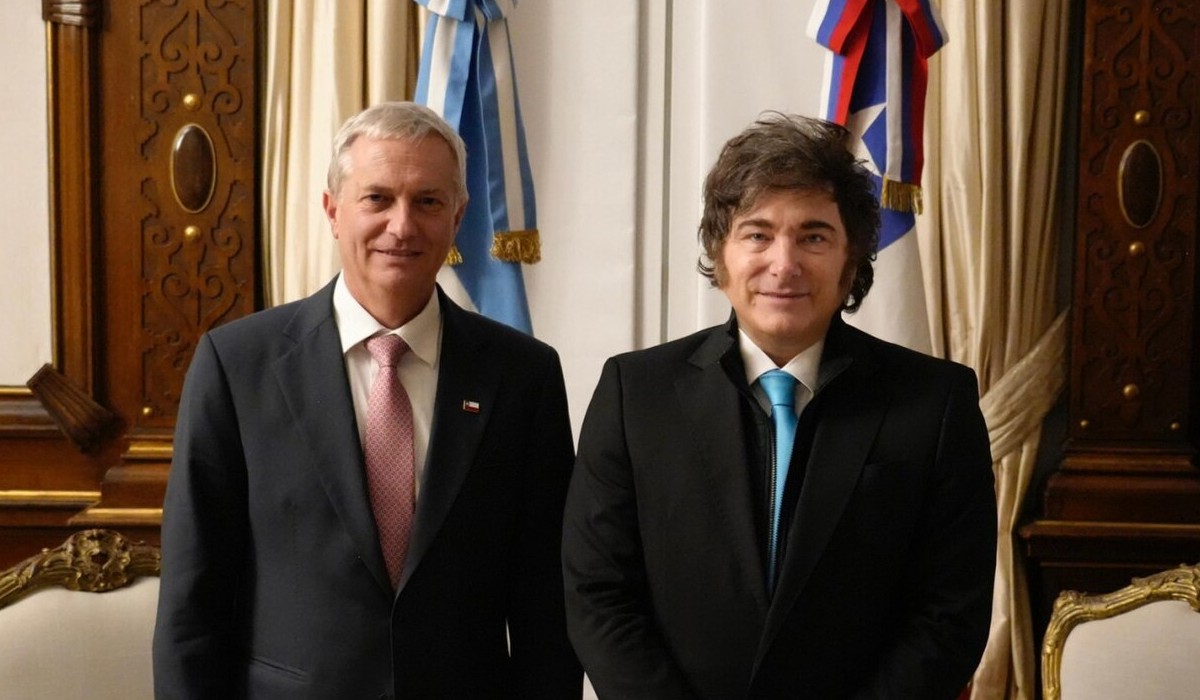
 José Antonio Kast with Javier Milei. Photo: Gobierno de la República Argentina / Wikimedia Commons / CC BY 4.0
Jose Antonio Kast’s victory follows the weakness and failures of the preceding social-democratic president, in a recuring regional and international pattern, explains John Clarke
After winning a run-off election on 14 December, far-right candidate Jose Antonio Kast is now the 38th president of Chile. As Al Jazeera explains, Kast took 58% of the vote, and defeated ‘former labour minister, Jeannette Jara, a Communist Party politician who represented the governing centre-left coalition.’
Kast leads the Republican Party and this is his third attempt to win the presidency. On the last occasion, in 2021, he was defeated by ten points by leftist Gabriel Boric but times have clearly changed. In this campaign, Kast raised standard right-wing issues of crime and immigration and presented himself as an agent of change.
The kind of ‘change’ that will now be inflicted on Chile is not hard to discern. Kast is an authentic representative of the most reactionary, oligarchic and authoritarian forces within the country. He is the son a former German Nazi Party member who emigrated to Chile in 1950 and he generated outrage during the campaign with his ‘sympathetic comments about Chile’s former dictator, military leader Augusto Pinochet.’ He went so far as to proudly assert that, ‘If he [Pinochet] were alive, he would vote for me.’
Rightward shift
Al Jazeera notes that that this ‘is the first time since 1990 — since the military dictatorship before 1990, when Chile returned to democracy — that such a conservative government will be in power.’ Moreover, the ‘result marks the latest victory for the far right in Latin America, which has seen a streak of right-wing leaders once considered political outsiders rise to power in countries like Argentina and Ecuador.’
There is no denying this rightward electoral shift in Latin America. In May, Americas Quarterly commented that: ‘In early 2023 six of the region’s seven most populous countries had, at least nominally, left-of-center governments. But only months later the right turn was evident. Not only did Javier Milei, a hard-right libertarian, surprise many analysts by being elected as Argentina’s president in November 2023, having defeated center-right candidates in primaries. In municipal elections in Brazil and Chile last year, the center-right emerged as clear winners.’
In the Chilean election, though the left candidate was unable to mount an effective challenge to the right, the cause is to be found in the shortcomings of the presidency of Gabriel Boric, who was unable to run this time due to constitutional stipulations.
Though rooted in the particular conditions of Chile, Boric’s political decline is symptomatic of a dilemma faced by left electoral forces internationally. The difficulties involved in advancing a progressive political agenda in this harsh and volatile period are considerable and the pressure to take the path of accommodation and retreat is very powerful.
Already by March of 2024, the Committee for the Abolition of Illegitimate Debt noted ominously that ‘elected with the hope of reorienting his country on the path of progressivism, Chile’s young president Gabriel Boric (38) seems rather to have refocused his politics, unable to compete with the conservative bloc or to unite the left around his government. At mid-term, Boric has not yet been able to carry out the expected far-reaching reforms.’
Though Boric ‘came to power embodying the hope of a post-neoliberal turn’ and with the support of energised social movements, he faced an entrenched power structure that still controlled the Congress. In this context, his ‘lack of capacity to mobilize social bases and social movements,’ combined with an intensifying tendency to compromise with the right-wing forces, weakened his presidency. Very predictably, the right simply saw his conciliatory gestures as a sign of weakness and were emboldened to press forward with their attacks.
Boric staked a great deal on getting voters to endorse a progressive reform of the country’s constitution but, with his base weakened and the right aggressively undermining him, this measure was rejected. It was an enormous defeat that he was unable to overcome.
Elciudadano.com provides an even harsher assessment of the Boric presidency, arguing that ‘Boric’s government (2022-2026) has become, in the eyes of critics, a catalog of concessions that politically disarmed his coalition and empowered the opposition. Voices from within his camp claim he betrayed the demands of the social uprising by ratifying the Trans-Pacific Partnership (TPP) … reaching agreements with the Pinochet family (Ponce Lerou) for lithium exploitation with SQM, and maintaining military presence in La Araucanía under a continuous State of Exception.’
US imperialism
The rightward electoral shift that is underway in Latin America is very much to the liking of the Trump administration, which is doing all it can to further this trend. The recently published US National Security Strategy makes clear that an intensified domination of Latin America is a priority for Trump and his cohorts. The document argues for the need to ‘focus on enlisting regional champions that can help create tolerable stability in the region, even beyond those partners’ borders’ (p.16).
It is not hard to suppose that the new Chilean president will be embraced as one such ‘regional champion’. The same can be said of the right-wing Venezuelan opposition leader Maria Corina Macado, who is presently cheering on Trump’s lawless efforts to destabilise the Maduro government and achieve regime change in that country.
In a related development, Plensa Latina reports that, on 15 December, ‘Honduran Vice Foreign Minister Gerardo Torres denounced before the Organization of American States (OAS) the open interference of US President Donald Trump in the general elections of November 30.’ The vote was so close that a lengthy and contentious recount is still underway. However, Trump’s efforts to influence the outcome are clear enough.
Honduran officials note that ‘in his social media posts—72 hours before the start of the election—the US president explicitly supported the presidential candidate of the right-wing National Party, Nasry Asfura.’ Furthermore, Trump warned that, in the event of an outcome of which he disapproved, ‘the U.S. administration would cut off all aid to Honduras.’
The weakening of left-wing electoral forces and the upsurge of the right in Latin America, which unfolds even as US imperialism seeks to strengthen its grip on the region, is an enormously dangerous and harmful development. However, it is also part of a much more widespread international failure of liberal and social-democratic parties to pose an effective alternative to the advance of the right.
Keir Starmer’s government in the UK is one glaring example of this phenomenon, as it seeks to contain Reform by adopting its racist and authoritarian political agenda without restraint. In Canada, the Liberal government of Mark Carney is responding to the trade crisis created by Trump’s tariff threats by adopting measures of austerity that go much further than any Conservative government has ever gone.
Even where left electoral forces have emerged, as in the case of Boric’s presidency in Chile, that have connections to social movements and that offer measures to advance working-class interests, the tendency to compromise or openly retreat is pervasive and the record of such attempts is disconcerting.
A hard-right president now holds power in Chile and the failure of his predecessor to deliver meaningful change helped to create the pessimism and demoralisation that made this possible. The incoming Jose Antonio Kast, moreover, will assuredly function as one of the Trump administration’s ‘regional champions’. He will also doubtless seek to impose harsh measures on the working class in order to serve the interests of the country’s dominant oligarchy and the needs of US imperialism.
The Chilean working class endured the long years of Pinochet’s dictatorship and it has struggled in the face of ‘democratic’ neoliberalism ever since. The new president will undoubtedly face working-class resistance and popular struggle. As this movement seeks an electoral expression, the cruel lesson of Gabriel Boric’s retreats and betrayals will be before it.
Before you go
The ongoing genocide in Gaza, Starmer’s austerity and the danger of a resurgent far right demonstrate the urgent need for socialist organisation and ideas. Counterfire has been central to the Palestine revolt and we are committed to building mass, united movements of resistance. Become a member today and join the fightback.

John Clarke
John Clarke became an organiser with the Ontario Coalition Against Poverty when it was formed in 1990 and has been involved in mobilising poor communities under attack ever since.