
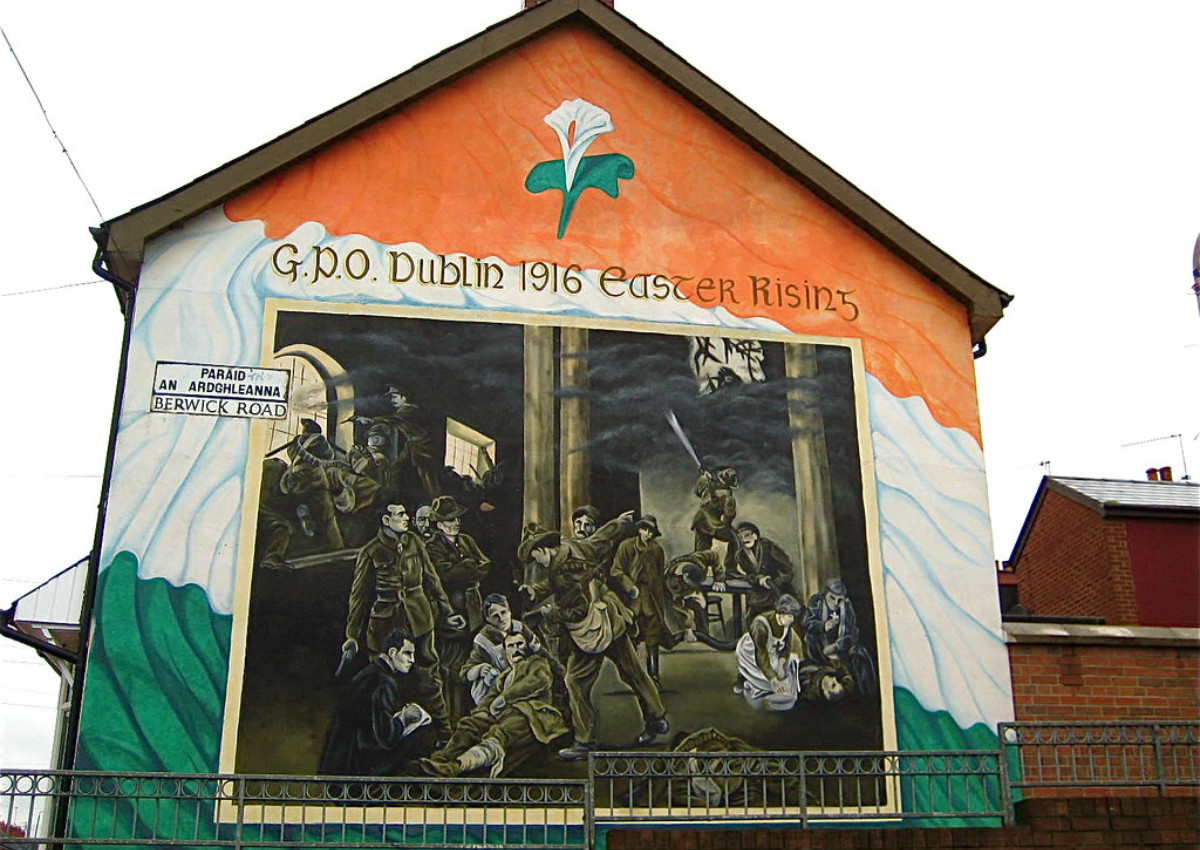
 Easter Rising Mural. Ardoyne, Belfast. Photo: jodimarr / CC BY-NC 2.0
One hundred and ten years ago, in the midst of a world war, Irish freedom fighters launched an insurrection to throw off the yoke of British imperialism, writes Pete Webster
On the 24 April 1916, Patrick Pearse, commander of the Irish Volunteers, stood on the steps of the GPO in Dublin and read out a proclamation of Irish independence from British rule. Hours before the GPO had been seized by a combined action between the Irish Republican Brotherhood’s Volunteers and the Irish Citizens Army founded by the revolutionary socialist James Connolly – more on him later.
The Easter Rising is often commemorated and seen as a significant historical date, a bit like 1066 and all that and, of course, it is. However the armed uprising did not materialise out of nowhere but stood at the head of centuries of struggle against British domination over the island.
It’s worth remembering that this call for liberation from Britain, with coordinated uprisings planned in other key areas – Cork, Meath, Galway and Wexford for example – came at a time when the whole of Ireland was under the rule of British and Irish wealthy landowners and industrialists. This was also in the middle of an imperialist world war that expected its dominion countries, like Ireland, to provide the cannon fodder to defend the Empire.
The centuries of English, and then British, involvement in Ireland is littered with numerous uprisings, rebellions and resistance that were defeated and brutal conditions imposed on those deemed to be involved – ie Irish and poor. There is a lot, quite rightly, to be embittered about. From Cromwell’s massacres at Drogheda and Wexford in the 1600’s to the United Irishmen of the late 18th century to the callousness of the potato famine in the 1840’s resulting in a population reduction from five million to less than three due to starvation and emigration to Britains colonies. Despite there being no shortage of food as exports of beef and wheat to England continued to line the coffers of the rich. A genocide in many people’s view. There are many more but insufficient space to list them all.
In the late nineteenth century Ireland continued to be the breadbasket for the mainland but it also saw rapid industrialisation and the formation of a much larger – and better organised – working class.
Socialists like Jim Larkin, the leader of the Irish Transport and General Workers Union, and James Connolly, recognised that it was workers who had the potential to take the struggle for national liberation’s forward but now on the basis of a direct struggle for a united socialist Ireland under workers control.
There was a rapid expansion of trade union membership and this resulted in an increase in the number of organised workplaces and an increasing level of industrial action. In that respect it mirrored developments in England and across Europe and America.
The capitalist class went on the offensive and instigated a number of lockouts in a bitter struggle to drive down wages and break the unions. The most notorious being the Dublin lockout of 1913 that reduced working conditions but, crucially, significant numbers of workers maintained their workplace organisations. Again, heightened levels of strikes were a feature of many of the more economically advanced countries in the years immediately before the outbreak of World War I.
War
It was assumed that in the event of the immediate threat of war between European states that the established social democratic parties organised in the Second International would not support a war that would pitch worker against worker. Tragically, the German SPD, seen as the most militant and politically conscious working class organisation, voted to support the war and opened the flood gates for others to follow suit in a nauseating display of political cowardice.
This was accompanied by a wave of patriotic jingoism that saw millions across Europe enlist to defend ‘their’ country. This was extended to the various colonial dominions ruled over by the imperialists and subject people were expected to rally to the defence of their respective masters. Ireland was no exception with 20,000 enlisting in the early days although predominantly from the Protestant heartlands of Ulster.
Only Lenin’s Bolsheviks in Russia and a handful of individual socialists had the courage to oppose the forthcoming carnage. Amongst them was Connolly who declared at the outbreak ‘We have no foreign enemy except for the Government of England…We serve neither King nor Kaiser, but Ireland’.
Anti-conscription
As the war continued and the initial enthusiasm waned conscription measures were brought in and Connolly and his Irish Socialist Party threw themselves into an anti-conscription campaign explaining that the only beneficiaries would be the the capitalist class. This did have an impact with fewer people enlisting and it proved difficult for the authorities to carry out forced conscription due to its unpopularity.
Connolly recognised that the general political situation was coming to a crisis point and that the conditions for an insurrection were maturing. He also understood that it would not just be a fight for national independence and that the working class should fight for a united socialist Ireland that nationalised industry under workers control and expropriated the estates of landowners.
The Irish Citizens Army was created out of the need to defend picket lines and strikers during the lockout and it started military training in 1914. It was the first armed workers’ militia in Europe to be formed. It was relatively small but we’ll organised with about 200 active members, mainly in Dublin but elsewhere too.
This was, however, much smaller than the Irish Volunteers – the armed wing of the Irish Republican Brotherhood – that amounted to around 13000 men. The IRB was a broad cross class organisation that had strong nationalist leanings and sought to see an independent, but bourgeois, Ireland. In discussions with its leading members he was to learn that the IRB were planning an uprising at Easter and Connolly agreed to participate alongside and with the ICA. He was well aware of the different aims of the IRB but if there was to be an armed struggle then the ICA would join although he was astute enough to advise the ICA volunteers that, as they were “out for economic as well as political liberty”, in the event of victory they should “hold on to” their rifles. He also said ‘We believe in constitutional action in normal times; we believe in revolutionary action in exceptional times. These are exceptional times.’
Defeat
The insurrection was to last just six days before Pearce and the remaining combatants were forced to agree an unconditional surrender. After the seizure of the GPO the British brought in thousands of troops with machine guns, artillery and even a gunboat on the Liffey. The GPO and surrounding streets were gradually reduced to rubble under the bombardment. When the other uprisings in key towns failed to materialise due to lack of arms (an expected ship of munitions from Germany had been intercepted by the Royal Navy) and poor lines of communication, the Dublin insurgents remained isolated. Some 2000 Volunteers, Citizens Army members and civilians lost their lives in the battle with many more injured.
Following the surrender martial law was imposed and in the reaction that followed some 3500 were detained with nearly 2000 receiving a custodial sentence and sent to prisons in Britain. The leaders captured at the GPO were court marshalled with 16 receiving the death penalty, including Connolly. He had been injured in the fighting and was unable to walk due to his wounds turning gangrenous. One of the last to be executed he was taken on a stretcher to the prison courtyard, tied to a chair and shot to death by a British firing squad.
Despite the repression the British failed to break the resistance of the Irish and in 1919 the War of Independence broke out that saw the island partitioned two years later as a compromise settlement with the nine traditional countries of Ulster being reduced to six under British rule to ensure a Protestant and loyalist enclave. So long as partition remains there will always be a struggle for a united Ireland by those that see Britain is part of the problem not the solution.
Lessons
There are several here to consider.
The collapse of the Second International underlines the urgent need to build an international movement against war and austerity and that can challenge the new world disorder. There is an opportunity to be part of building resistance by participating in the International Anti-War Conference here in London on 20 June.
The betrayal also forced revolutionary socialists to consider how best to organise given the failure of the leaders of the working class parties in 1914. Connolly, with his Citizens Army, understood the need for an armed insurrection. He called for the British empires defeat recognising it as the main enemy. Crucially he was unable to create an organisation that was capable of overcoming the barriers to a socialist revolution and the answer to that conundrum was provided by Lenin’s Bolsheviks in Russia just a few months later in 1917.
The development and expansion of working class organisation and militancy in the years before the outbreak of war, the experience of the 1913 lockout and the anti-conscription campaigns during it were crucial in developing politically conscious opposition to the British.
As then, as now, there is a urgent need to organise against the horrors of a rotten system that is wreaking havoc around the globe and adding to the environmental degradation in its senseless wars and drive to maintain profits for the super rich.
Join us if you can.
Before you go
The ongoing genocide in Gaza, Starmer’s austerity and the danger of a resurgent far right demonstrate the urgent need for socialist organisation and ideas. Counterfire has been central to the Palestine revolt and we are committed to building mass, united movements of resistance. Become a member today and join the fightback.
