
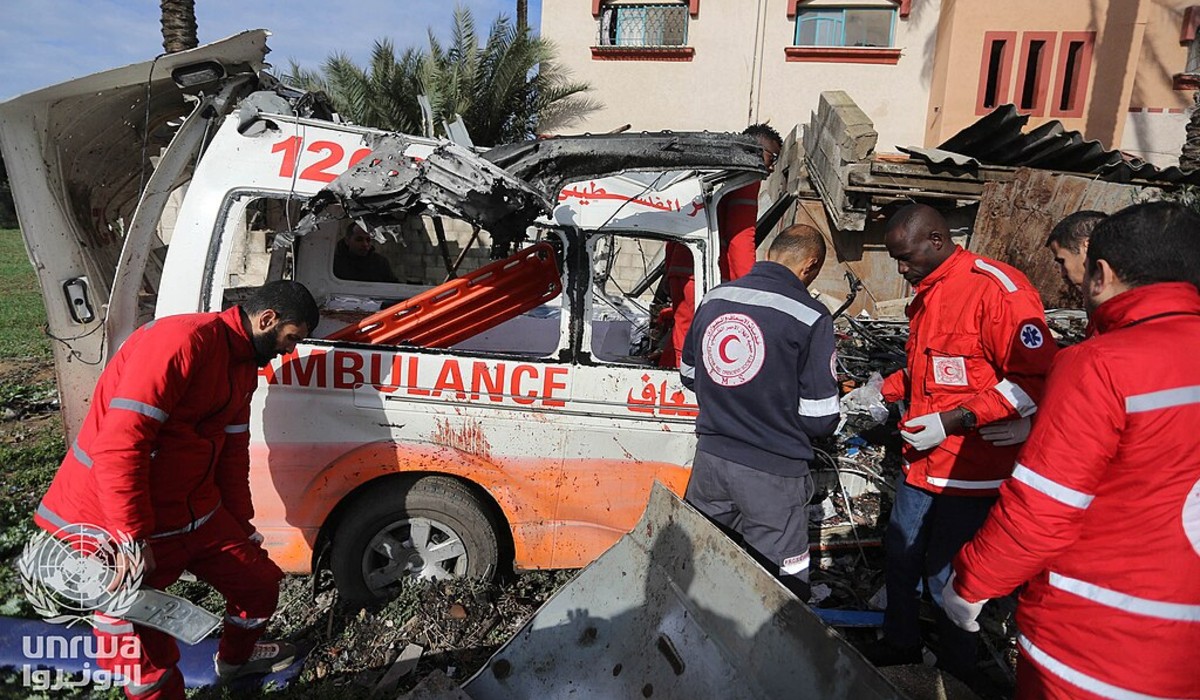
 Red Crescent workers inspect bombed ambulance, January 2024. Photo: UNRWA / CC BY-SA 3.0
Michael Lavalette spoke to a doctor (Doctor X) who has recently returned from Gaza about some of the issues facing Gazans and medical support teams in the beleaguered Gaza Strip
Dr X is a neurosurgeon who has deployed to Gaza on several occasions since 2018. His most recent secondment occurred just as the latest ‘ceasefire’ was announced. Here, he remains anonymous so he can re-enter emergency zones in the future.
What was Gaza like before October 2023?
Even before the current genocide started, conditions in Gaza were not easy. The Israelis put lots of conditions on doctors entering Gaza. We were restricted in what we could and couldn’t take in. We were escorted in and out and, once in our accommodation, we were only allowed to go back and forth between our accommodation and the hospital.
We worked with the hospitals and supported them to carry out operations on those who were the victims of Israel’s regular attacks and incursions. So it was difficult, but, in a sense, manageable.
Though things were difficult, Gaza was a functioning place. I was in Khan Yunis and it was beautiful. The buildings and architecture, the setting, the beach. When Trump says he wants to turn Gaza into a luxurious resort, you can see why he might think that: it’s so beautiful, with so much potential. But, of course, Gaza isn’t an empty piece of real estate! It’s home to over two million people.
Once the genocide began, things changed dramatically and our work increased exponentially.
I’m sure it is difficult to discuss all aspects of the medical disaster in Gaza, but could you give us details of some aspects of the ‘medicide’?
The first thing to say is that the complete destruction of Gazan society creates the conditions for ill health to spread and for recovery to be much more difficult.
For example, the bombing, as we all know, has destroyed homes, so people live in overcrowded conditions, in tents, destroyed buildings or they sleep outside. Fresh drinking water is difficult to get. Soap and shampoo are luxuries, so keeping clean is immensely difficult. Sewage systems are destroyed. Functioning toilets are a significant walk away from where people and families are located.
As the siege conditions tightened, hunger grew to become the norm, then it progressed to starvation. Food inflation rocketed so, for example, a kilo of flour, an egg, or a small piece of chicken would cost hundreds of dollars. It’s hard to describe in words the huge barriers people face just trying to get the basics of life in place every day.
Against this backdrop, we had to undertake medical intervention to deal with the most horrendous level of injury that people have suffered. Let me give you some examples of the issues we face:
- As people will know, the Israelis have attacked, bombed and destroyed hospitals and medical facilities across Gaza. Leaving aside the breaches of international law, this has direct consequences in so far as (a) medical staff are targeted, injured and killed, (b) medical machinery and equipment are destroyed, either in the initial attacks or when they occupy the hospitals and just fire into machinery to make it unworkable, (c) patients have to be moved under the most difficult of circumstances, often without enough ambulances, and (d) all this has a huge impact on the remaining hospitals who are immediately overcrowded and working way beyond capacity.
- The siege has meant that ‘use once’ equipment (for example drill bits) are having to be used and reused because we cannot get supplies in. I’m a neurosurgeon, I have had to use hand drills because electric drills don’t work, and often the bits are so blunt, it takes a very long time to get through the skull to allow me to start working. But we have also run of out medicines and anaesthetic; I have found myself operating on people, to save their lives, but without anaesthetic. All I can do is apologise as they’re screaming in agony and try to get the work done as soon as I possibly can.
- At the food dispersal zones, we soon realised that the Israelis were ‘playing games’. One day people would come in with knee wounds, the next it would be head wounds, the next chest wounds, the following day ankle wounds. We realised this could only be a pattern, the soldiers were ‘playing target practice’ with civilians and children.
- I deal with a lot of head wounds. As you will know, wounds swell, so you are confronted by brain matter seeping out of bullet wounds, the matter is degrading and gives off an odour. But one thing I’d never experienced before was that this mingled with the smell of hair that hasn’t been properly washed for months. I didn’t expect this, nor have I ever experienced it, the smell was something beyond description.
- Another thing I hadn’t seen before was that, under conditions of starvation, old wounds started to degrade. So operations that people had had years ago started to re-open, allowing infection to take hold.
- The wounds that people receive are so bad and so debilitating that most Palestinians speak openly about wishing to be hit by a bomb directly, rather than be hit by the shrapnel and its effects.
This is just a small selection of the issues we have faced. But I want to add something else. What is remarkable is the sense of togetherness, of ‘samoud’ (steadfastness), of looking after each other that I witness every time I go to Gaza and which remained central to life in the Gaza Strip during the genocide.
From this month’s Counterfire freesheet
Before you go
The ongoing genocide in Gaza, Starmer’s austerity and the danger of a resurgent far right demonstrate the urgent need for socialist organisation and ideas. Counterfire has been central to the Palestine revolt and we are committed to building mass, united movements of resistance. Become a member today and join the fightback.
