
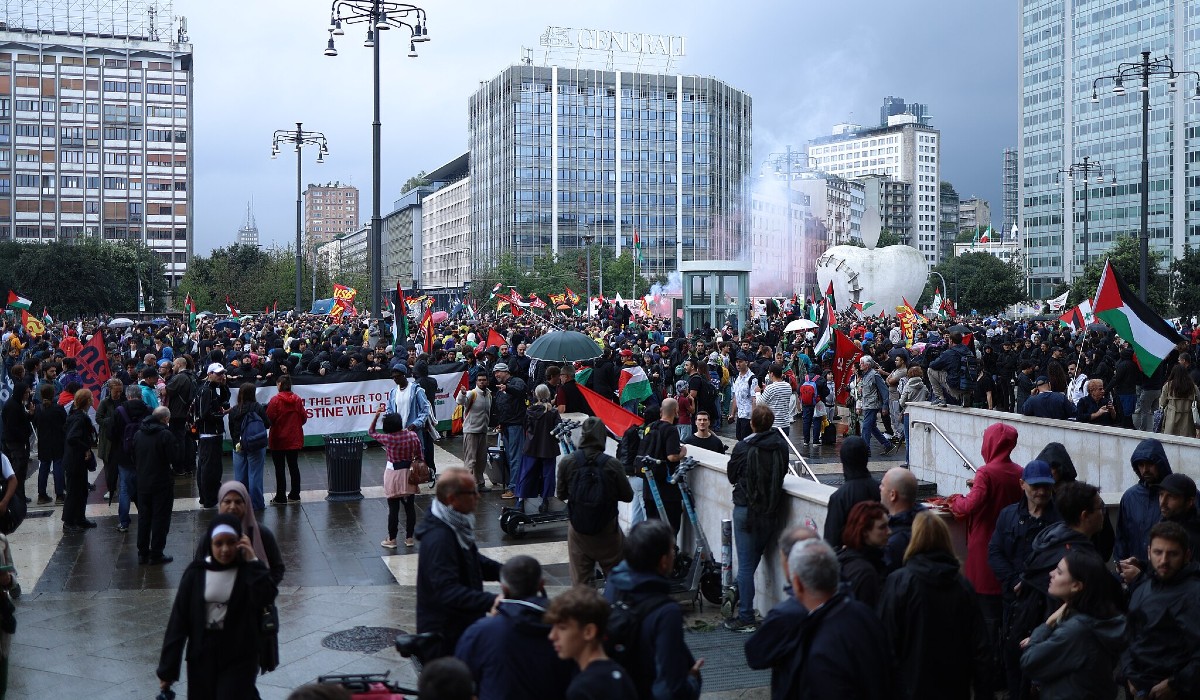
 Piazza Duca d’Aosta, in front of Milan’s central station, crowded with people at the end of the protest / Wikimedia Commons / CC BY-SA 4.0
John Rees on what the Gaza deal means, and what it doesn’t mean
The true dynamic behind the Gaza ceasefire was inadvertently revealed by US President Donald Trump when he told ‘Bibi’, the diminutive by which he routinely refers to Israeli prime minister Benjamin Netanyahu, that ‘Israel cannot fight the world, Bibi. They can’t fight the world’.
And the world that halted Israel’s ethnic cleaning was not the world of Donald Trump and the leaders of the most powerful states in the world. For most of the two years of havoc that Isarel wreaked on Gaza, they stood by at best, although, in most cases, they did their worst by actively arming and sustaining Israel.
Latterly, they made some noises about recognising a Palestinian state, however hedged with conditions. However, long before the representatives of the world’s states walked out on Netanyahu at the general assembly of the United Nations, it was the masses of ordinary people on the streets that made Israel into a leper state.
Israel began its war on Gaza with world public opinion in its favour, but its own actions and the relentless mobilisations on the streets turned the tide of opinion against the Zionist project. Across Europe, support for Palestine has grown and support for Israel has plummeted. That was the result of mass mobilisation on the streets, of the flotilla, of the boycotts, and of the general strikes in Europe.
It is still far from clear how long the ceasefire, for that is all it is at the moment, will last. Naturally any relief from the bombing and starvation will see Palestinians celebrating in the streets, and their joy is all too understandable. However, beyond hostage releases, exchanges of prisoners, pauses in the fighting, and the withdrawal of the IDF by a few kilometres, it’s not obvious that a more stable peace with emerge
Ahmed Fouad Alkhatib, director of Realign for Palestine at the Atlantic Council, talked with Reuters about future problems:
‘Hamas is not only counting on guarantees from President Trump to pressure Israel and Netanyahu not to restart the war, but they’re also imagining and speculating, based on what I’ve gathered that with the hostages being out, it’s going to be very difficult for Israel to restart the war, that it won’t have any legitimacy to re-engage in military operations in the strip, and that without this cover, without this sense of legitimacy, it would be untenable for Netanyahu and for the Israeli government to reengage re begin the war.’
He continued,
‘And that this would put it at odds with the international community, but also with President Trump as well. And so that is something that Hamas is counting on to prevent the restarting of the war after giving up all of its chief negotiating leverage.’
More generally the proposed ‘peace’ plan, however, has received significant criticism for being unserious, vague, and steeped in anti-Palestinian bias while offering no viable pathway to lasting peace or justice.
Under the terms of Trump’s plan, he would chair a so-called ‘Board of Peace’: a transitional governing body tasked with administering the enclave. Joining him on this board would be Tony Blair, an appointment many Palestinians will see as the return of a representative of their old colonial overlord in the particularly offensive form of the figure who presided over the destruction of Iraq.
Given that there is no reason to think that Israel might not restart military operations at any time, the security of Palestinians is bound up with the calls for Hamas to disarm. Hamas will obviously be reluctant to do so, and not only because of the fundamental issue of Palestinian security, but also because it is not the only armed group in Gaza.
If Hamas disarms, it might relinquish its leadership of armed resistance to Palestinian Islamic Jihad. Islamic Jihad fighters might become ‘the biggest beneficiaries in the Palestinian body politic from the perspective of those Palestinians who believe in armed resistance’, as one commentator put it.
Hamas will know that it was itself the product of the PLO’s surrender to the imperial powers last plan for peace, the Oslo accords. It will not want to become the victim of the same dynamic, ceding its authority to Islamic Jihad.
Palestinians will rightly celebrate today, but tomorrow is uncertain, and the struggle for liberation must continue.
Before you go
The ongoing genocide in Gaza, Starmer’s austerity and the danger of a resurgent far right demonstrate the urgent need for socialist organisation and ideas. Counterfire has been central to the Palestine revolt and we are committed to building mass, united movements of resistance. Become a member today and join the fightback.

John Rees
John Rees is a writer, broadcaster and activist, and is one of the organisers of the People’s Assembly. His books include ‘The Algebra of Revolution’, ‘Imperialism and Resistance’, ‘Timelines, A Political History of the Modern World’, ‘The People Demand, A Short History of the Arab Revolutions’ (with Joseph Daher), ‘A People’s History of London’ (with Lindsey German) and The Leveller Revolution. He is co-founder of the Stop the War Coalition.