
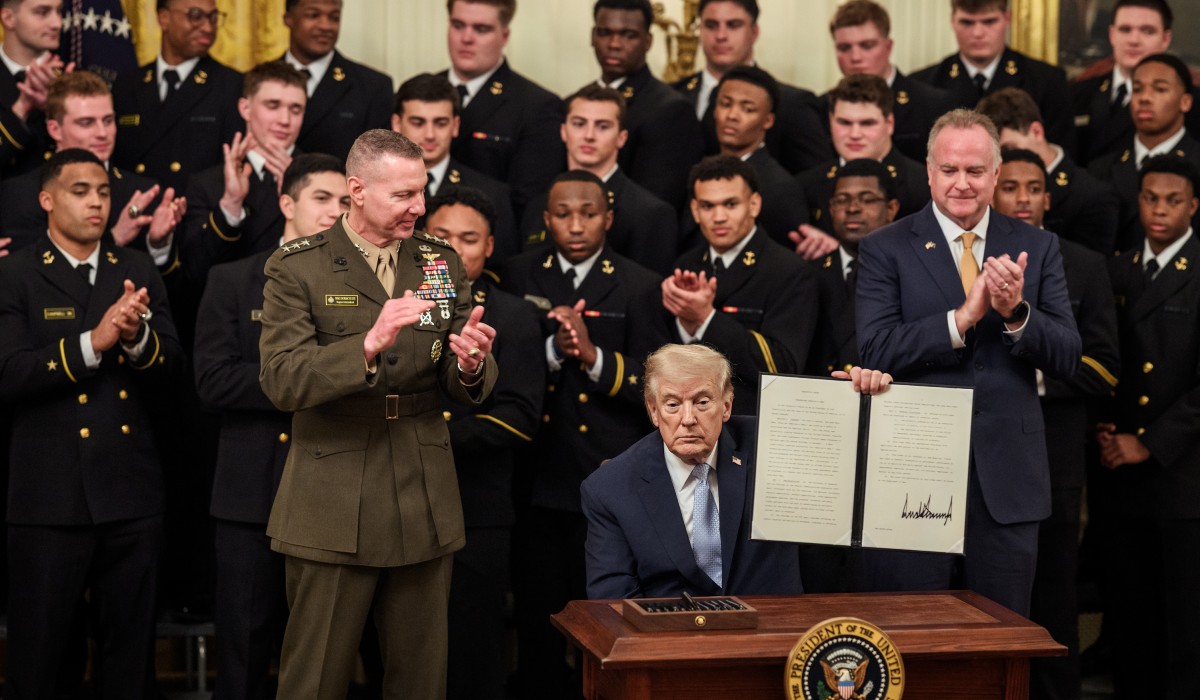
 President Donald J. Trump signs an Executive Order during a Commander in Chief Trophy presentation for the U.S. Naval Academy / Wikimedia Commons / Public Domain
Chris Bambery examines the likelihood of the Iran war ending
Trump Always Chickens Out. Has the Iran war reached TACO time?
At the weekend Trump was telling Iran they had forty-eight hours to open the Straits of Hormuz or he would obliterate their power plants. Now, after Iran threatened massive retaliation against the Gulf States, the US president has extended his ultimatum to five days! Not only that, he now says not only that he is talking to Tehran, but a deal is in the air.
Tehran denies it is talking to the US, with Mohammad Bagher Ghalibaf, the Speaker of Iran’s parliament calling it ‘fake news’. However, Tehran also said that ‘certain friendly states’ had been conveying messages from the US regarding negotiations.
We know that on Saturday evening Trump spoke on the phone to Pakistan’s Chief of Army Staff, Asim Munir. And, following that call Pakistan’s prime minister, Muhammad Shehbaz Sharif, spoke to the Iranian president, Masoud Pezeshkian, on Monday. According to an official readout of the call, they ‘agreed on the urgent need for de-escalation, dialogue and diplomacy’.
Diplomatic sources have said that talks could take place later this week in Islamabad.
Pakistan, Oman, Türkiye and Egypt have all been trying to broker talks. Pakistan itself has been hit hard by the increase in the oil price and the shortage of liquid natural gas. Pakistan has a defence pact with Saudi Arabia and the Gulf States but has also maintained relations with neighbouring Iran.
A statement by Pakistan’s foreign ministry said, ‘If the parties desire, Islamabad is always willing to host talks. We have consistently advocated for dialogue and diplomacy to promote peace and stability in the region’.
The Iranians seem to have ruled out any negotiations involving Steve Witkoff or Trump’s son-in-law, Jared Kushner. Twice the pair have led the US side in negotiations with Iran over its nuclear programme and twice, just as these were due to resume, America attacked Iran.
The suggestion is that US Vice President JD Vance would lead the US negotiating team. He is seen as sceptical about the US war on Iran and potentially more realistic about what the end of the war would look like. The name being touted as his opposite number is Mohammad Bagher Ghalibaf.
Some Western reports are suggesting Ghalibaf could play the role of Delcy Rodríguez who took over as Venezuelan President when the US abducted Nicolás Maduro. She has since bowed to Trump’s demands to let American oil multinationals into the country’s energy industry.
But Ghalibaf was elected by Iran’s Council of Experts and is seen as being close to the country’s Revolutionary Guards. Any decision on negotiations will have to be agreed by the Supreme Leader, Mojtaba Khamenei.
Meanwhile a former Revolutionary Guards commander, Mohammad Bagher Zolghadr, is now the new secretary of the Supreme National Security Council, in place of Ali Larijani who was assassinated by Israel.
All of this does not suggest a regime which is about to fall on its sword.
Not only has Iran survived four weeks of war, it has carried the war to the Gulf States and has now stepped up its missile attacks on Israel, whose Iron Dome defence system is unable to stop strikes on targets like Ben Gurion airport and Tel Aviv.
Trump is coming under pressure from US allies to end the war. In particular, the Gulf States want the war to end, but other allies are affected badly too. The Philippines is a crucial US ally in the South China Sea, as the cold war between Washington and Beijing continues.
Manila has had to declare a state of national emergency over the US-Israeli war on Iran, citing the ‘imminent danger’ posed to the country’s energy supply.
The Philippines President Ferdinand Marcos Jr said a committee has been formed to ensure the orderly movement, supply, distribution and availability of fuel, food, medicines, agricultural products and other essential goods.
But the crucial consideration for Trump will be how the war is impacting domestically.
John Feehery in an opinion piece on Al Jazeeri notes:
‘Of course, the number one reason to end this war now is domestic politics. The American people do not want it, and they certainly do not want the higher petrol prices that have accompanied it…
‘Voters do not know how this is all going to play out. They already have plenty of other things that are making them worried about the future. Artificial intelligence is threatening their livelihoods. Data centres are sucking up water and electricity and increasing utility prices. Political conflict has led to staffing shortages at the Transportation Security Administration, making air travel more uncertain’.
If there is a deal between Washington and Tehran the latter would demand, at the very least, written guarantees that there would be no further attacks. The issue of Washington lifting sanctions would also feature. Iran has no problem agreeing to not building a nuclear bomb because it was forbidden by the previous Supreme Leader, Ali Khamenei.
How Israel will respond to any deal is a moot point. It must know that its plans to tear Iran apart are not on the agenda. But its biggest concern might well be its war in Lebanon. Despite claims to have crippled Hezbollah, they are fighting back and hitting northern Israel. And now Netanyahu wants to re-occupy southern Lebanon, up to the Litani River, which is bound to keep the war going
If, and its a big if, the US and Iran come to a deal it will be seen as a victory for the latter. It will also mean many other ifs, not least the future of the Gulf States. They have relied on US protection but that has not stopped Iranian attacks. That might well lead to a re-assessment of their security strategy.
Before you go
The ongoing genocide in Gaza, Starmer’s austerity and the danger of a resurgent far right demonstrate the urgent need for socialist organisation and ideas. Counterfire has been central to the Palestine revolt and we are committed to building mass, united movements of resistance. Become a member today and join the fightback.

Chris Bambery
Chris Bambery is an author, political activist and commentator, and a supporter of Rise, the radical left wing coalition in Scotland. His books include A People's History of Scotland and The Second World War: A Marxist Analysis.