
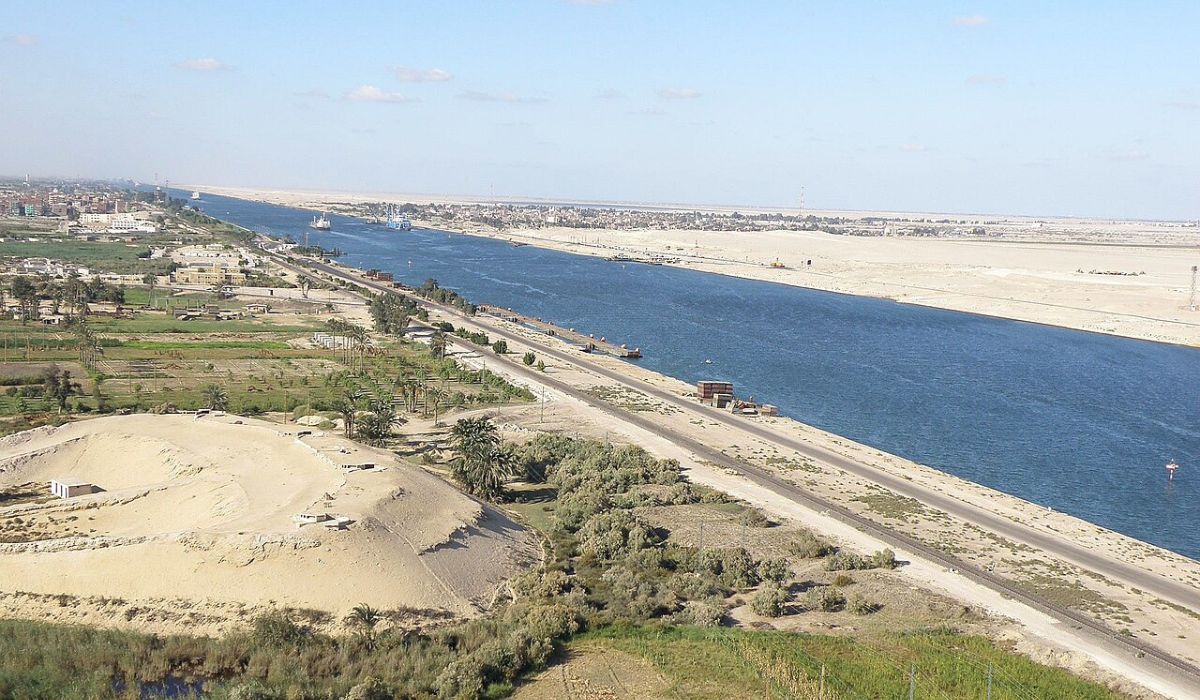
 Suez Canal, September 2009. Source: Mmelouk - Wikicommons / cropped from original / CC BY-SA 4.0
Michael Lavalette reviews a documentary on the Suez crisis, whose 70th anniversary is this year, which demonstrated Britain’s decline as a world power when its intervention ended in humiliating defeat
In November 1956, British and French troops landed in Egypt under the pretext of separating two warring nations (Egypt and Israel). The French and British governments announced themselves as a ‘peacekeeping’ force and they demanded that both sides ‘withdraw to 10 miles either side of the Suez Canal’.
But the ‘peacekeeping’ claim was a sham. In fact, the British, French and Israeli governments had planned the whole thing, from Israel’s invasion through to the British and French intervention. Within days, the world would know of the bizarre plan – and the US and Soviet Union governments would demand British and French withdrawal from Egypt. Israel too would have to return to its 1948 borders.
The Suez crisis was rooted in the decline of the British and French Empires. Both emerged from the Second World War significantly weaker economically. But both still had significant empires and were involved in a range of political and military campaigns against anticolonial movements.
Britain lost its imperial jewel in the crown when India gained independence in 1948. In Malaysia, the British fought a brutal counterinsurgency campaign between 1948 and 1957, which ended in independence. In Kenya, the British fought the Mau Mau from 1952. Although they suppressed the revolt in the most barbaric ways, they would lose Kenya in 1963.
In 1954, the French were kicked out of Vietnam after the Battle of Dien Bien Phu and were embroiled in the struggle in Algeria – 1957 was the year of the ‘Battle of Algiers’ that would mark the turning point against French colonial rule in the country.
As the empires shrank, both scrambled to ensure that trade and trade routes remained open to them, and for both countries the Suez Canal was a key waterway linking Britain and France to their, now independent, former colonies. But the problem for Britain and France was that, in Egypt, the new nationalist leader, Gamal Abdel Nasser, was asserting Egypt’s right to independence.
Nasser was determined to kick the British military presence out of Egypt, especially the Suez region. The French saw Nasser as a threat because they thought he was a beacon for independence movements across North Africa and the Middle East, particularly in Algeria.
Nasser was determined to ‘modernise’ Egypt. He introduced land reforms and embarked on a plan to build the Aswan Dam to control the Nile floods and to generate electricity that would bring electricity to poor Egyptian homes. The problem was that the cost of the dam project was enormous. In the context of the Cold War, Nasser approached both the Soviets and the Americans to help fund the project, playing one off against the other. The Americans agreed to fund the dam, but then, at the last moment, they pulled funding.
Nasser was now faced with a monumental problem: how could he fund his pet project? His answer was to nationalise the Suez Canal Company.
The Suez Canal was made up of two elements. The canal itself, the infrastructure and the costs of maintaining it were Egyptian. But the Suez Canal Company controlled all shipping entering and leaving the canal. The company controlled the navigation through the canal. And it took the vast profits the canal generated. The majority of shares in the Suez Canal Company were owned by British interests (with the French having a significant minority stake).
When Nasser nationalised the company (even though he compensated shareholders) the British and French got together with Israel to hatch their plan to remove Nasser and regain control of the Suez company. The British and French were declining powers, but they thought they could act like gangsters to rob the Egyptians and reassert their authority (sounds remarkably familiar in the era of Trump!).
Instead, the Suez crisis marked the death knell of the British and French imperial projects. They were humiliated, and it was made clear that they were now operating in a world of two superpowers – the US and the Soviet Union.
The Soviet Union was in the midst of suppressing the Hungarian Uprising, but nevertheless, Khrushchev sent a (not very subtle) letter to British Prime Minister Anthony Eden, pointing out that Soviet nuclear missiles could hit Paris and London and that illegal bombing of Egypt might lead the Soviets to respond. The Americans responded by effectively crashing the British economy – perhaps the most effective economic sanctions ever implemented!
Faced with the pressure from both superpowers, the British and French were forced out of Egypt with their tails between their legs.
The Suez Crisis is the focus of Channel 4’s two-part documentary Suez: 24 hours that broke the British Empire. It included input from some important historians who have written about the crisis (including Egyptian author Dr Dina Rezk and Alex Van Tunzelmann, who wrote the very good book about Suez, Blood and Sand).
The two episodes cover all the main turning points in the crucial days of the crisis: the rise of Nasser, the nationalisation of the Suez company, and the madcap intervention plan developed by the ‘Triple Aggression Force’ (as Nasser called them).
They include some archive film of the anti-war demonstration (at that point, the largest post-war demonstration in central London), when over 20,000 marched against intervention. It won’t be a surprise to readers to learn that the police in London responded aggressively; they drew batons and sent in the horses to disperse the peaceful marchers (plus ca change!)
By the end of the two episodes, a fairly comprehensive picture of the crisis and its consequences is presented.
However, there are one or two issues with the series.
The first is the way the episodes are cut. It starts with the day of the British and French invasion and works its way through the first few hours. We then jump forward and back along a timeline, with bits of the story ‘revealed’ as we go along. Almost as if it were a ‘whodunit’ with the big reveal saved for the ending.
This means that it is over half an hour in before we start to get any real context. Throughout the first episode, I found myself complaining about the partial storytelling! For most of the first episode, it gives the impression that Britain withdrew because of the Soviet threat (no mention of America at this point). More astonishingly, it’s only towards the end of the first episode that Israel’s role is mentioned.
The second episode rebalances things, and the role of the US and Israel comes into play, but the early presentation is significantly misleading!
Overall, the role of Israel and its actions is underplayed. The tripartite plan was for Israel to move quickly up to the Canal. The British and French would then give an ultimatum demanding both ‘warring parties withdraw to 10 miles either side of the canal’. But the Israelis got stuck in the Sinai – 120 miles from the canal. The ‘ultimatum’ actually meant Egypt retreating 130 miles and Israel advancing towards the canal!
One thing not covered was what the Israelis did in the rear. Their attack meant that Israel took Gaza and, I’m sure readers will be shocked to learn, they immediately started slaughtering Palestinians. Between 29 October and 12 November, the Israelis undertook three separate massacres in Gaza (in Kafr Qasim, on the first day of the invasion, on 3 November in Khan Yunis, where close to three hundred Palestinian men were slaughtered, and on 12 November in Rafah, where over 100 men were killed). None of this was talked about in either episode.
This is a useful historical documentary on one of the most significant episodes of recent British history. It emphasises that empires in decline often enter brutal, madcap adventures to try and shore up their diminishing status – and that these adventures often reveal how weak the empire is. Maybe some in the American establishment should watch and take note.
Before you go
The ongoing genocide in Gaza, Starmer’s austerity and the danger of a resurgent far right demonstrate the urgent need for socialist organisation and ideas. Counterfire has been central to the Palestine revolt and we are committed to building mass, united movements of resistance. Become a member today and join the fightback.
