
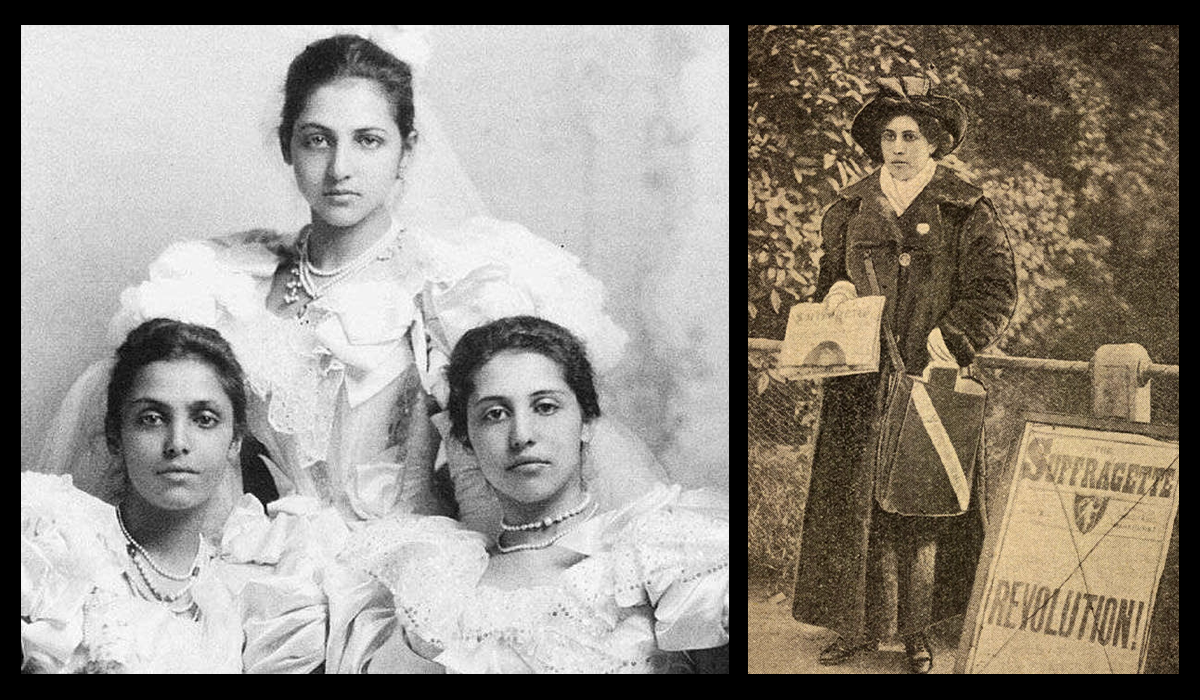
 (Left) Princesses Sophia, Bamba and Catherine, Buckingham Palace, 1895 | (Right) Sophia Duleep Singh selling The Suffragette outside Hampton Court Palace
Katherine Connelly reviews the new exhibition at Kensington Palace which give us a glimpse of the high-level, yet intimate, workings of empire
Most readers of Counterfire are probably not frequent attenders of Britain’s palaces and their exhibitions celebrating the extreme wealth and privilege of the royal family, with whom we are unfortunately still lumbered. This exhibition at Kensington Palace, however, attempts something different, revealing through personal stories how sex, class and resistance were shaped by Britain’s plunder of India: the ‘jewel’ in its imperial crown.
‘The Last Princesses of Punjab’ tells the story of Britain’s imperial relationship with India through the fraught interconnections between six regal women. First, we encounter the Maharani Jind Kaur, who fought the efforts of Britain’s East India Company to seize the Sikh Empire’s territory in Punjab after the death of her husband, Ranjit Singh.
Punjab was seized by Queen Victoria, later to proclaim herself ‘Empress of India’, along with the Koh-i-Noor diamond which, appallingly, remains in the British monarchy’s possession. Along with Kaur’s jewellery, some of which is displayed in the exhibit, the British also took her son, the Maharaja Duleep Singh, who was patronised as a sort of exotic court pet by Queen Victoria. The scars from this strange predicament later revealed themselves as he spiralled into self-destruction and attempted to regain his kingdom. His unhappy marriage to Bamba Müller, the daughter of a German father and Ethiopian mother brought up in Cairo, and the third woman in this story, resulted in six children. Their three daughters, Bamba, Catherine and Sophia – the last princesses of Punjab – were all aristocrats and rebels.
Bamba and Catherine pursued higher education, at a time when this was extremely unusual for women. Catherine further defied political and social expectations by joining the suffragists and living with her female partner Lina Schäfer. Resident in Germany until Schäfer’s death, Catherine helped Jews to flee the Nazis, and there is moving testimony from their descendants in the exhibit.
Meanwhile, Sophia, goddaughter of Queen Victoria, joined the militant suffragettes and though she was never imprisoned, almost certainly because of her social status, the exhibit contains an array of artefacts from her part in the struggle, including the protest she wrote on her Census form and the photograph of her selling the Suffragette newspaper with the headline ‘Revolution’ outside her home in Hampton Court Palace!
The exhibition states that the Singh sisters were not anti-imperialists and during World War One, in which over a million Indians fought, Sophia worked as a nurse for Indian troops. Yet, when the sisters visited India in 1903, they were appalled by the poverty they witnessed under colonial rule, and they mixed with nationalist figureheads. Certainly Bamba’s claim to be the ‘Queen of Punjab’ sat uneasily with Britain’s claim upon the territory.
The exhibition addresses some of these contradictions, noting that the sisters were dispossessed by the same empire that sustained their aristocratic lifestyles. We are therefore able to glimpse the high-level, yet intimate, workings of empire: its use of violence, theft and bribery, and ultimately its inability to ever completely suppress resistance.
The exhibition is on at Kensington Palace until 8 November 2026
From this month’s Counterfire freesheet
Before you go
The ongoing genocide in Gaza, Starmer’s austerity and the danger of a resurgent far right demonstrate the urgent need for socialist organisation and ideas. Counterfire has been central to the Palestine revolt and we are committed to building mass, united movements of resistance. Become a member today and join the fightback.

Katherine Connelly
Kate Connelly is a writer and historian. She led school student strikes in the British anti-war movement in 2003, co-ordinated the Emily Wilding Davison Memorial Campaign in 2013 and is a leading member of Counterfire. She wrote the acclaimed biography, 'Sylvia Pankhurst: Suffragette, Socialist and Scourge of Empire' and recently edited and introduced 'A Suffragette in America: Reflections on Prisoners, Pickets and Political Change'.