
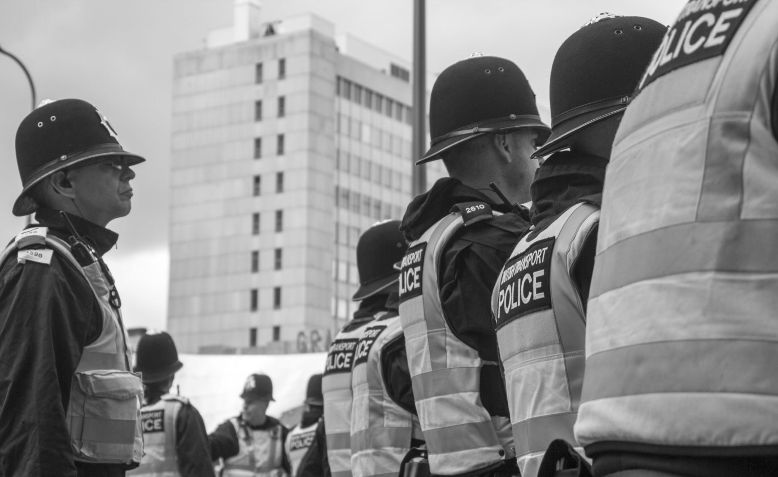
 Metropolitan Police. Photo: Pixabay / Public Domain
Counterfire in Bristol held a meeting about the Spycops Inquiry at which the whole scandal was outlined and it was affirmed how our activism can defend us, explains Jon Harding
The recent TV show, Love and Lies Exposed has brought the Spycops story into millions of homes, but what have we learnt, and what is the situation now? To explore these questions, a recent meeting in Bristol provided both context and a sense of direction.
The Bristol Counterfire meeting held on Tuesday 9 September, at which these events and ideas were discussed, is an example of the way forward. The three panellists, Tom Fowler, Eleanor Fairbraida and Lindsey German were excellent, and are to be applauded. This article is based on the discussions at the Counterfire Bristol meeting.
The discussion began with Tom Fowler revisiting the origins of this scandal, which lie in a pivotal moment of protest history. The Special Demonstration Squad was formed after a protest against the Vietnam war outside the US embassy in Grosvenor square, in 1968. The police found it hard to control the crowd and a decision was made to form an undercover unit to somehow make policing more effective.
The SDS, or Spycops, were well funded and created elaborate alter identities, in order to make themselves appear to be exciting characters. Members of the new unit adopted the name of a dead child, for example, and created false identities, often with back stories of trauma that would ingratiate them with their empathetic victims. Pretending to be a DJ, or a film maker, or perhaps an ex-drug-dealer, many deceived their victims into relationships, while embedding themselves in direct-action groups and campaigns. These police officers would then live very closely with unsuspecting activists until they suddenly disappeared from the scene.
Men such as Bob Lambert, who went by the name of Mark ‘Bob’ Robinson, and was involved in the Debenhams incendiary bombing, have now come to wider public attention, due to the exposure by activists, after men who pretended to be close acquaintances or lovers suddenly disappeared. Many have now got to the truth of the matter, through sharing their experiences, and in-depth investigation.
This relentless pressure from victims and activists eventually forced the state’s hand. In 2014, after a series of revelations, the government was forced into accepting the need for an undercover-police inquiry which eventually started in 2020. The SDS has been operating since 1968, and the inquiry has now heard evidence from officers and their victims, in relation to events that took place up to 1993. Next month, the third tranche of the inquiry will hear evidence pertaining to the period 1993-2007.
Surveillance and victimisation
Although the inquiry has revealed little that activists didn’t already know, it has enabled us to focus our attention on a very real antidemocratic abuse of human rights, and it has helped create a space in which we can begin to understand the reasons for the abusive practices.
The testimony from these hearings has revealed a disturbing pattern of psychological manipulation. Spycops giving evidence under conditions of anonymity have detailed how they collected information concerning sexual and other deeply private behaviour, the knowledge of which made certain targets vulnerable to manipulation or even blackmail, with the purpose of controlling them, or turning them into informers. Ironically, one Spycop was so convincing, he was approached by the Soviet embassy, who wanted him to become an informer.
This surveillance was not random but a coordinated effort directed by the highest levels of the security state. The SDS targeted people at the behest of MI5, through a channel known as Box 500. Everyone targeted was entered into a registry file, and the information gathered about them has been kept permanently, and used for ongoing targeting. For instance, Peter Hain was first targeted in the 1970s, but retargeted while Minister for Wales. A report made about him, while he was a Minister for Wales, classified him as a South African terrorist.
From the evidence, it is clear that the police categorised activists as criminals, even though no offences were being committed. They took everything very seriously.
This systemic criminalisation of dissent stands in stark contrast to the police’s approach to the far right. The police don’t seem to have spied on the far right; this may be because many officers have far-right links already. The way the police protected the NF at Southall is indicative of the Met’s leanings. The killing of Blair Peach is infamous, because the police attacked the anti-racists, not the racists. The inquiry has highlighted just how callous the police were in Southall, by revealing that Blair Peach’s funeral was secretly filmed, and extremely upsetting footage was made of his grieving partner. The manner in which Stephen Lawrence’s family were spied on, was equally vicious.
When asked why they don’t target the far right, the response seems to be that the police think it’s too dangerous, whereas peaceful left wingers are viewed as soft targets, posing no threat to anything but the authoritarian state.
The institutional prejudices within the police force were laid bare in their own reporting. Institutionalised attitudes towards women and people of colour are exposed in the police reports, with women being objectified and degraded, and black people sometimes being described as stupid. As for left-wing men, in one report they are dismissed as not good at fighting.
Beyond the psychological manipulation and surveillance, the tactics escalated to outright entrapment. One potential witness who claims to have been imprisoned, after being entrapped during his involvement in actions against the National Front in Lewisham, was denied the right to give his testimony.
Student groups were targeted, and in one case, a student leader, Richard Chessam was forced out of his role by a Spycop, who went on to become the leader, himself. The Socialist Workers Party was spied on particularly, and Irish Republican groups also received a lot of attention, however we still don’t know the full facts.
The human cost of this decades-long campaign has been immense. The entire police spying process means our civil liberties have been trampled over; lives have been ruined through trauma and blacklisting. It’s not just individuals who have been hurt; communities have been traumatised, and fallen to pieces. The Sumac Centre in Nottingham was so badly infiltrated that trust was lost, and it’s only recently that activists have begun to rebuild the Centre’s once vibrant feeling of community.
Inquiry’s limits
Unfortunately, the official inquiry into these abuses has been deeply flawed. The Inquiry is very one sided. The only topics explored are those already in the public domain, and what the police witnesses say is taken as credible, whereas the victims are subject to hostile and sometimes irrelevant questioning, and what they want to say is often ignored.
Being separated into tranches, and by having a new Chair for the next tranche, the process seems to be drawn out to the max, and somehow diluted. The government is permitting only the bare minimum required of it, and seems keen to kick the whole Spycops affair into the long grass.
Police are giving witness statements in conditions of anonymity, they can easily make excuses not to attend, and they‘re believed when they claim not to remember incriminating events, but, at the same time, seem to have no difficulty recalling events that put them in a better light. While those have been spied on are treated much more harshly, and often their statements aren’t accepted. It’s almost as if the victims are criminals.
Despite the Inquiry’s shortcomings, it has forced some crucial admissions. ‘Police spies out of our lives’ has been integral to the setting up of the Inquiry. This happened because the Ellison Report concluded that a group of victims had a case that needed answering. Not only have the police been forced to admit to spying, but the women have now found out that they were actually targeted before they first made contact with Spycops. This dismisses any suggestion that they were somehow weak, or invited the spies into their lives. This is one small comfort for women who were effectively raped, or formed close relationships with these despicable men.
Most victims had no idea the police would sink to such low levels. They knew that telephone calls could be tapped, and that rooms could bugged, but these interventions required high-level authorisation. However, sending in a Spycop with licence to rape and destroy lives, required authorisation at a much lower level.
Paradoxically, this shared experience of betrayal has had a unifying effect on the activist community, and overall, the Inquiry has had a healing effect. Activists who didn’t always see eye to eye, but never saw the enemy within, have been brought together and have accepted their differences, and now understand one another to be on the same side, in a fight against an authoritarian state.
In many cases, the judiciary has sided with the victims, and the IPC found that in Kate Wilson’s case, five of her human rights were broken. The courts say the state was wrong, and activists should have rights. No one has ever been convicted on evidence obtained by Spycops, but rather, the courts have upheld the right to protest, and activism has been upheld as a democratic right.
The idea that people have been subject to such horrific treatment, but largely been able to survive to tell the tale, reinforces a sense of hope that humanity will overcome. Many of the campaigns were successful, even with the destructive force of Spycop involvement.
Significant gaps in our knowledge remain, pointing to a deeper and wider conspiracy. Although we are now aware of some of Spycops policing, there is much we don’t know. As mentioned, we know little about spying on the SWP or Republican organisations. Stop the War has also been spied on, and the Poll Tax campaign was, too. However we do know that events such as the Debenhams fire bombing, and the incident involving ball bearings at the Poll Tax demonstration were instigated by the state.
Greenham women were spied on at the request of Margaret Thatcher, and Michael Heseltine demanded information about his opponent, before a parliamentary election.
‘They come at us because we are strong’. This seems to be the best rationalisation for overt policing and secret policing. Anti-racism, women’s rights, anti-war, and climate-change campaigns are still strong and often successful, even though the system and the state is against us. The state’s current hostility to the Palestine campaigns highlight this.
How we fight back
It’s ironic that innocent pro-democratic activists who want peace and justice have been targeted by violent policemen who were actually subverting democracy and acting unlawfully.
After their undercover work, many officers transitioned into influential roles, perpetuating the cycle of abuse. After serving in the SDS, some Spycops got jobs in Special Branch and the Parliamentary and Diplomatic Protection Squad, while others moved over to careers in MI6 and counter-terrorism, or into the private surveillance sector. Bob Lambert, who once posed as an animal-rights activist, went on to work on the Prevent strategy, and somehow became head of the Muslim Contact Unit at Exeter University.
The Spycops hoovered up lots of information, some deeply personal, some in the public domain, and some completely irrelevant, such as cooking skills and family interactions. In some ways, social media has now reduced the need to infiltrate groups, to find out such information, but this has a downside, because it allows the police to see interpersonal connections, and locations on a massive scale. This information gathered from social media allows judgements to be made about who should be blacklisted. Today, activists, like those in the past, are often denied the right to play their legitimate role in civil society, universities, and other spheres of public and commercial life.
The methods of infiltration have evolved with the times, becoming even more insidious. In the digital age, many things have changed. Surveillance is far easier, facial recognition is becoming commonplace. However, the police have changed their strategies. The young Spanish Spycop cadets have been known to keep social-media accounts from their adolescence, embark on university courses in their initial period of being trained, and even involve their families in their spying operations. This makes it far more difficult for them to be unmasked.
So, how do we defend ourselves against such a pervasive threat? One of the best defences against Spycops is to accept they operate, and to build organisations which can protect against the most negative effects. This means not becoming obsessed by ‘purity tests’ and being more accepting of others who really have the interests of the organisation at heart, even if they do have minor foibles. Spycops are very keen to exploit group cleavages, and encourage animosity. With strong foundational tenets and well-understood policies and procedures, organisations can withstand almost anything thrown at them, even if it is designed by the best brains the security services can muster.
Sometimes Spycops will encourage activists to be far more hardcore than necessary, and at other times they encourage inaction, but with strong democratically controlled organisation, groups can’t be manipulated in this way. We need to stick to our guns, metaphorically of course.
In retrospect, there were certainly telltale signs that could possibly have been picked up, but hindsight is a wonderful thing. The Spycops were often going away for lengthy periods from those they spied on, and no one met their families, and they often had a sob story as an explanation for this. Also, the Spycops made themselves extremely useful, through having such resources as vans, or cash. They had enough cash to buy new clothes, and delicacies to share, and they often tried to get into key logistical positions, which gave them access to information about membership, planned actions, strategies, and tactics.
This historical context is vital because the repression continues today in new forms. We are experiencing a growth in repression, and those on the left are being treated like criminals. For some unknown reason, it is deemed necessary to ban Palestine marches from going anywhere near a synagogue, despite their never having been any threat to Jewish people, or ever tried to interfere with communities practicing their faith. Two-tier policing has never gone away, in fact it seems to be worse.
The fundamental question remains: how do we resist? How do we fight police repression and the attack on our right to protest?
Looking at America, it’s obvious that we must improve our democratic safeguards. Activism is an essential element in this, and also, in bringing about peace and justice. Activism is an essential to kick Spycops out of our lives.
Before you go
The ongoing genocide in Gaza, Starmer’s austerity and the danger of a resurgent far right demonstrate the urgent need for socialist organisation and ideas. Counterfire has been central to the Palestine revolt and we are committed to building mass, united movements of resistance. Become a member today and join the fightback.
