
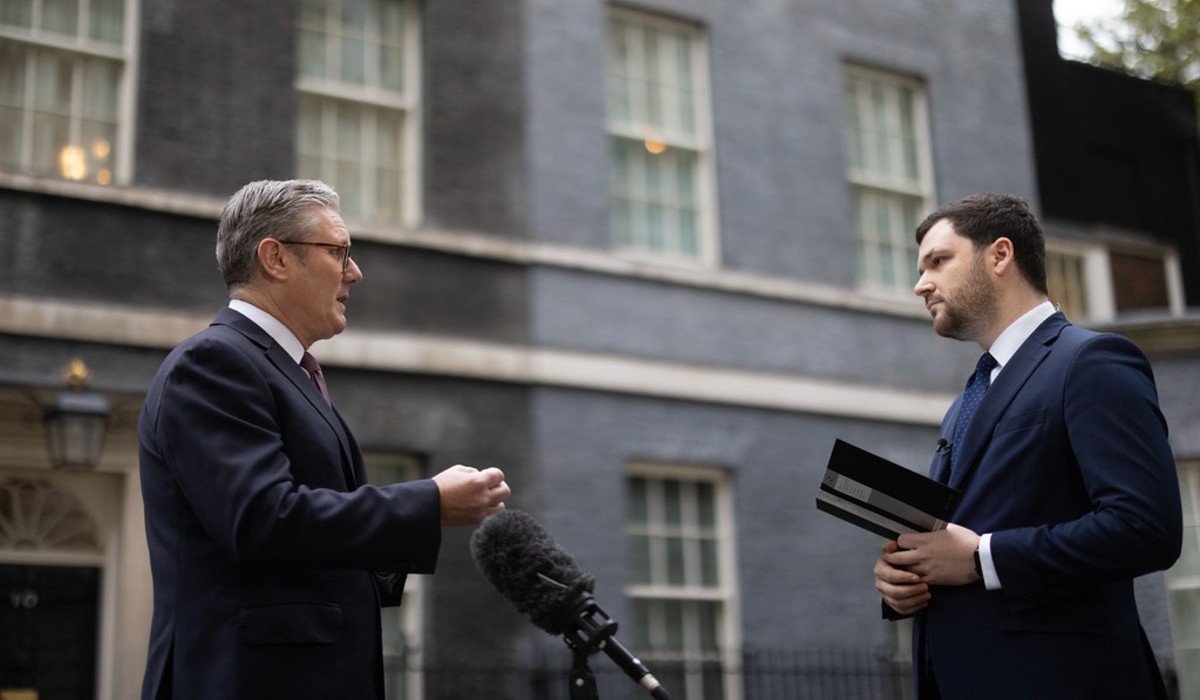
 Keir Starmer speaking to media. Photo: Simon Dawson / No 10 Flickr / CC BY-NC-ND 2.0
Des Freedman examines the British Media’s failure to challenge Britain’s aggression on Iran
Britain is, apparently, not at war with Iran.
This is because it’s only engaged in ‘defensive’ operations which means that US bombers can use UK bases but only, as the BBC reported, ‘for defensive strikes on Iranian missile sites’. This means that for most of the media, it’s perfectly logical for the government to send Typhoon fighter planes to Qatar and to beef up its military presence in Cyprus in order to secure peace and not prosecute war.
When the Ministry of Defence circulates footage of the attacks on Iranian drones that its planes have carried out over Iraq and Jordan, TV eagerly scoops this up. Sky, for example, proudly announces that British F-35 jets had ‘blasted much cheaper unmanned aerial vehicles out of the sky’.
When the BBC covered defence secretary John Healey’s visit to RAF Akrotiri on Cyprus, it repeated his comments about the need to reinforce air defences to prop up ‘our shared security’. It failed to mention the Cypriot government’s criticism earlier that week of Britain using Akrotiri for clearly military, as opposed to humanitarian, purposes.
And of course, it didn’t mention the very real campaign in Cyprus to shut the base down entirely.
When it comes to military conflict, the vast majority of the media all too often obediently adopt the role of stenographer and publicist.
We see plenty of images of smoke, explosions and expensive military hardware but very little analysis of the legality of this ‘defensive’ position.
The fact is that military conflict provides dramatic front-page photos, justifies apocalyptic language, drives clicks, increases ratings and makes military correspondents feel especially important.
Newspapers are free to be as sensationalist and jingoistic as they care to be, putting our ‘boys’ first and prioritising the ‘national interest’ with little concern for the victims of war, particularly if they are brown or black.
TV is expected to be more ‘impartial’ but bulletins are dominated by government spokespeople, generals, ex-spies, ‘expert’ academics and sympathetic think tanks making the general case for military intervention.
Where there is a criticism of government, it’s more likely to be about tactics: do we have enough aircraft carriers and personnel? ‘Has Starmer’s Iran response been too slow?’ as one BBC News podcast asked. Why is HMS Dragon still stuck in Portsmouth and not defending British interests in the Mediterranean more promptly?
Media coverage is rarely based on detailed investigation of the reasons for military engagement. That would mean, in the current context, focusing on the awkward question of why Israel and the US pre-emptively attacked Iran even though constructive negotiations were ongoing.
So instead of holding the government to account, we’re more likely to get justifications for war. In 2003, in the run-up to the disastrous invasion of Iraq, we were told that the UK was ’45 minutes from attack’. Now, we’re told that ‘Iran poses [a] VERY real threat to normal Brits’ as the Sun put it.
This threat (from Iran or Russia or indeed China) is then used to highlight the need to step up defence spending and to restore the UK’s military prowess as an urgent policy priority. No mention is made of the need to wage a war on poverty or on homelessness or on cancer.
Meanwhile, the media use language that will be familiar to anyone who’s looked at how the media reported Gaza. Of course, it’s impossible to generalise but here are some telling examples of the media’s normalisation of the idea that this ‘defensive’ war is legitimate.
When two US missiles killed 165 schoolgirls in southern Iran, the BBC referred to this as a ‘reported strike’ while avoiding such qualified language when talking about Iranian missiles launched against Britain’s ‘allies’.
Sky spoke of the ‘horror story’ of an Iranian missile killing Israeli citizens but no such compassion was shown when reporting the funeral of the children ‘killed in what Iran described as an attack on a girl’s school’.
Sir Richard Dearlove, the former MI6 boss, was given the chance to argue on LBC in favour of military intervention in Iran and to state, without opposition, that the UK should have ‘supported the Americans and Israelis unequivocally’. No mention is made of the fact that Dearlove provided intelligence about the non-existent weapons of mass destruction that led to the UK’s invasion of in Iraq in 2003 and is perhaps not the best guest from whom to solicit informed opinion.
The BBC described Israel’s invasion of Lebanon as a ‘ground incursion’ while Channel 4 spoke of troops ‘crossing into’ Lebanon as if they were on holiday.
Tabloid front pages focused on UK holidaymakers trapped in Dubai, although they spoke less about the irony of British tax exiles calling on the government to whisk them back ‘home’.
There is, of course, some criticism of the military offensive against Iran in the media, mostly because of the role of Donald Trump. This has allowed sections of the media to report more critically and to focus on the lack of strategic and military planning on the part of the US, justifying the UK not playing a more decisive or active role.
However, this has also allowed political differences to be played out with the right-wing press highlighting Britain’s hollowed-out military and diminished role on the world stage while more ‘liberal’ commentators address the unpredictability and short-termism of the US president’s world view.
Meanwhile, very few journalists ask the key questions about how any of this can be justified in international law or why it is permissible for the US and Israel, as two nuclear states, to bomb another to stop it from joining the nuclear club. Where is the outrage about Israel occupying and bombing its neighbours immediately after killing 70,000 people in Gaza? Why is it OK for major news outlets to refer to the former supreme leader of Iran as ‘evil’ but shy away from using this description of the Israeli prime minister?
In failing to challenge Britain’s ‘defensive’ aggression over Iran, the media are totally out of step with public opinion.
When Fiona Bruce asked the audience on Question Time ‘how many of you think this is a war Britain should be involved in?’, virtually no hands went up.
A recent YouGov poll shows that 49% do not support Trump’s bombing of Iran against 28% who do while 50% oppose the government’s decision to allow British airbases to be used to launch attacks against Iran with less than one-third of people supporting it.
The media don’t represent these views and cater overwhelmingly to the most hawkish voices in government. There is virtually no debate in the mainstream media on why the UK will be safer if it engages in military action in the Middle East – simply a cacophony of noise that we have to move to a war footing and increase the defence budget, even if that means shredding public services.
The media don’t speak for the anti-war majority; we will have to do that ourselves.
Before you go
The ongoing genocide in Gaza, Starmer’s austerity and the danger of a resurgent far right demonstrate the urgent need for socialist organisation and ideas. Counterfire has been central to the Palestine revolt and we are committed to building mass, united movements of resistance. Become a member today and join the fightback.

Des Freedman
Des Freedman is Professor of Media and Communications in the Department of Media and Communications at Goldsmiths, University of London. He is the co-author of 'The Media Manifesto' (Polity 2020, author of 'The Contradictions of Media Power' (Bloomsbury 2014), co-editor of 'The Assault on Universities: A Manifesto for Resistance' (Pluto 2011), and former Chair of the Media Reform Coalition.