
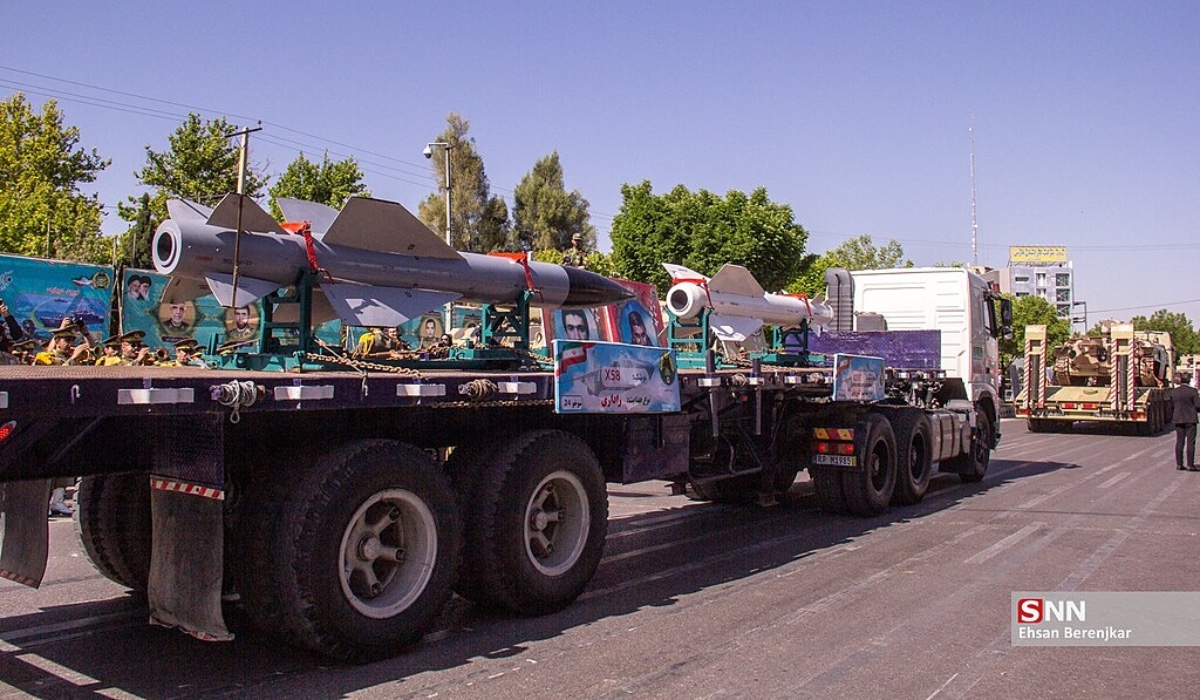
 Iran Army Day in Shiraz 2023/ Student News Agency, Attribution, via Wikimedia Commons
As the war intensifies with confirmed attacks on shipping in the Strait of Hormuz, Zahid Rahman examines Iran’s response to the US and Israel’s attacks
On February 28, the US and Israel launched an unprovoked attack on Iran. Since then the country’s supreme leader has been eliminated, targeted strikes have fallen on much of its cities, infrastructure and military bases, and most of the war’s fatalities have been Iranian. On the surface level, there is a paradox when Trump announces the war as being “pretty well complete” and will end “very soon” whilst Iran has ruled out talks. Furthermore, their foreign minister Araghchi has suggested that a unilateral halt to hostilities by President Trump would not be reciprocated.
For the Iranian state this war is existential. It wants to avoid another scenario like this. Fundamentally, the country has two war aims: keeping the regime in power and restoring deterrence. Since 2023, Iran has seen the decimation of its ‘axis of resistance’ across the Middle East: Hamas in Gaza was significantly fragmented, Hezbollah’s combat capabilities in Lebanon was degraded, the Assad regime in Syria had fallen and Ansarallah (commonly known as the Houthis) were demoralised by Trump’s airstrikes in 2025. In the weakening of these allies, Iran has lost much of its deterrence effect. It is no coincidence that Israel had felt bolder in bombing the Iranian Embassy in Syria in April 2024, assassinating Ismail Haniyeh in Tehran later that year, and having launched two separate wars against Iran including the current one. With this erosion of regional power, Tehran has had to rely increasingly on its own military to deter further attacks; this has evidently failed.
After the killing of their supreme leader on the first day of the conflict, the Iranian armed forces were firing drones and missiles in heavy salvos towards its Gulf neighbours and Israel. It showed they were able to function well though much of its higher echelons had been assassinated. Iran had adopted a Mosaic defence strategy. Taking the metaphor of a mosaic, where many tiles form a larger picture, Iran had initiated a plan that decentralised command amongst various local units that together form a resilient defensive structure. This has allowed its armed forces to survive decapitation and carry on fighting. In his message to Arab countries on March 7, the Iranian president admitted the fact that local forces were given “fire at will authority” immediately after the war began.
Ultimately, this made it harder for the Americans and Israelis to stop the constant and intermittent firing of drones and missiles from Iran. This was also helped by Iran’s carefully hidden and mobile launchers; a tactic that has proved relatively effective in a country comparable to western Europe’s landmass.
Iran’s strategy isn’t to have a proportional equilibrium. It understands that the US and Israel have a numerical and technological advantage over it in almost all aspects; trying to impose a proportionate number of casualties is neither realistic nor necessary to its war aims. Instead of trying to preserve all its assets, the military establishment changed its doctrine after last year’s war. The new doctrine assumes significant initial military degradation by the US-Israel coalition and has been designed to retain a second strike capability that would allow it to hit back.
Iran hits multiple targets
The targets of Iran’s retaliation are not only US military bases, but oil sites, hotels and airports in the Gulf countries. In addition to this it has closed the Strait of Hormuz, leading to the price of oil reaching $119 per barrel on Monday. The country is externalising the costs of this war on the world economy as a means of applying ‘maximum pressure’ on the US. “If you can tolerate oil at more than $200 per barrel, continue this game,” said a spokesperson of the Iranian Revolutionary Guard Corps.This strategy deliberately disrupts trade and energy markets while sustaining intermittent drone and missile attacks across the region. This pressure is to make the Americans regret the war but also to rebuild deterrence.
Strain is being felt from a military standpoint as well. Since the end of the Cold War the United States has maintained a logistical network designed to fight two major wars simultaneously across the world. This has been a cornerstone of US strategic planning. Advanced THAAD and Patriot interceptors are being moved from South Korea to the Middle East in the face of Iran’s retaliatory strikes. The US is reaching a watershed moment in its global strategy. A single regional conflagration is stretching its military capabilities in ways that were once thought manageable, undermining long-standing assumptions about its global hegemony.
Iran cannot defeat the US and Israel on the battlefield. However victory does not require a lower number of body bags. Tehran’s goal is to demonstrate that any war against it will carry escalating costs, creating a new status quo in which future attacks become unthinkable. By decentralising its forces, sustaining intermittent attacks and destabilising global energy markets, Iran is attempting to show that even a weakened state can impose consequences on its adversaries. Time is on its side: the longer the conflict continues, the greater the economic and political burden on the global economy. This strategic patience explains Iran’s attritional approach and its continued resilience despite heavy losses.
Before you go
The ongoing genocide in Gaza, Starmer’s austerity and the danger of a resurgent far right demonstrate the urgent need for socialist organisation and ideas. Counterfire has been central to the Palestine revolt and we are committed to building mass, united movements of resistance. Become a member today and join the fightback.
