
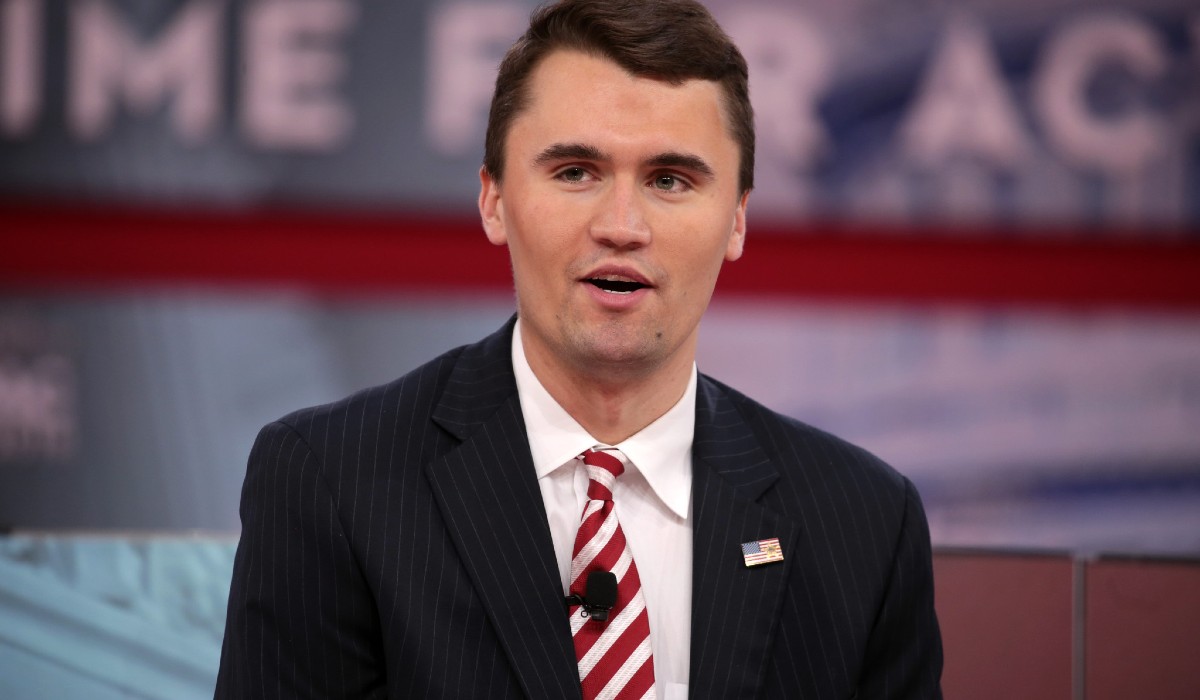
 Charlie Kirk speaking at the 2018 Conservative Political Action Conference / Photo: Gage Skidmore / CC BY-SA 2.0
Charlie Kirk’s assassination has prompted a wave of hypocrisy globally and an excuse for Trump to ramp up authoritarian repression. Kevin Ovenden examines how the left should respond
Donald Trump has not wasted a second to use the shooting dead of far-right provocateur Charlie Kirk to escalate his frightening authoritarian offensive across the US. His government is working on a battery of measures that include going after foreign students accused of having ‘rationalised, praised, or made light of’ Kirk’s death. It will not stop with foreigners.
In a total inversion of reality, this is done in the false name of free speech. Kirk gained a YouTube following and vast sums with stunts in which he would take on college students in rants that were dressed up as debate. But he entered radical National Conservative politics in 2012 aged eighteen with a McCarthyite campaign to drive liberal and left professors and teachers out of their jobs. He set out to intimidate and frighten those he targeted and then to buttress the intensely racist and misogynistic core of Trump’s Maga movement.
Democrats and liberal figures have gone beyond condemning the assassination to ludicrously endorsing the lie that Kirk was some martyr to democracy. European leaders in addition to those of the radical right have joined in. Not least Keir Starmer. At the same time there is genuine shock in the US. Forces of the left and social movements are bracing to respond to a further round of state repression as Trump claims that they are responsible for the assassination. A lie that will legitimise in the eyes of the far-right violence against all opponents, from the left, through trade unionists, black people, immigrants, feminists, LGBT+ people, democrats and any who stand in their way.
At moments such as this, we on the left must make a special effort to craft our case so it is aimed at what will be a large middle ground that is horrified at a public assassination, streamed live, even if many of them also rejected Kirk’s violent reactionary politics.
We should resist the temptation of the echo chamber, content to speak to each other with ever greater mockery and denunciation of the dead man. That is the flipside of the collapse behind the hard right’s attempt to crush dissenting views under a false national unity. Already the MSNBC broadcaster has sacked a political analyst for daring to ask whether Kirk’s campaigns of intimidation and racism, and praise of violence by, among others, the Israeli state, might just have rebounded on him. We need a strong political response, not rows about how people ‘feel’ or worse, ‘should feel’.
Political violence and system breakdown
Over a decade ago, some of us on the left warned that an epoch of ‘political violence’ was returning. By which we meant assassinations and the deployment of violence against political opponents. There is here the hypocrisy of state actions not being deemed ‘political violence’, just as state terrorism is not called ‘terrorism’. Still, and however imperfect the term, ‘political violence’ does describe something specific and we know what it is.
Writing in the Jewish Socialist Magazine in October 2016, I put it thus: ‘The crisis years in Europe have brought a return of fascist violence at a higher level and more extensively than at any time since the 1970s. In addition to racially motivated killings – which often flow, even if indirectly, from organised racist agitation – the last five years point to a trend of fascist murders of “political opponents”.’
In a later piece, I talked about how the breakdown of parliamentary politics and liberal democratic structures leads to increasing ‘political violence’ against particular targets, mainly of the left, but on occasion on the right. The 1920s and the 1970s are good comparisons in European history.
This is being driven by the fascistic right, as reports from security services across Europe and North America demonstrate. There was the assassination of centrist CDU (Tory) politician Walter Lübcke in Hesse by a supporter of the neo-Nazi right in June 2019. There was the fascist murder of Labour MP Jo Cox in Britain in 2016, though the mainstream reaction has been to depoliticise it. Instead we are told it was but a by-product of incivility in public life and of people being horrible to MPs.
More recently, the murder by a far-right gunman of the top Democrat in the Minnesota House of Representatives, Melissa Hortman, and her husband in June this year prompted very little attention internationally and was received largely along partisan lines in the US. The same with the murder of another Democrat politician the following month. Trump did not mention them this week, blaming the left for violence.
Neither did Keir Starmer break off official business to issue heartfelt messages to the bereaved families of centre-left politicians at the time or call for the defence of free speech. He did that over Kirk at the same time as presiding over a war on civil liberties and freedom of speech in Britain aimed squarely at the Palestine movement and genuinely radical campaigns.
The difference, of course, is the politics of kowtowing to Donald Trump, which was what the appointment of now thrice-disgraced Peter Mandelson to Washington was also about. So only now do we hear about ‘political violence’. When not only the day-to-day violence of capitalist America is taken for granted, but the direct violence of the radical right against opponents is brushed aside as patriotic citizens against the ‘extreme left’.
We must point out to all those we can reach the hypocrisies here.
But we shouldn’t lose sight of the big picture. Wars are raging. Militarism is rising along with its twin, authoritarianism. The US feels it can bomb civilians off the coast of Venezuela and threaten others at will. Israel bombs Qatar and suggests it will attack anywhere where the leaders of Hamas are, even as it is meant to be negotiating with them. The normalisation of violence and the threat of it in world affairs is increasing. So is the violence and the intimidation by the far right within one country after another. And by the state.
In that context someone, for reasons we’ve yet to find out, took aim at a far-right proponent of violent intimidation against the left and democratic opponents, and of genocidal violence against a whole people. That is a product of the breakdown of capitalist democracy, which the forces who lauded Charlie Kirk are driving through. They do so in the most dangerous instances not with blind bigotry or mere hate.
They carry it out according to worked out and funded plans to crush any meaningful democracy and establish a violent, pro-capitalist authoritarianism. That will not be stopped by assassinating the Charlie Kirks of this world. It wouldn’t stop even with the assassination of an organ-grinder rather than a monkey.
The left must offer a better path
At the same time, the words of Russian revolutionary Leon Trotsky come to mind writing of Herschel Grynszpan, who assassinated a Nazi diplomat in Paris in November 1938.
The Nazi party seized on the killing as an excuse to launch Reichspogromsnacht, a wave of violence against Jews in Germany lasting two days. Still, Trotsky wrote with a sentiment that many others on the left and sincere democrats shared:
‘It is clear to anyone even slightly acquainted with political history that the policy of the fascist gangsters directly and sometimes deliberately provokes terrorist acts. What is most astonishing is that so far there has been only one Grynszpan. Undoubtedly the number of such acts will increase.
‘We Marxists consider the tactic of individual terror inexpedient in the tasks of the liberating struggle of the proletariat as well as oppressed nationalities. A single isolated hero cannot replace the masses. But we understand only too clearly the inevitability of such convulsive acts of despair and vengeance. All our emotions, all our sympathies are with the self-sacrificing avengers even though they have been unable to discover the correct road. Our sympathy becomes intensified because Grynszpan is not a political militant but an inexperienced youth, almost a boy, whose only counsellor was a feeling of indignation.’
At the time of writing, we know next to nothing about the suspect in the shooting.
But on the assumption that this was an act of political violence or vengeance and not something else, we should not be surprised. The particularities of the US state have meant endemic state violence and also narrowly political violence of various kinds. How many other countries have had four presidents assassinated, a favourite for the presidency also, and two presidents shot? Then there is the legion of radical black and other leaders such as Martin Luther King.
The difference now is that such violence is more endemic and its driving force is an at times openly murderous far right. Some of it shows signs of radicalising further over Trump policies that do not appear to be putting America first in the way they want.
Can we be shocked if in response someone turns desperately to those methods championed by the violent right and throws a particle of the terror that is being imposed daily in the US back at those who they hold responsible for it?
It does not make it right. It is wrong. From a purely political point of view, regardless of anything else. It provides a moment for Trump to exploit, with no opposition from the Democrats, and to extend what is already a frightening assault on civil liberties and even limited democratic norms. Sending troops into oppositional cities. A Supreme Court ruling that people can be detained on the basis of how they look or speak. Raids to round up immigrants. Censorship. Forcing people out of their jobs. Generating lynch mobs against opponents.
Trump could not do this over the Charlottesville fascist murder of Heather Heyer in August 2017. It was not only because the woman killed was of the anti-racist left. It was also because she was of a large, collective movement aiming to stop the fascist gangsters and their attempt to ‘unite the right’. Instead, and against his instincts to side firmly with the radical right and fascists, he said there were ‘good people on both sides’.
Matters have radicalised since. The Maga invasion of the Capitol building in 2021 marked a turning point. Trump’s second term is worse than the first. One reason is the capitulation of the official Democrat opposition. It has reduced itself to a permanent outrage machine speaking to a diminished base about how awful Trump is but doing nothing practically to stop him and to mobilise working people, women, minorities and all those under assault in response.
There is a terrible lesson here for the left not to follow the liberal centre down that route: not in the US, nor in Britain and Europe. What we can do here is offer solidarity and practical support where we can to all those in the US seeking to build a mass, democratic response to the violent reaction Trump has ramped up. He has done so in proportion to his falling support. Opposing Trump’s state visit in large numbers is one contribution. Wider mobilisation and an active, more united left are key to our answer at this time of rising political violence of all kinds. These can provide an alternative to those tempted down a self-defeating path out of their righteous anger at what our states are doing and the way that so many political figures are paving the way for the fascist right.
There is not a moment to lose for the left to pull itself together and rise to the seriousness of the situation. If we let the moment slip for a political alternative connected to mass social struggles, then we leave only the politics of despair. That despair was summed up this week in what leads a lot of ordinary people, against their interests, to support for the likes of Kirk on the one hand, and on the other, as seems likely, what was in the mind of his killer.
Before you go
The ongoing genocide in Gaza, Starmer’s austerity and the danger of a resurgent far right demonstrate the urgent need for socialist organisation and ideas. Counterfire has been central to the Palestine revolt and we are committed to building mass, united movements of resistance. Become a member today and join the fightback.

Kevin Ovenden
Kevin Ovenden is a progressive journalist who has followed politics and social movements for 25 years. He is a leading activist in solidarity with the Palestinian struggle, led five successful aid convoys to break the siege on Gaza, and was aboard the Mavi Marmara aid ship when Israeli commandoes boarded it killing 10 people in May 2010. He is author of Syriza: Inside the Labyrinth.