
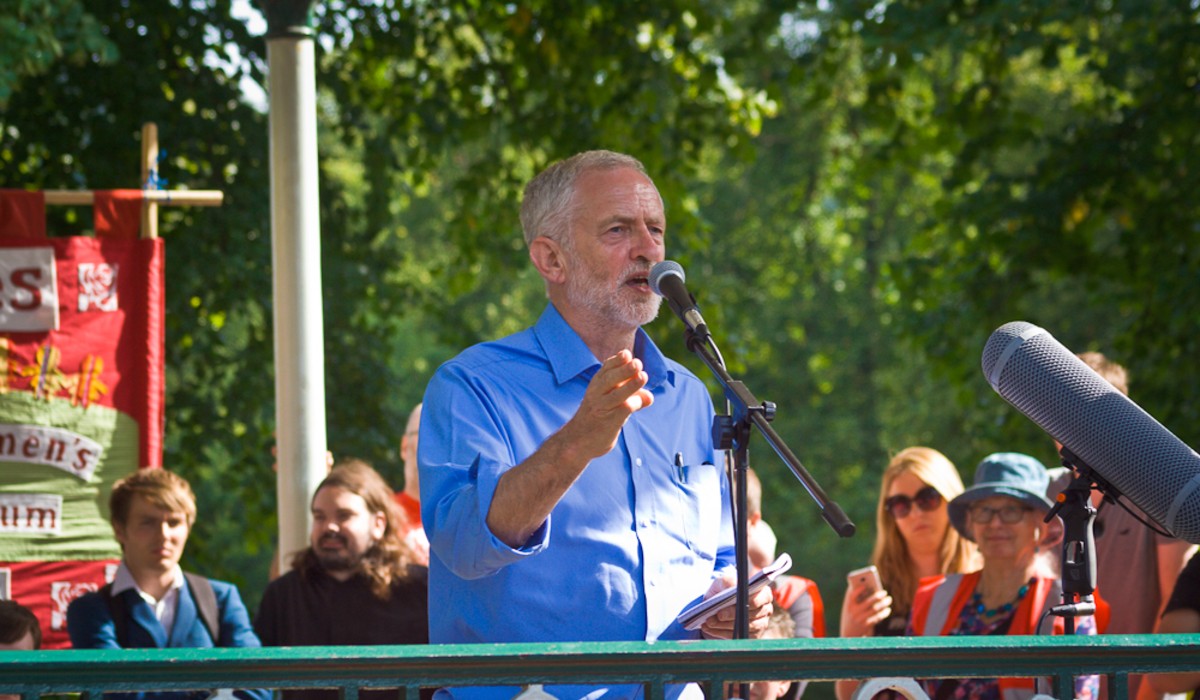
 Jeremy Corbyn speaks at a rally during his time as leader of the Labour Party. Photo: Wikimedia commons
The new party is a step forward but must not become a Labour Party mark 2, argues John Rees
The announcement of the intention to form a new left party by Jeremy Corbyn and Zarah Sultana has been met with widespread enthusiasm on the left.
As of now some 500,000 people have signed the new organisation’s mailing list. These are not quite ‘members’ and many will have paid no money, but it is still an impressive practical indication of the desire to break with the old politics.
The party may have been long delayed and chaotically launched, but the pent-up demand for an alternative to the manifestly failing Starmer government, and the threat that Reform will be the main beneficiaries of Labour’s disastrous policies, has swept all difficulties aside for the moment.
But excitement about ‘something new’ is easier to generate when it is as yet undefined. A party with no name, or policies, or structure is an object onto which everyone can project their desires. When decisions about the most fundamental aspects of the new organisation are made then that moment will have passed.
In order to assess the prospects of the new party some historical context is necessary.
The experience of new parties
New parties are nothing new. Even in the UK Respect did manage to elect an independent MP and a clutch of councillors in the aftermath of the Iraq War, but it did not become broadly enough based to survive the internal tensions generated by electoral politics.
But the largest and initially most successful new parties have been in continental Europe. Their fate is directly relevant to discussions around the new party announced by Corbyn and Sultana.
Let us look at three of the most high-profile cases: Syriza in Greece, Die Linke in Germany, and Podemos in Spain.
Syriza was formed in 2004 but it took 8 years of splits and reformations for it to become the largest party in the Greek parliament with just over 36 percent of the vote. It’s leader, Alexis Tsipras, was a darling of the international left, enthusiastically welcomed at a meeting at the Friends Meeting House in London, as he was across the continent.
All that came tumbling down in 2015 when the Syriza government was routed by the European Union elite and international bankers imposed a grotesque austerity programme on Greek society. Some 25 MPs and much of the left walked out. Syriza remained in power, but now simply as a replacement social democratic regime of exactly the kind it had been formed to replace.
Since then Syriza has withered and moved to the right under its new leader Stefanos Kasselakis, a business figure who has ignored the party’s once democratic structures.
Die Linke was formed in 2007 from a merger of the successor of the old East German Communist Party and a weaker left party in West Germany. It was always stronger in the East and it gained over 11 percent of the vote in the 2009 federal elections. But then Die Linke struggled to sustain this momentum, slumping to 8.6 percent in the federal elections of 2013. The vote improved a little in 2019, but was down again in 2021 to 4.9 percent amidst a red scare and a shift to the right by the party leadership.
This meant Die Linke fell below the 5 percent bar for parliamentary representation. Infighting, scandals, and splits followed. In 2022 the Die Linke leadership backed Ukraine in the West’s proxy war with Russia. They were opposed by Sahra Wagenknecht, who left to form her own party based on some left positions combined with right wing policies on immigration and refugees.
Die Linke got just 2.7 percent of the vote in the 2024 European elections, although it bounced back with 8.8 percent of the vote in this year’s federal election. It was the best vote since 2017 giving them 64 MPs. That eclipsed Wagenknecht’s breakaway operation which fell below the 5 percent bar for representation.
Podemos in Spain was formed in 2014. It polled 8 percent in the Euro elections that year. In the 2015 and 2016 general elections it became Spain’s third largest party. In 2019 Spain faced two general elections. In the second of these Podemos won just short of 13 percent of the vote and elected 35 MPs.
Podemos then entered a coalition government with Spain’s historic social democratic Party, the PSOE. It was a disaster. The PSOE both stole some of Podemos clothes and relegated them to a junior partner. The radical impulse that had given birth to Podemos in the anti-austerity movement that followed the banking crash was squandered.
Podemos’s failure is sometimes attributed to the overweening role of Pablo Iglesias, it’s first leader, sometimes to infighting, sometimes to increasing moderation. But the summary cause is its evolution, like Syriza, from insurgent newcomer to standard issue social democracy.
What are the lessons of the European experience?
Above all else what the European experience shows is the limits of change that can be brought through electoral politics. Let’s look at two aspects of this.
Firstly, let’s take a look at the effect of the new left parties on the fascist and populist right. Many in the UK hope that the new party can cut the ground from under Farage’s Reform by giving discontent with Starmer’s Labour government a home on the left.
It is of course welcome that the electoral alternatives will include a left party, and it is true that this can create a counterpoint to the rise of Reform.
But the European experience shows that the mere existence of a left party polarises politics rather than stopping the right in it’s tracks by draining its reservoir of support. Die Linke has not prevented the rise of the proto-fascist Alternative for Germany, the Afd. It was not primarily Syriza that has led to the decline of Golden Dawn but a wider anti-fascist mobilisation. Podemos has not prevented the rise of Vox, the populist far right formation that became the third largest party in the second Spanish election of 2019.
Of course it is a significant advantage to the left to have an electoral presence which contests the far right. That is obviously an advance on leaving traditional social democracy to constantly compromise with and adapt to the far right, as Starmer is doing with Reform.
It is simply to point out that the far right cannot be stopped simply by electoral methods, especially when the scale of the social crisis keeps widening and no left party has the likelihood of taking power on, even, a radical reformist programme any time soon.
Secondly, and this is a much more profound issue, the European experience tells us about the persistence of social democracy. In all cases social democratic parties have persisted and often retaken ground they lost to the new parties when they were at their peak. That’s especially true of the SPD in Germany and the PSOE in Spain, the two European social democratic parties most like the UK Labour Party.
Again, this is not an argument against a new party. Far better that there is a left pole of attraction than the suffocating monolith of Labourism goes uncontested. There is a considerable section of the electorate that stands to the left of Labour and it can and should be represented.
But elections reflect previously existing consciousness, they do not create it, or only do so to a limited degree. It is the wider scale of social crisis across society and the direct struggle it produces strikes and mass social movements-that transform consciousness. Everyone knows that Corbynism the first time around was a more-or-less direct product of the anti-war movement and the anti-austerity movement. The possibilities for a new party are being shaped right now by the scale of the Palestine solidarity movement. That’s what drove the election of an unprecedented four independent MPs and councillors across the country.
What this underlines is that a new party that doesn’t see its fundamental, defining relationship to be that with extra-parliamentary movements will find itself forced to compromise by the pressures of electoralism and the persistence of mainstream social democracy.
A better new party
So, what would it take to for the new party in the UK to avoid the fate of its European forerunners?
Firstly, the new party needs to reject Labourism in general and in detail. The very last thing the left needs is another 1900 moment, the year the Labour Party was formed.
We have more than a century of experience from the betrayal of the 1926 General Strike, through the defection of Ramsey MacDonald to the Tory coalition, the enthusiastic founding of NATO and the secret nuclear weapons programme after World War Two, the dismal traitorous behaviour in the 1984-85 miners’ strike, to the Blair catastrophe over Iraq, to know better than that.
Nor should we underestimate the pull of Labourism simply because the new party is a break from Labour. Many joining the new party simply want what they imagine to be a more radical version of Labour’s electoralist strategy. What they fail to realise is that electoralism is the root of Labourism’s failure.
The idea that we can simply take over the existing mechanisms of state power through the electoral process is a perspective that should be set aside at the outset. All the historical evidence is that this is a strategy that cannot work.
The capitalist state is absolutely immune to fundamental change emerging in this way. Corbynism itself was destroyed when it attempted to implement this strategy, even before it got to office. A new party will face even more of the same resistance.
This is not to say that electoral politics are unimportant. But they are not important, or even practical, in the old electoralist way of gaining office in order to legislate change.
They can be important if elections are seen as a way of using elected office as a megaphone for extra-parliamentary mobilisation. MPs and councillors should be there to amplify and extend extra-parliamentary mobilisations, whether by social movements or trade unions.
A successful electoral strategy for the left must see the self-organisation of working people as the core of our power, and elected representatives as their servants not their masters.
This need cannot be met by abstractions about ‘empowering local communities’, a long-held reformers dream since at least the time of utopian socialist Robert Owen. There is no realistic prospect of estates in Burnley or Tower Hamlets becoming miniature New Lanarks, let alone Paris Communes.
In many forgotten and left behind working class communities they have had enough of false promises from politicians and repeatedly abandoned commitments to ‘do something’ about the problems that bedevil their lives.
What they need are co-organisers, not elected saviours. And what those organisers need to organise is class struggle, political mobilisation, and the strengthening and deepening of social movements and trade unions.
Jeremy Corbyn has long had that approach, organisationally and politically linked to the anti-war, anti-austerity, and trade union movement. Yet as Labour leader he was surrounded by people who tried to limit or marginalise that aspect of his political profile.
That led directly to the greatest and most consequential mistake of Corbyn’s time as leader, the acceptance of the IHRA definition of anti-semitism. Forced on him against his better instincts it was a blow to Corbyn, his best supporters, and the entire Palestine solidarity movement.
Left Labour MPs, including Zarah Sultana, made a similar error when they withdrew their support for the Stop the War Coalition over the Ukraine war.
The new party must aim to construct a base in the core of the working class, the class most decimated by the neo-liberal era of the last generation. It should not limit itself to sociologically invented groups such as ‘asset-poor workers, downwardly mobile graduates and racialised people’, recently described by James Schneider, the co-founder of Momentum, as the target constituency of the new party.
This is the kind of policy-wonk talk that so undermined Corbynism. The new party should aspire to represent all workers, not some confected subsection of the class. Graduates are not remotely a social layer of equal weight to the working class, and they are not, in general, downwardly mobile. In fact, they on average earn £11,500 a year more than non-graduates. And communities suffering racism are not separate to the working class, but part of it. A huge advantage is given away if we don’t combat racism in class terms but merely repeat failed liberal politics on racism which, at best, talk of integration while promoting the economic inequality which destroys integration and divides the working class.
The new party has to set its face against this approach from the start. Hope is a precious commodity in working class communities these days. If it is squandered the consequences will be dire.
It is up to every socialist to throw themselves into the construction of a new party. It is a historic chance to break with Labourism. But that must be fought for, and the struggle has already begun.
Before you go
The ongoing genocide in Gaza, Starmer’s austerity and the danger of a resurgent far right demonstrate the urgent need for socialist organisation and ideas. Counterfire has been central to the Palestine revolt and we are committed to building mass, united movements of resistance. Become a member today and join the fightback.

John Rees
John Rees is a writer, broadcaster and activist, and is one of the organisers of the People’s Assembly. His books include ‘The Algebra of Revolution’, ‘Imperialism and Resistance’, ‘Timelines, A Political History of the Modern World’, ‘The People Demand, A Short History of the Arab Revolutions’ (with Joseph Daher), ‘A People’s History of London’ (with Lindsey German) and The Leveller Revolution. He is co-founder of the Stop the War Coalition.