
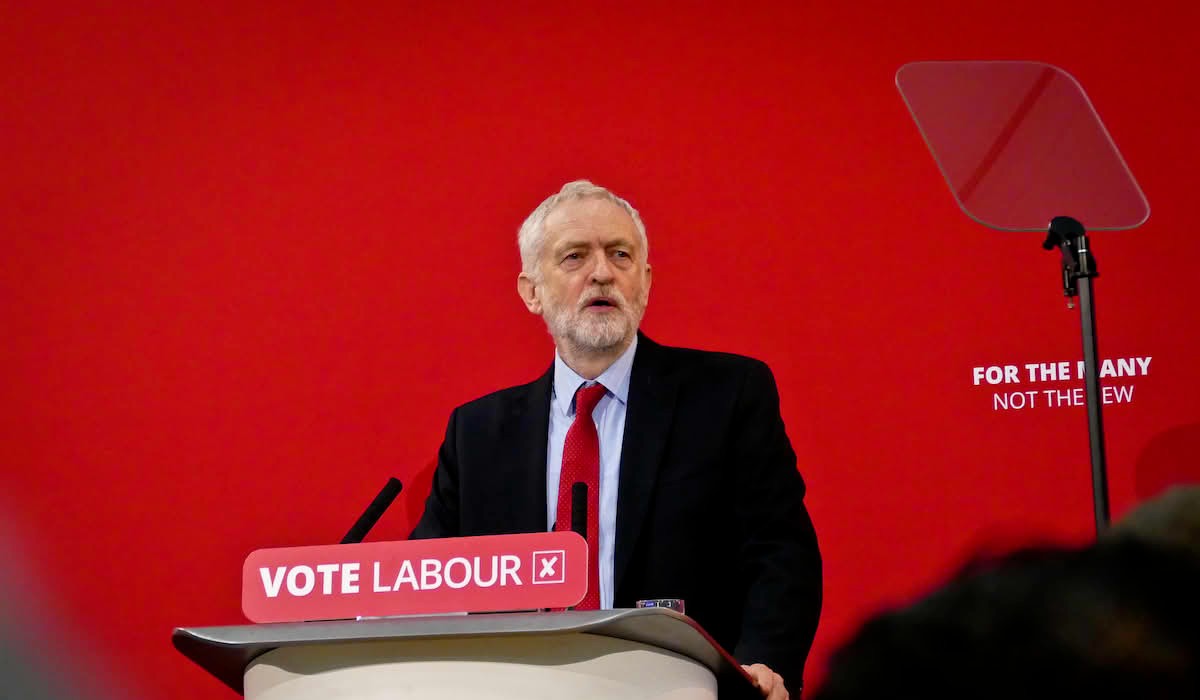
 Jeremy Corbyn. Photo: Sophie Brown CC BY 4.0
A new political alternative is desperately needed argues Mike Wayne, but it must learn the lessons of the recent past
If you would like to bake a new left-wing political party, here are some essential ingredients:
- 1lb of a ‘loveless landslide’ general-election victory on a very low 33.7% of the vote and with only 9.7 million votes (less than the disaster election for Labour in 2019). 6oz of successful independently elected MPs in said general election.
- 4oz of an authoritarian, factionalist right wing in Labour making it abundantly clear to even those who are hard at learning, that they have no place whatsoever in their tent.
- 6oz of a despised political leader whose accelerated decay in terms of public approval has taken even you by surprise.
- 2lbs of total moral collapse when confronted with a strategic ally behaving with clear genocidal intent.
- 10lbs of decades-old investment in a neoliberal economic model that went bust all the way back in 2008, locking everyone into a zombie economy that refuses to die.
One can only hope that the secret talks about a new political party that have been going on for some time now will quite soon be opened up for a larger, more transparent conversation about a new party. One of the benefits when starting anything new is that you have a blank sheet of paper and it would be good to be able to translate some of the lessons of recent times into a new organisation. When Corbyn first became leader of the Labour party in 2015, he indicated that he would like the Labour party to become more like a social movement in an attempt to escape the sclerotic parliamentarianism which had only increased with the decline of trade-union influence during the Blair years. Unfortunately, Labour were forced to turn inwards as they fought for control over the political machinery of the party against a right wing that declared war on the Corbyn leadership from day one.
Hopefully, a new party organism would resurrect that social movement idea, infusing the party with ideas and activism and connecting it with the needs and demands of local communities. An advantage here will be that it will not be embarrassed by the legacy of the Labour party from which it needs to break. Corbyn had little to say, for example, about the part Labour councils were playing in the gentrification of the cities, a dynamic that really takes us to the heart of our political economy, dominated as it is by property developers and the City, destroying public assets for private gain.
Embed anti-imperialism
The moral abomination that is today’s Labour party is of course crystallised by their support for the genocidal Zionism of the Israeli state. Since the 2003 Iraq war, the geopolitical interests of the West in the Middle East (Libya in 2011, Syria in 2013, Palestine from 2023) have been met with a vigorous anti-war movement in the UK. This movement, which has sustained itself in the latest crisis over the Palestinian genocide, against an increasingly hostile state response, has provided the opportunity to bring millions of people together in a moral-political cause that seems beyond the capacity of the other main political parties and most of the dominant media to articulate: genocide is bad news.
Of course, behind that there is a more complex and potentially more difficult and political argument that has to be made to explain why this is happening, but a political party that emerges partly out of this crisis really must embed the moral outrage that people feel into an explanation of the geopolitical interests at work (clue: imperialism, that is the meshing together of military power, corporate interests and elite political projects).
We should remember here that one of Corbyn’s best moments came during the 2017 General Election after the terrorist attack in Manchester. Here he refused to cede ground to the usual discourse of the right that triumphs at these times, and while (rightly) condemning the attacks, he noted the link between terrorism at home and the wars abroad in which the UK establishment routinely likes to get involved. That response caught the public mood and the city of Manchester certainly seemed determined to prevent the right from capturing the attack for their own purposes; an example of the party and its wider social base interacting to good effect.
The new party really must exist to provide an electoral challenge to the neoliberal status quo. Neoliberalism is the reason why the established parties are in crisis and why Farage’s populist right is breaking through. Offering people a choice at the ballot box that breaks with neoliberalism economically, which Reform of course cannot do, is essential, otherwise the path to power for a far-right government will be smooth and unstoppable, paved at every stage by this appalling Labour government. What is more important here is less the specifics of a programme than the democratic accountability that members will have over the executive. Of course, leaders should be given the space to lead, but if the long-term decline in party trust is to be reversed, members should be able to hold leaders’ feet to the fire, especially when it comes to implementing the agreed programme.
Again, we have a blank sheet of paper so we can hope there will be some creative thinking about governance structures that will reflect the importance of political life outside the national and local authority electoral bodies. Otherwise, the new party will not be able to resist the same integration pressures which have disintegrated the social-democratic parties of old.
Regain the working class
We can all dream of what political programme might evolve in a new political organism but it has a golden opportunity to speak to millions of people who have been abandoned by the mainstream parties. In the 2017 general election, Corbyn’s Labour party proved the popularity of policies that begin to reverse the distribution of wealth from the rest to the rich. What changed between 2017 and 2019 was that a good chunk of the Labour’s party’s social base, which had been weakening for years under New Labour’s assumption that Labour voters had nowhere else to go, finally collapsed.
It is worth repeating why Labour lost in 2019 because of course the dominant political parties and media use that loss to discredit the entire programme. It was not the programme that was rejected but Labour’s policy on Brexit. Fifty of the 52 seats that Labour lost were in areas where majorities had voted to leave the EU only for them to be told that they should think again. The fury was palpable. Corbyn had been manoeuvred into a ‘Second Vote’ policy on Brexit by his membership and his shadow cabinet. The result fractured the class alliance between the working class that had been left behind in the small de-industrialised towns of the North and the middle class that dominated the Labour party membership.
The social-class demographics of the Labour party membership changed in the 1990s, with the proportion of working-class members falling from one quarter to one-seventh.[1] The situation is not much better amongst the trade unions, the majority of whom came out unequivocally for Remain. While trade-union membership has halved since 1979, the social base of the trade-union movement has also contracted. In 1964, over three-quarters of union members were from the working class, while by the 2010s, half of union members were located in what Tilley and Evans call the ‘new middle class’[2], i.e. employed professionals in intermediate (not senior management) non-manual occupations.[3]
For a new party to succeed, it is going to have to break out of the middle-class enclave in which not only the Labour party but left politics in general has become trapped. It must not only speak to a broader social base, it must include that social base in its membership and in its leadership. Without that organic link, the ingredients for a new political party will not be enough.
[1] Patrick Seyd and Paul Whiteley, New Labour Grassroots: the Transformation of the Labour Party Membership, (Palgrave: London 2002), p.37.
[2] Geoffrey Evans and James Tilley, The New Politics of Class: The Political Exclusion of the British Working Class, (Oxford UniversityPress: Oxford, 2017, pp.66-7.
[3] ibid. p.4.
Before you go
The ongoing genocide in Gaza, Starmer’s austerity and the danger of a resurgent far right demonstrate the urgent need for socialist organisation and ideas. Counterfire has been central to the Palestine revolt and we are committed to building mass, united movements of resistance. Become a member today and join the fightback.
