
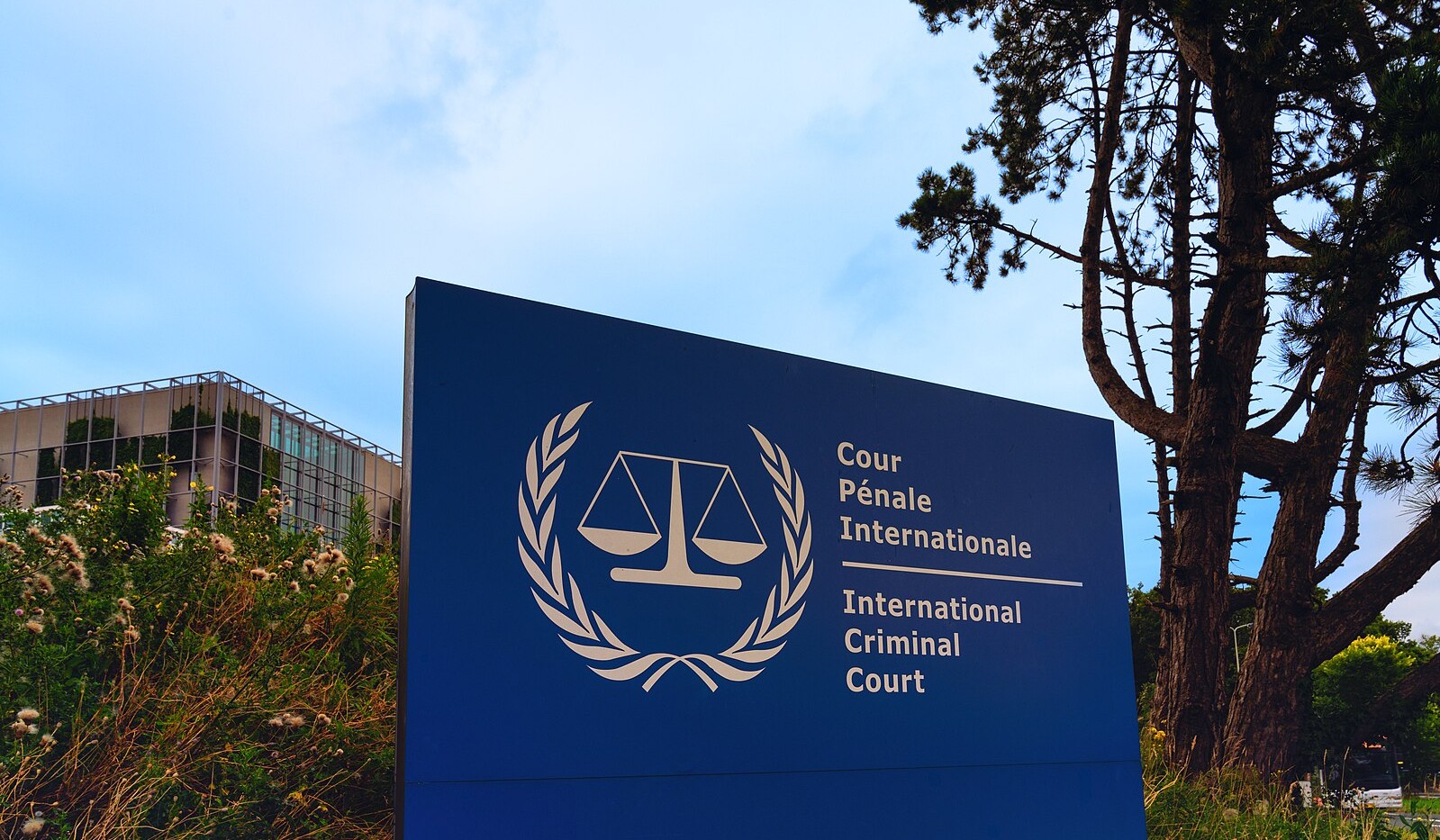
 Photo: Wikimedia Commons / CC BY 2.0
Chris Bambery considers the left’s criticisms of international law given US and Israeli attempts to destroy altogether its capability and legitimacy
‘Unlike many other wars, this one is documented live by the UN and NGOs. This conflict is even being litigated at the highest level, involving the two courts in The Hague: the ICJ for genocide and the ICC for crimes against humanity and war crimes. No one will be able to say they didn’t know.’
Those are the words of Professor Vincent Chetail, Director of the Global Migration Centre. The war in Gaza is different not just in the horror inflicted on the Palestinians but by the fact that as it has been happening, it is being condemned by the highest bodies of international law.
When you go through the litany of official, legal charges against Israel, it is no wonder Israeli Prime Minister, Benjamin Netanyahu, US President, Donald Trump, and their far-right supporters are turning the sights on international legal institutions like the ICJ, ICC and the United Nations itself.
Their far-right cheerleaders claim international law is a plaything of an international, globalised elite. In fact, they themselves are cheerleaders for Netanyahu and genocide when they echo him in denouncing these bodies.
The Independent International Commission of Inquiry on the Occupied Palestinian Territory was established by the UN Human Rights Council in 2021 to investigate all alleged violations of international humanitarian and human-rights law. The commission has previously concluded that Hamas and other Palestinian armed groups committed war crimes and other serious violations of international law on 7 October 2023, and that Israeli Defence Force has committed both crimes against humanity and war crimes in Gaza.
In a 72-page report issued earlier this month, it concludes that the Israeli government and the IDF have committed and are continuing to commit four of the five acts of genocide defined under the 1948 Genocide Convention against a national, ethnic, racial or religious group: Palestinians in Gaza.
The 1948 Genocide Convention was passed by the United Nations in 1948 in response to the Holocaust. The Convention defines genocide as any of five ‘acts committed with intent to destroy, in whole or in part, a national, ethnic, racial or religious group.’ The man behind it was the Jewish-Polish academic and lawyer, Raphael Lemkin, who had fled his native country in September 1939 as the Nazis invaded, finding refuge in America. He is credited with coining the term ‘genocide’.
In December 2023 at the International Court of Justice, South Africa formally accused Israel of violating the Genocide Convention, filing the case South Africa v. Israel (Genocide Convention), due to Israel’s actions during the Gaza war. In addition to starting the litigation process, South Africa also asked the International Court of Justice to demand that Israel cease its military operations in the Gaza Strip as a provisional measure.
In 2021, the International Criminal Court stated that it would investigate the Israeli government for war crimes within Palestinian territories. Israel told the ICC that it did not recognise the court’s authority to do so. Netanyahu said in April 2024 that Israel ‘will never accept any attempt by the ICC to undermine its inherent right of self-defense.’
In May 2024, ICC prosecutor Karim A. A. Khan announced his application for arrest warrants for Israeli Prime Minister Benjamin Netanyahu and Foreign Minister Yoav Gallant, and Hamas leaders Yahya Sinwar, Mohammed Deif, and Ismail Haniyeh. Khan said he has ‘reasonable grounds to believe’ each of the five men bears ‘criminal responsibility’ for war crimes and crimes against humanity. Both Israeli and Hamas officials denounced the development.
In December 2024, a team of United Nations human-rights experts concluded that ‘Israel has openly defied international law time and again, inflicting maximum suffering on civilians in the occupied Palestinian territory and beyond.’ The experts highlighted crimes against humanity including murder, torture, sexual violence, and repeated forced displacement amounting to forcible transfer, war crimes encompassing indiscriminate attacks on civilians and civilian objects, including objects indispensable to the survival of the civilian population, educational institutions and cultural heritage, the use of starvation as a weapon of war, the targeting of healthcare workers and health facilities, attacks on humanitarian workers, arbitrary restrictions on access to humanitarian aid, attacks on journalists, collective punishment and perfidy.
Imperial limits
Faced with all this, Israel and its key ally, the USA, are now attempting to sabotage the very institutions that were created to uphold international law and prosecute perpetrators of atrocities. Nadim Khoury, former director at Human Rights Watch and the founder of the Arab Reform Initiative think tank explains, ‘Israel has clearly hit the limit of what they can get away with by using legal arguments. Now, they’re just acting with total impunity to undermine the institutions trying to enforce international laws.’
If you were to go back to the end of the Cold War and the collapse of the USSR, the ICJ and ICC generally followed the US line. Indeed some of the international laws were shaped by the US. The 1951 UN Convention on the Status of Refugees was very much a Cold War device designed to embarrass the USSR. Refugees were defined as being disenfranchised by their state on the basis of religion, race, nationality, membership of a particular social group or their political opinions. Ninety five percent of refugees admitted to the USA came from Stalinist states.
The International Court of Justice was established in 1945 by the UN Charter. After the court ruled that under Ronald Reagan, the United States’s covert war against Nicaragua was in violation of international law, the United States stated it would only accept ICJ verdicts on a discretionary basis. Under Chapter XIV of the United Nations Charter, the UN Security Council is charged with enforcing Court rulings, however, any one of the five permanent members of the council can use its veto to block it.
The International Criminal Court (ICC) was established in 2002 with Washington’s backing to prosecute individuals for the international crimes of genocide, crimes against humanity, war crimes, and the crime of aggression. There are 125 members states but China, India, Israel, Russia, and the United States are not among them. The Clinton administration signed the Rome Treaty setting up the ICC but did not ask the US Senate to ratify it because the draft statute was amended so that citizens of a state that did not recognise the Court could be prosecuted. In response, the US signed over 100 bilateral treaties with states whereby US personnel were excluded from prosecution.
In 2002, the US Congress passed and President Bush signed off the American Service-Members’ Protection Act, whereby the US must cut off any financial support to ICC members who agree to surrender US personnel to the ICC. The law also authorised the president to use all means necessary to free Americans detained by the ICC. The US has never ratified Clinton’s signature and is not a member of the ICC.
At first, however, the ICC seemed quite pliable, ruling out prosecuting US personnel for crimes in Iraq and Afghanistan. In fact, the ICC has never sought to prosecute any US citizen.
Indeed, the ICC has indicted more than fifty individuals, overwhelmingly from African countries. Twenty-one people have been detained in The Hague, ten have been convicted of crimes, and four have been acquitted. In 2015, the ICC admitted Palestine as a member of the court despite strong opposition from the United States and its allies.
When, eventually, in 2020, the ICC launched a probe into US and Nato crimes in Afghanistan in 2020, Trump imposed sanctions against individuals associated with the ICC. In 1993, the UN Security Council set up an International Criminal Tribunal on Yugoslavia, to prosecute those guilty of war crimes during the break-up of the country. The only people prosecuted were Serbs, although Croats were also involved in carrying out ethnic cleansing.
Following the later Nato bombing campaign against Serbia, there was no attempt to bring the alliance to book for its attack on the Chinese Embassy in Belgrade, on a TV station in that city and on a civilian passenger train. The press officer for Nato explained that it ‘was the NATO countries who established the Tribunal, who fund and support it on a daily basis.’ Little wonder Marxists have been dismissive of international law.
Property and power
International law is based on a supposed international system where each state is a member of one global market and all are supposedly equal. Of course, that did not reflect the reality of the post-1945 world or of today’s. Imperialism creates hierarchies of financial, economic and military power and gross inequality between states. Formal equality conceals material inequality.
As Marx observed: ‘Between equal rights force decides.’ The Indian scholar and Marxist, B.S. Chimni, writes: ‘The principal features of bourgeois imperialist international law are that it greatly limits the autonomy of the dependent and dominated state through, inter alia, relocating sovereign powers from states to international institutions, it facilitates and safeguards the free mobility of capital, in particular international finance capital, it creates and protects international property rights without imposing corresponding duties on the right-holders, and it legitimizes greater use of force through introducing new doctrines to protect the emerging globalized system of production and finance and the accompanying geo-politics.’ As Perry Anderson points out: ‘Wars waged by the liberal powers dominating the system were selfless police actions upholding international law. Wars waged by anyone else were criminal enterprises violating international law.’
When the current system of international law was created in the wake of World War II, Carl Schmitt pointed out that it was firmly based on a European concept of international law, but noted: ‘Europe was no longer the sacred centre of the earth.’
There is one right which overrides all others: ‘Property rights are taken for granted in all international trade and finance … the relations of one national with one another, as soon as they begin, are permeated by basic legal concepts: nationality, national territory, property, torts, contracts, rights and duties and responsibilities of states.’[1]
Roger Masters argues that there are three crucial features of the international legal system: ‘the most exclusive power of states to make the legal rules by which there are bound; their no less significant power to interpret the obligations so assumed; and their ultimate responsibility for securing the observance of their legal rights.’[2]
In a global hierarchy of states, it is the most powerful who can decide on all three, particularly the United States. The United Nations Charter states that it aims to ‘save succeeding generations from the scourge of war’. It pledges to uphold human rights and international law. Yet the five permanent members of the Security Council, the United States, the USSR, Britain, France and China, who first ratified the founding Charter, did not apply these standards to their formal and informal empires. The UK and France, for instance, were at that time waging bloody colonial wars in Malaya and Indochina.
The Bretton Woods institutions helped ensure that after decolonisation, the world system was one of lenders and donors for the global south after decolonisation. The ‘international rules-based order’ was a system of dollar-domination and insisted on measures such as the liberalisation of markets and Structural Adjustment Programmes. Little wonder that China Miéville argues that ‘international law’s constituent forms are [the] constituent forms of global capitalism, and therefore of imperialism.’[3]
But – and there has to be a but – when China wrote that, in 2005, little could he have envisaged the ICJ, ICC and UN Human Rights experts doing what they have done regarding Israel’s genocide. Conversely, it would have been hard to imagine the flood of vitriol the right have spat at these institutions.
Still a shield
Donald Trump in his first term made it clear that following his withdrawal from the United Nations Human Rights Council, he would not recognise the ICC: ‘So the United States took the only responsible course: We withdrew from the Human Rights Council, and we will not return until real reform is enacted. For similar reasons, the United States will provide no support in recognition to the International Criminal Court. As far as America is concerned, the ICC has no jurisdiction, no legitimacy, and no authority. The ICC claims near-universal jurisdiction over the citizens of every country, violating all principles of justice, fairness, and due process. We will never surrender America’s sovereignty to an unelected, unaccountable, global bureaucracy.’
We should note that, in his first administration, Trump took the he US out of the World Health Organisation and the UN Human Rights Council. On returning to the White House, Trump quickly reimposed sanctions on the ICC over ‘illegitimate and baseless actions’ targeting the United States and Israel. This announcement in February 2025 was made in the same week that Netanyahu became the first foreign leader to visit the White House during Trump’s second term.
The US has always stood back from allowing international law to apply to its own citizens; that’s why it did not join the League of Nations after World War I (not, as is often claimed, because of isolationism).
In 2021, after the ICC stated that it would investigate the Israeli government for war crimes within Palestinian territories, Israel told the ICC that it did not recognise the court’s authority to do so. As noted, Netanyahu said, in April 2024, that Israel ‘will never accept any attempt by the ICC to undermine its inherent right of self-defense.’
But Trump, Farage and the far right want to rip up all sorts of international law. We should oppose that. That does not mean dropping the criticisms outlined above. For instance, there is a debate about reforming the UN, starting by removing the permanent members of the Security Council. We have something to say in the debate.
B.S. Chimni argues that can serve as a ‘shield’, since powerful states will lose legitimacy if they openly violate international law. Consequently: ‘The critics of the international legal system should do what it takes to use it to the benefit of the TOC [transnational oppositional class] without of course forgetting the limits of what is possible in the existing world order.’[4]
I am no lawyer but this seems to me to broadly right. The verdicts of the ICJ and the ICC were a shot in the arm for Palestinians and the global solidarity movement. That’s why the far right want rid of them.
One last point. The global followers of Netanyahu should be told why the Genocide Convention came into being and who its chief architect was. Netanyahu is denouncing something survivors of the Holocaust brought into being.
[1] Louis Henkin, How Nations Behave: Law and Foreign Policy (Columbia University Press: New York, 1979), p.320.
[2] Roger Masters, ‘World Politics as a Primitive Political System’ in World Politics 16, No. 4, 1964, pp.595-619.
[3] China Miéville, Between Equal Rights: A Marxist Theory of International Law (Brill: Leiden 2005), p.290
[4] B.S. Chimni, International Law and World Order: A Critique of Contemporary Approaches, (Cambridge University Press: Cambridge, 2017), p.521 and p.523.
Before you go
The ongoing genocide in Gaza, Starmer’s austerity and the danger of a resurgent far right demonstrate the urgent need for socialist organisation and ideas. Counterfire has been central to the Palestine revolt and we are committed to building mass, united movements of resistance. Become a member today and join the fightback.

Chris Bambery
Chris Bambery is an author, political activist and commentator, and a supporter of Rise, the radical left wing coalition in Scotland. His books include A People's History of Scotland and The Second World War: A Marxist Analysis.