
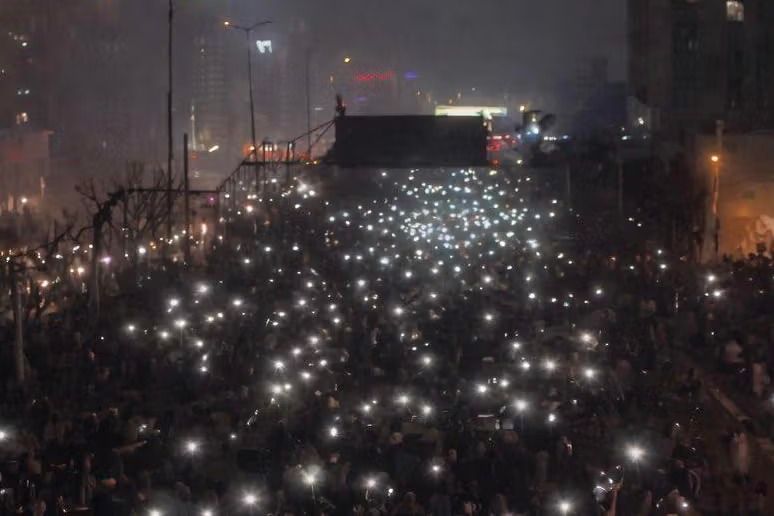
 Protest in Iran 2026, Media from the public Telegram channel Mamlekate. Photo: Mamlekate (Telegram) / Wikimedia Commons / CC BY-SA 4.0.
As US Navy battle fleets converge off the coast of Iran, Naz Massoumi interviews Eskandar Sadeghi-Boroujerdi on the roots of the recent uprising and the prospects for Iran and its people
The recent protests in Iran have been described as the most serious challenge to the Iranian government in some time, triggered initially by the sharp depreciation of the national currency. How would you characterise the dynamics of the protests, and the convergence of factors that enabled them to spread so rapidly?
The protests that erupted in Iran in late 2025 and early 2026 were initially catalysed by the sharp depreciation of the national currency, but their rapid spread and political intensity can only be understood by situating them within a longer trajectory of economic exhaustion, widening class cleavages and exploitation, and political closure. Currency collapse in Iran, a process in which United States Treasury Secretary Scott Bessent has acknowledged American involvement, is not experienced as an abstract macroeconomic phenomenon. It translates immediately into rising food prices, rent inflation, transport costs, and shortages of basic goods, and is therefore felt as a direct assault on everyday life. When the rial fell to historic lows, the effects were immediate and widely shared across social groups, from wage workers and pensioners to small traders and bazaar merchants whose livelihoods depend on price stability and reliable supply chains.
The early participation of bazaaris was particularly significant. Historically, powerful elements within the bazaar (by no means the bazaar in its entirety) have often functioned as a socially conservative constituency with ties to elites within the Islamic Republic and connected through networks of patronage and protection. Their vocal and highly visible protests indicated that the crisis had moved beyond marginal or oppositional sectors and into social layers that had previously acted as buffers for the wider political system. In its initial phase, this was not a movement driven primarily by ideological opposition, but by a shared sense that the economic ground beneath people’s feet had collapsed. Yet as the protests spiralled and diffused throughout the country, economic grievance rapidly shifted into a widespread and anti-systemic denunciations of the Islamic Republic as a whole. Slogans moved quickly from complaints about prices and wages to direct challenges to the political order and its leadership. This rapid politicisation reflected a deeper corrosion of political legitimacy which has been ongoing for several years. Few protesters appeared to believe that existing institutions were either capable of reform or responsive to popular demands.
What enabled the protests to spread so rapidly was precisely this convergence of economic shock with accumulated political apathy, alienation and disillusionment. Years of brutal economic sanctions, rampant inflation, and austerity had already hollowed out living standards and social trust. The currency collapse acted as a trigger, but the combustible material was already present. Protest did not require coordination from above because the grievances were immediately recognisable and widely shared. This explains both the speed of mobilisation and its geographic breadth, extending well beyond Tehran to provincial cities that have long borne the brunt of uneven development and state neglect.
These protests follow a pattern of earlier cycles of mobilisation in Iran including the 2009 Green Movement, the winter 2017 to 2018 unrest and the Women Life Freedom protests of 2022. How does the current moment compare with these previous challenges to the Iranian state, in terms of scale, composition, and political significance?
There are clear continuities with earlier cycles of protest in Iran, but also important differences that reflect the evolution of the country’s political economy and the steady narrowing of institutional avenues for change. The Green Movement of 2009 was rooted in electoral politics and reformist expectations. It was driven by a belief, however fragile, that the system could be pressured from within through constitutional mechanisms, legal contestation, and non-violent civic mobilisation. That horizon has since collapsed. Subsequent protest waves, particularly in 2017 and 2018, marked a decisive shift away from reformist politics toward socially driven unrest centred on economic grievance, class inequality, and long-standing regional marginalisation and underdevelopment.
The Women Life Freedom movement of 2022 represented a further qualitative break. It articulated an explicitly emancipatory rejection of gendered domination, compulsory veiling, and the everyday authoritarian regulation of women’s bodies and behaviour. While it did not coalesce into a unified political programme, it nonetheless expressed a coherent cluster of values and aspirations and fundamentally altered the political landscape by normalising open defiance of the state’s moral and disciplinary authority. The current protests unfold in the political aftermath of that moment. They are shaped by its memory, the scale of repression that followed, and the further erosion of legitimacy produced by the state’s response.
In terms of composition, the present protests are among the most socially heterogeneous since 2022, but they have been demographically dominated by a generation under thirty facing bleak economic prospects and little faith in the possibility of improvement under the existing order. For many, the issue is no longer reform or adjustment but the absence of any credible future within the status quo. In political terms, this reflects a post-reformist landscape in which protest is no longer oriented toward correcting the system but increasingly toward rejecting it as incapable of delivering either material security or political dignity. This helps explain the extraordinary geographic spread of mobilisation, with protests erupting across scores of towns and cities. Widespread immiseration and downward class mobility is clearly a central driver, but it has interacted with political repression and deepening environmental crises to produce an especially volatile conjuncture.
While many protests were peaceful, there is no denying that this cycle of mobilisation also exhibited a more violent dimension than some previous waves. It is important to approach this issue carefully, not least because of the state’s interest in exaggerating or instrumentalising violence for propagandistic purposes. At the same time, there was extensive destruction of public infrastructure, including buses, mosques, state media facilities, and police stations. The latter in particular were widely perceived (with good reason) as institutional embodiments of political and ideological authoritarianism and repression. Some reformist politicians have attributed such actions to provocations by elements within the security apparatus, while certain foreign officials, including figures in the United States and Israel, have at times openly claimed a role for their own intelligence services on the ground. In light of the events of the June war, it is highly likely that both Israel and the United States possess assets inside Iran and sought to exacerbate and take maximum advantage of the instability. What they could not do, however, was generate mass protest at this scale. The uprising was organic and rooted in genuine socio-economic and political grievance, even as it unfolded within a context of external interference and regional confrontation.
The precise extent of foreign involvement remains unclear and may never be fully known. What is clear is that the Islamic Republic responded with overwhelming force, frequently deploying lethal violence against unarmed protesters and treating the unrest as an extension of external confrontation following the June war. This does not mean that protesters shared a unified vision of what should replace the existing order, but it does point to a deepening crisis of consent and acquiescence and a political system increasingly reliant on extreme levels of violence and effectively at war with a sizeable cross section of its own population.
Although the protests began around economic grievances, what role have organised and unionised workers played in the latest wave of unrest? To what extent were there prospects for the street protests to develop into sustained labour action or strikes?
Organised labour in Iran operates under conditions of severe legal restriction and repression, and this context is essential for understanding both its presence and its limits during the latest wave of unrest. Independent unions are routinely harassed or dismantled, labour activists are arrested, and workplace organising carries significant personal risk. Under such conditions, the absence of large scale coordinated strikes should not be read as political passivity, but as the outcome of deep structural constraints that have long shaped the terrain of labour politics in the Islamic Republic.
This is not to suggest an absence of labour struggle. On the contrary, Iran has witnessed sustained and often militant labour mobilisation over many years, including high profile struggles at Haft Tappeh, Hepco, and among retirees, teachers, and contract workers. These movements have centred on wage arrears, job security, privatisation, and pension erosion, and they form an important backdrop to the current unrest. The recent protests are not disconnected from these struggles, but neither should they be conflated with them. The uprisings that spread across the country were largely spontaneous in character, even where they intersected with organised constituencies such as the bazaar in the early phase, or with anti-regime groups attempting to organise under conditions of intense repression.
The grievances animating labour protest have deep roots. Wage arrears, casualisation, the hollowing out of collective bargaining, and the steady erosion of pensions have been persistent sources of anger since at least the mid nineteen nineties, and they have intensified sharply over the past fifteen years. Workers participated in the recent protests primarily as citizens and community members rather than as organised labour blocs, reflecting both the fragmentation of labour organisation and the risks attached to overt collective action.
The prospects for sustained strikes were constrained not only by repression, but by deepening precarity produced through the interaction of United States led economic sanctions and shifts within the domestic political economy of the Islamic Republic. Sanctions intensified under the Obama administration, briefly eased following the conclusion of the JCPOA or “Iran nuclear deal”, and were then dramatically escalated after Donald Trump withdrew from the nuclear agreement in 2018 and launched the so-called “maximum pressure” campaign, effectively a strategy of all out economic warfare. These measures have contributed to chronic inflation, currency collapse, and widespread insecurity. Yet they have not operated in a vacuum. They have intersected with the priorities of powerful ruling class fractions within the Islamic Republic that have long sought to shift the costs of crisis onto society at large through austerity, subsidy withdrawal, selling off state assets, cronyism and clientelist networks, and labour market deregulation.
Over the past two decades, successive governments have steadily reduced social provision and dismantled welfare protections, while presenting market discipline, fiscal restraint, price liberalisation, and labour flexibility as the only viable response to Iran’s systemic crises. This commitment to free market orthodoxy has increasingly been treated as “common sense” within elite policy circles, even as living standards have deteriorated and inequality has deepened. Sanctions have accelerated this trajectory by constraining state revenues and providing both justification and cover for regressive economic restructuring. The result has been a sustained transfer of risk and precarity from the state and predatory oligarchs onto workers, pensioners, and the urban and provincial poor.
For many workers, the margin between subsistence and destitution has narrowed to such an extent that prolonged work stoppages become profoundly challenging. This is one of the least acknowledged consequences of economic warfare. By intensifying precarity while simultaneously legitimising domestic austerity, sanctions have fragmented labour power and weakened precisely those social forces most capable of producing durable democratic change from below. In this sense, international economic pressure and internal class politics have become mutually reinforcing, locking large sections of the population into a cycle of immiseration, protest, and repression.
What emerges is a grim and largely uncoordinated convergence between external economic pressure and internal class restructuring. US-led sanctions have systematically immiserated large sections of Iranian society (an objective for which they were explicitly designed), while the country’s ruling elites have responded by shifting the burden of economic decline onto the working and popular classes through inflation, austerity, and the hollowing out of social provision. Western policymakers are well aware that such policies generate social unrest and destabilisation, and that this unrest is likely to manifest as anti-systemic opposition to the Islamic Republic. The regime, in turn, responds with violent repression, which in this instance reached an unprecedented scale, with credible estimates indicating several thousand fatalities. Iranian workers and the population more broadly are thus caught between economic warfare from without and oligarchic predation and state violence from within.
The left and socialist movements have a long and complex history of organisation in Iran. How would you assess the current condition of the Iranian left, its influence within the protest movement, and its political prospects?
The Iranian left exists under conditions of sustained repression, organisational fragmentation, and political marginalisation, yet its social concerns remain deeply resonant. Formal left organisations inside Iran have been systematically destroyed over decades through arrests, surveillance, and the destruction of organisational capacity. Many activists have been imprisoned, forced into exile, or pushed into informal modes of organising.
Despite this, socialist ideas about economic justice, opposition to privatisation, gender equality, and labour rights circulate widely, even when they are not articulated in explicitly ideological language. Much of the protest discourse around bread, dignity, corruption, and inequality reflects concerns that have long been central to left politics. The challenge is not the absence of radical sentiment, but the absence of safe and durable organisational space in which it can be consolidated.
In the diaspora, the Iranian left faces a different set of distortions. Media and funding structures often amplify authoritarian or externally aligned figures while marginalising labour centred and feminist perspectives with deep roots inside Iran. This creates a disconnect between external representations of opposition politics and the lived realities of struggle on the ground. The political prospects of the left will depend in large part on its ability to navigate this terrain without being co-opted by either statist apologetics or philo-colonial regime change projects.
State repression has been especially severe compared to earlier protest waves, with highly contested estimates of fatalities ranging from several thousand to tens of thousands. What factors, in your view, have driven the scale and intensity of the state’s response?
The scale of repression reflects both internal fragility and external pressure. Internally, the Islamic Republic is confronting a profound legitimacy crisis without credible mechanisms of accommodation or reform. Internally, the Islamic Republic is confronting a legitimacy crisis of a different order from earlier protest waves. What distinguishes the current moment is not simply the persistence of unrest, but its breadth and diffusion across regions and constituencies that were previously regarded as politically quiescent or even loyal. The participation of bazaar merchants, provincial towns, and socially conservative strata signalled to the ruling elite that the traditional buffers insulating the system from mass unrest were eroding. In the absence of credible mechanisms for reform, mediation, or elite renewal, repression has increasingly functioned not as an emergency response but as a strategy by default.
This logic is reinforced by the institutional composition of the state itself. The Islamic Republic is a political order forged through revolution, counter-revolution, and prolonged interstate war, and its security apparatus remains central to regime cohesion. The memory of 1979, the Iran-Iraq War, and subsequent episodes of internal challenge continue to shape elite perceptions of threat. These protests were therefore interpreted not as episodic dissent but as an existential threat. In this context, the use of overwhelming force, including lethal violence against unarmed protesters, is rationalised as pre-emptive containment rather than contingent excess. The absence of meaningful channels for political accommodation, a perilous fiscal position, and the radicalisation of protesters’ demands mean that violence substitutes for the political management of discontent or its partial absorption through tactical concessions, a strategy the Islamic Republic has relied upon extensively in the past.
External pressures further intensify this dynamic. Iran has been subjected for years to a condition of effective siege, encompassing sanctions, covert operations, cyber warfare, and the recurrent threat of military escalation. This environment has profoundly shaped state responses to dissent. Protest is routinely framed through the lens of national security and external subversion, allowing the regime to collapse social grievance into the category of foreign conspiracy. This framing does not explain the origins of protest, which are overwhelmingly domestic, but it does help explain the scale and speed of repression. Economic warfare and militarised pressure strengthen the hand of the security apparatus while weakening civil society and reformist currents advocating for peaceful change or some kind of democratic transition. They also provide the ideological and institutional justification for treating popular mobilisation as an extension of external conflict rather than as a political crisis requiring negotiation.
Reza Pahlavi and his supporters in the diaspora have sought to position themselves as representatives of the protest movement while lobbying for US intervention. How would you characterise their political orientation and influence during the recent crisis?
Monarchist currents associated with Reza Pahlavi are rooted in a politics of nostalgia, recrudescent authoritarianism, social hierarchy, and alignment with imperial power. Over time, this current has also taken on increasingly explicit forms of Aryanist ethno-supremacism in stark opposition to embracing the inherent ethnic and religious diversity which characterises contemporary Iran. This has been accompanied by a hardening embrace of a chauvinistic and highly intolerant strand of ethnic nationalism. Elements within this milieu have increasingly adopted a rhetoric of national rebirth and civilisational restoration that bears uncomfortable affinities with far-right movements elsewhere.
Their open advocacy of sanctions, economic warfare, and military intervention places them in direct opposition to the material interests of Iranian workers and popular classes, who have borne the overwhelming costs of these policies. This orientation has been especially evident in their response to Israel’s war on Gaza. Leading figures within the Pahlavist camp have either openly supported Israel’s actions or remained conspicuously silent in the face of mass civilian slaughter, effectively endorsing what amounts to a genocidal campaign. This position is not incidental. It reflects a world-view in which imperial violence is normalised so long as it is directed against enemies understood as civilisational or ideological threats.
Support for Israel within these circles is best understood not as an aberration, but as a strategic and ideological choice. Israel is seen simultaneously as a model of ethno-national statehood, a key regional military power, and a crucial ally in the struggle against the Islamic Republic. Reza Pahlavi’s repeated visits to Israel, his public meetings with Israeli leaders including Benjamin Netanyahu, and his close relationship with Israeli media and advocacy networks underscore this alignment. That such ties are celebrated rather than concealed speaks volumes about the political horizon being offered. The endorsement of Israel’s war on Gaza thus sits comfortably alongside calls for sanctions and military intervention against Iran, revealing a coherent if deeply reactionary world-view.
Their growing visibility inside Iran owes less to genuine social legitimacy than to the failures of the Islamic Republic itself. The systematic destruction of reformist avenues, the repression of labour, women’s activists and civil society, and the monopolisation of state media by an ideologically zealous faction of the ruling elite have created conditions in which alternative narratives circulate largely through foreign based Persian language broadcasters. Channels such as Iran International and Manoto TV have invested heavily in rehabilitating a sanitised and misleading image of the Pahlavi era, while benefiting from the collapse of public trust in Iranian state television. Their reach reflects popular desperation and media paucity rather than endorsement of monarchist politics as such.
The prominence of Pahlavist figures in Western media and policy circles similarly reflects geopolitical utility rather than domestic credibility. They articulate a narrative that aligns neatly with interventionist agendas, presenting themselves as viable intermediaries for regime change while remaining disconnected from the social forces driving protest inside Iran. They are acutely aware that they lack the capacity to dislodge the Islamic Republic through internal mobilisation alone, which is precisely why they have long advocated external intervention and imperial aggression, even at the cost of plunging the country into chaos or war. Replacing one authoritarian elite with another under conditions of foreign tutelage does not constitute self-determination and almost certainly reproduces domination in a different form, while leaving the working population to pay the price.
Following the Israeli and US bombing of Iran last June, the latest protests have unfolded in a context of sanctions and intensified foreign pressure. How likely is a US attack, and what are the most plausible scenarios that might follow from this conjuncture?
Assessing the likelihood of a direct US attack is always difficult, but recent developments suggest a pattern of escalation designed to maximise leverage rather than to initiate full scale intervention (at least for the moment). But the reality is that imperial aggression of this nature has the capacity to unleash a series of events which few, especially its architects, can foresee. The Trump administration’s mobilisation of a veritable “armada” as he put it, including the USS Abraham Lincoln, evokes an older logic of gunboat diplomacy, signalling an explicit threat of war if the US objective of “total surrender” isn’t met. This military posturing operates alongside sanctions, covert action, cyber warfare, and regional proxy conflict, which together constitute a form of ongoing economic and strategic warfare that keeps Iran in a permanent state of precariousness. These measures have contributed to currency volatility, inflation, and investment collapse, thereby intensifying social conflict and political strain inside Iran.
At the same time, the Islamic Republic has thus far retained the coherence of its armed forces, with no significant defections. This suggests that, despite deep social discontent, the core of the security apparatus remains intact. Israeli decision makers have pushed aggressively for regime change, most recently during Operation Rising Lion, operating on the assumption that a sustained aerial campaign and the decapitation of senior IRGC leadership might trigger an internal collapse. This calculation proved mistaken. Not only did the anticipated uprising fail to materialise, but there was briefly a rally around the homeland effect, as external attack reinforced nationalist sentiment and regime cohesion. That effect, however, was short lived. It quickly dissipated under the weight of continuing economic deterioration, which remains severe and structurally unresolved. It is difficult to see how the Islamic Republic’s predicament could improve meaningfully without sanctions relief. Yet sanctions are far easier to impose than to remove, and their removal carries significant political costs in Washington. While Trump could in principle roll back substantial elements of the sanctions regime through executive action, even without dismantling it entirely, the question is whether he is willing to incur the domestic and geopolitical costs of doing so.
Here the role of Israel becomes central. Netanyahu has every incentive to obstruct any diplomatic off ramp and has already sought to poison the well by expanding the scope of negotiations, most recently by insisting that Iran’s ballistic missile programme be placed on the agenda. Such demands are designed less to reach an agreement than to ensure that talks fail, thereby sustaining a climate of confrontation. This strategy is reinforced by powerful constituencies within Trump’s donor base that are strongly aligned with Israeli priorities and view the Islamic Republic as one of the last remaining obstacles to untrammelled regional dominance. It is therefore difficult to imagine these forces acquiescing quietly to a renewed diplomatic settlement.
The broader regional context further complicates matters. The devastation of Gaza and the grotesque spectacle of Trump’s so-called Board of Peace, an initiative that sought to override decades of multilateral institution building and international legal norms, reveal not only the administration’s contempt for international law, but also the limits of Trump’s own populist rhetoric. Many within his electoral base supported him on the assumption that he would bring the so-called forever wars in the Middle East to an end. That belief was always misplaced as we well know, even if it proved electorally effective. The current trajectory suggests not de-escalation, but a volatile mix of coercion, diplomatic sabotage, and regional militarisation, in which the risk of another full-blown conflict remains ever present (especially if Trump deems that the Islamic Republic is internally vulnerable), even if full scale war is not the preferred outcome of the US administration.
Finally, are there any strategic lessons that can be drawn from this latest round of protests for activists both inside and outside Iran?
Any discussion of strategic lessons needs to begin with a basic principle of political humility. It is not the place of commentators or activists outside Iran to prescribe pathways of struggle, forms of organisation, or political outcomes for those living under conditions of severe repression. People inside Iran are confronting extraordinary risks, and they alone can determine how, when, and in what ways they contest the structures that dominate their lives. For those of us with family, loved ones, and close ties to the country, this is not an abstract point. It is a matter of unqualified solidarity with those facing authoritarian violence at home and the pressures of imperial aggression from abroad, without assuming the authority to speak over them or dictate the terms of their liberation.
What can be said, however, is that the rejection of false binaries is essential. Opposing the authoritarian structures and exploitative conditions that hobble Iran’s working and popular classes does not require endorsing sanctions, military threats, or externally imposed regime change. At the same time, demands for accountability for those responsible for repression, and for justice for the victims of the Islamic Republic, remain a legitimate and necessary part of what the left outside Iran can and should articulate. Equally, opposing imperialism does not require silence about state violence, repression, or the crushing of labour, feminist, and civil society movements. Any serious emancipatory politics must be capable of holding these positions together, rather than collapsing into apologetics on one side or instrumentalisation on the other.
For those outside Iran, particularly in the West, the responsibilities are clearer. Sanctions must be opposed categorically. They function as a form of collective punishment that is largely invisible to those who design them but devastating for those who live under them, eroding access to medicine, food security, employment, and basic social reproduction. They do not weaken authoritarianism in any progressive sense, in fact there are very solid empirical grounds for believing they entrench it in all sorts of pernicious ways. They immiserate society, generate black markets and smuggling networks, fragment collective organisation, and tilt the balance of power toward the most coercive apparatuses of the state at the expense of civil society and democratic movements. Opposition to sanctions is therefore not a concession to the Islamic Republic, but an expression of solidarity with the working and popular classes who bear their costs.
At the same time, Western military intervention and coercive diplomacy must be rejected without equivocation. Decades of intervention have devastated the region, destroyed entire societies, and entrenched cycles of violence and dependency. Since the invasion of Iraq, and even more starkly in the context of the genocide in Gaza, Western claims to act in the name of democracy, human rights, or international order ring hollow. They are morally bankrupt and politically discredited. To invoke such powers as agents of liberation for Iran is not only historically illiterate but ethically indefensible.
What is unfolding in Iran is not a singular or isolated crisis. It is the product of a long running interaction between authoritarian governance, oligarchic predation, deepening class inequality, environmental degradation, and sustained imperial confrontation. Any meaningful engagement, whether analytical or political, must begin from that recognition. Solidarity, in this context, is not about offering blueprints or slogans. It is about refusing complicity in policies that intensify suffering, amplifying voices rooted in lived struggle rather than geopolitical instrumentality or cynicism and standing firmly against domination in all its forms.
Eskandar is a Lecturer in the International Relations of the Middle East at the University of St Andrews. He is the author of Revolution and Its Discontents: Political Thought and Reform in Iran.
Before you go
The ongoing genocide in Gaza, Starmer’s austerity and the danger of a resurgent far right demonstrate the urgent need for socialist organisation and ideas. Counterfire has been central to the Palestine revolt and we are committed to building mass, united movements of resistance. Become a member today and join the fightback.
