
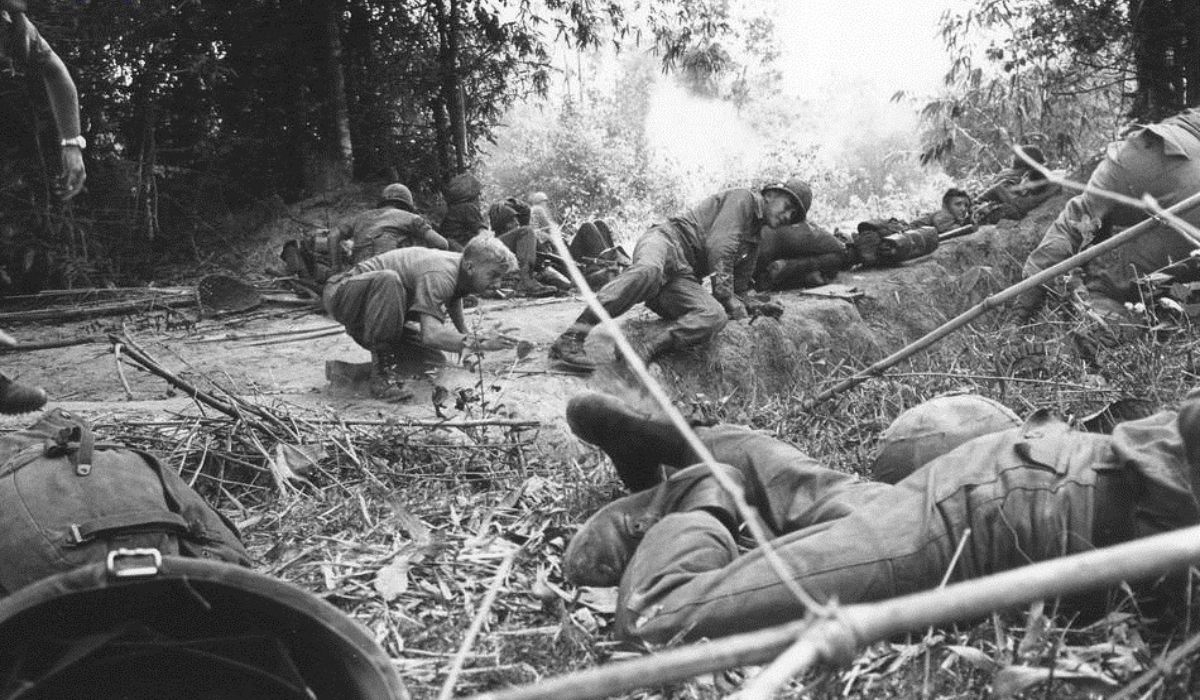
 Soldiers of the 28th Infantry's 1st Battalion scramble for cover as Vietnamese fighters open fire from concealed tunnels. Source: TommyJapan1 - Flickr / cropped from original / CC BY 2.0
The US government’s assumption that it could easily defeat the Iranian state comes in a long line of imperialist miscalculations that ended in disaster, explains Chris Bambery
Throughout history, there are many examples of imperialist powers coming unstuck because they underestimated their enemy. That underestimation comes from an admix of arrogance and racism that breeds a feeling of invincibility in the might of empires.
The ruling class need to know their history if they are going to avoid repeating the same mistakes, but it looks like there is a bad case of collective amnesia in Washington. They thought their war with Iran would be over in days, and now seem incapable of understanding how they have finished up in a humiliating stalemate.
Here are some lessons that Trump and his MAGA crew could learn from.
Let’s take June 1941 and Hitler’s decision to invade the Soviet Union. The Wehrmacht had spectacularly swept through Poland, Norway, the Low Countries and had taken France, reversing the humiliation of 1918.
Berlin believed that a war with the Soviet Union would be over in three or four months because, as Hitler explained to his lapdog general staff, the ‘Jewish-Bolshevik elite’ presided over a rotten system that would collapse. All they had to do to bring it down was ‘kick the door in’.
The German general staff fed Hitler’s ego, and instead of cautioning a man who had only reached the rank of corporal in the First World War, they constantly told him what he wanted to hear. The invasion, Operation Barbarossa, was bound to win because, as General Halder explained in a planning conference attended by the Führer, ‘The Red Army is leaderless’. Germany, he argued, was superior in leadership, equipment and fighting troops. The Red Army would be broken into fragments, and disaster would overtake the Soviet Union.
There was some basis to this. Stalin’s purges had destroyed much of the Red Army’s command and officer corps. Under the terror, taking the initiative was dangerous. Stalin refused to believe that Hitler would break the Molotov-Ribbentrop Pact they had signed in August 1939.
When Operation Barbarossa was launched, the Red Army was completely unprepared. As Hitler’s panzers crossed the borders of the Soviet Union, German bombers annihilated Stalin’s air force before it got off the ground.
However, the Red Army survived. The main defence of the Soviets was land, the vast expanses that had drawn Napoleon’s armies to destruction. Hitler’s arrogance, after the initial spectacular successes of the invasion, led to him thinking he could take the city which bore his rival’s name: Stalingrad. The hell of Stalingrad led to a major defeat and the beginning of the end for Operation Barbarossa that ended with Russian troops taking Berlin.
The primary reason why Hitler and his generals underestimated the enemy was their vile, genocidal racism that posited German superhumans (Übermenschen) against Slavic subhumans (Üntermenschen).
A pattern of imperial overreach
The racist arrogance of Hitler was not peculiarly German, though. In late 1941, British anti-Japanese racism played a major role in the underestimation of Japanese power. Air Marshal Robert Brooke-Popham said, after a visit to Hong Kong, that he ‘had a good close-up, across the barbed wire, of various sub-human specimens dressed in dirty grey uniforms, which I was informed were Japanese soldiers’.
Those same soldiers went on to rout the British in Malaya. The British refused to believe that the Japanese could advance through dense jungle and concentrated on defending the few metalled roads. They ignored the warnings of the locals who knew of trails through the jungles, only to discover that they had been outflanked by the Japanese ‘sub-humans’ who had used local knowledge to confound Malaya’s imperial masters.
The nadir of the British Empire was the subsequent surrender of ‘Fortress Singapore’ by a numerically smaller Japanese army. That effectively decided the fate of the British Empire in Asia, and gave a huge boost to the campaign for Indian independence.
I have already written about the war in Vietnam, but to reprise my main argument, the Americans had an essentially colonial view of the Vietnamese and massively underestimated the strength of nationalism, believing that their technological advantage would deliver victory. As the Vietnamese resistance took its toll the US climbed up the escalation ladder so that more than 2.7 million service personnel ended up serving in Vietnam., but all to no avail.
When the US and their allies decided to invade and occupy Afghanistan in 2001, their British allies should have reminded them that twice in the nineteenth century Britain had tried to take the country with disastrous results.
The First Afghan War, 1838-1842, saw the Brits occupy Kabul but then were forced to retreat to India. The main force was almost completely wiped out. The Second Afghan War, 1878-1880, was slightly more successful but at a huge cost. The defeat of the most powerful empire in history should have dented British arrogance, but the scions of empire had to hold their nerve.
In his ‘The Young British Soldier’ by empire fan boy, Rudyard Kipling, offered new recruits to the British army a bit of telling advice:
‘When you’re wounded and left on Afghanistan’s plains,
And the women come out to cut up what remains,
Jest roll to your rifle and blow out your brains
An’ go to your Gawd like a soldier’.
Better advice would have been for the soldiers to turn their guns on those who started the war, and that advice still holds.
But back in 2001, no one seemed to remember all this. The Taliban were driven out only to sweep back to victory in 2021. The Americans had to beat a chaotic and humiliating withdrawal.
Now here we are again.
Trump has massively underestimated the Iranians, just as his predecessors did the Vietnamese and the Taliban. Now he is trying for a deal, but whether or not the Iranians will accept his overtures is another matter. He is also threatening them with the big stick if they don’t submit.
Behind all this is the fact that the Iranians have been preparing for this war for decades. The Americans don’t seem to realise this is one of the oldest civilisations in the world, with a strong sense of national pride.
Once again, imperial arrogance has been exposed. We must learn the lessons from history that they never will.
Chris Bambery is the author of The Second World War: A Marxist History, (Pluto Press, 2014)

Chris Bambery
Chris Bambery is an author, political activist and commentator, and a supporter of Rise, the radical left wing coalition in Scotland. His books include A People's History of Scotland and The Second World War: A Marxist Analysis.