
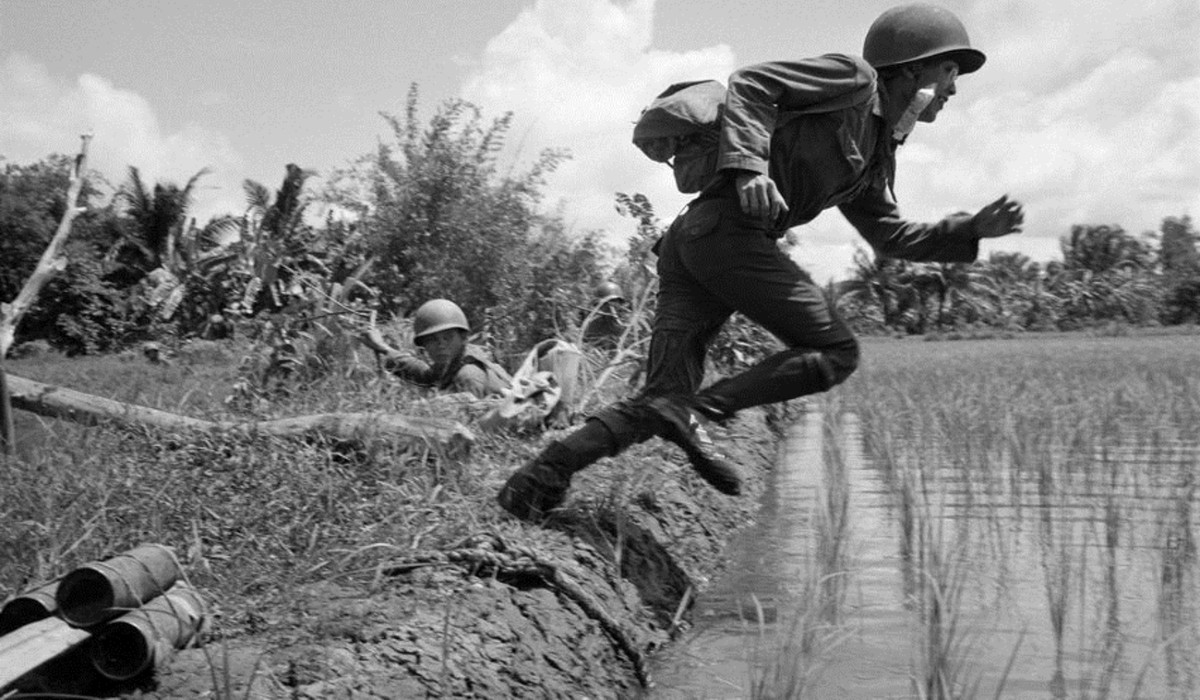
 Vietnamese medic during Vietnam war. Photo: TommyJapan1 / Flickr / CC BY 2.0
The US suffered an epochal defeat in its intervention in Vietnam, but the lessons from that war have been forgotten or ignored now in the attack on Iran, argues Chris Bambery
Last week Reuters reported: ‘U.S. intelligence indicates that Iran’s leadership is still largely intact and is not at risk of collapse any time soon after nearly two weeks of relentless U.S. and Israeli bombardment, according to three sources familiar with the matter.
‘A “multitude” of intelligence reports provide “consistent analysis that the regime is not in danger” of collapse and “retains control of the Iranian public,” said one of the sources, all of whom were granted anonymity to discuss U.S. intelligence findings.’
So much for Trump and Netanyahu’s hopes for rapid regime change.
Despite that, Pete Hegseth, Secretary of State for War, continues to give upbeat briefings saying Iran is being degraded and cannot resist. Facts don’t get in his way.
Few wars go to plan and virtually none to the planner’s timetable. This one hasn’t. It was meant to be over in four or five days. In this sense, if in few others, there is an interesting parallel with America’s war in Vietnam.
Cold War blinkers
The US entered the Vietnam because it saw it through the false lens of Cold War principles, above all that to protect the geo-political grand area of US influence from communist expansion, ‘containment’ was necessary to meet the constant communist threat.
Mao Zedong’s victory in China in 1949, with the proclamation of the People’s Republic, was a major defeat for the US. Washington became certain that the expansion of communism in Asia would follow and that had to be stopped. As a consequence, Washington entered the escalatory ladder of intervention and oversaw the expansion of the already huge military-industrial complex needed to achieve an elusive victory, starting with the Korean War.
Gabriel Kolko points out that Washington was less interested in Vietnam than the global situation it believed it confronted: ‘Washington always saw the challenge of Indochina as just one part of a much greater problem it confronted throughout the world. Vietnam became the conjunction of the postwar crisis of U.S. imperialism at a crucial stage of America’s much greater effort to resolve its own doubts about its capacity to protect the larger internal socioeconomic environment in which its interests could survive and prosper.’[1]
A 1964 National Security Council document, argued that Vietnam was, ‘a test case of U.S. capacity to help a nation to meet the Communist “war of liberation”.’[2] US intervention began early, in the failed war France fought with the Viet Minh to recover its old colony from 1946 to 1954. The US paid approximately 82% of French costs.[3]
The Americans had known Ho Chi Minh and the Viet Minh in World War II when both were fighting imperial Japan, which had occupied Vietnam. They should have grasped the Viet Minh’s aim was national independence and they would have been satisfied with that. But Cold War blinkers meant Washington never understood this.
After the Viet Minh’s seismic victory over the French at Dien Ben Phu, there was a ceasefire. The French and Vietnamese, along with representatives from the United States and China, then met in Geneva in mid-1954 to discuss the future of Indochina. They reached two agreements.
First, the French and the Viet Minh agreed to a temporary division of the country along the seventeenth parallel. French forces would remain in the south, and Ho Chi Minh’s forces would control the north. The second agreement promised that neither the north nor the south would join alliances with outside parties and called for general elections in 1956.
The United States did not sign the second agreement, establishing instead its own government in South Vietnam. The elections, which Ho Chi Minh would have won, never happened. As the French pulled out, the United States appointed Ngo Dinh Diem to lead South Vietnam. He had little popular support and ran a repressive dictatorship.
Escalating intervention
Beginning in 1960, communist forces (which eventually became known as the National Liberation Front (NLF) launched a guerilla war against the South Vietnamese regime in response to that repression. From 1960 to 1965, the regime failed to contain this insurgency, despite massive US aid and US training of their forces.
The direct intervention of the US began in December 1961 under President John F Kennedy. The Kennedy administration believed it could hold the line against communist expansion in Vietnam while limiting the war to South Vietnam. Its goal was to show that a national-liberation movement could be defeated without the conflict escalating into a larger war. Kennedy unleashed the American air force against Vietnamese villagers, authorised napalm, and started crop destruction.
The turning point in America’s escalation was the so-called Gulf of Tonkin incident. In August 1964, two US destroyers off the coast of North Vietnam reported they were under attack by North Vietnamese vessels and that they were returning fire. Later investigation revealed that the 4 August attack did not happen; no North Vietnamese vessels had been present. That did not prevent the Johnson administration using the event to escalate further.
The US began carpet bombing North Vietnam in 1965, hoping Hanoi would use its influence to call off the insurgency in the South. At that time, there were no North Vietnamese troops in South Vietnam. Washington anticipated when they began bombing the North that it would bring North Vietnamese troops into the South. When it did, Washington then lied that US intervention was done to resist an invasion from the North.
America quickly ran into two problems. The first was that North Vietnam did not stand aloof but escalated the war by intervening in the south. In response, President Lyndon Johnson escalated the American intervention. The second was that the NLF could draw on support in the countryside because they were fighting for national sovereignty, and they promised land reform. As Gabriel Kolko argues, the struggle for land became ‘the engine of the Vietnamese Revolution …’.[4] The policies of the United States and its South Vietnamese client alienated the mass of the population, but in contrast the Communist Party integrated them into its military and political programs, prosecuting a ‘people’s war’.
The idea America was fighting a ‘just war’ or was winning was exploded by the Tet Offensive in January 1968 when a surprise offensive by the NLF took, overnight, all of South Vietnam’s cities and the US embassy in Saigon. The Americans would eventually defeat the NLF but the latter had achieved a political victory. It was clear they had popular support and the Americans had no political solution. Within America, TV footage of US troops and CIA men attacking their own embassy sent the message that the war was unwinnable.
It was also clear that opposition to the war was very apparent within US forces in Vietnam, particularly the conscripts. Noam Chomsky points out: ‘… the America army began to deteriorate internally because, after all, the United States was fighting a very unusual type of war. It’s very rare for a country to try to fight a colonial war with a conscript army. Usually wars like the Vietnam war are fought with mercenaries — like the French Foreign Legion. The U.S. tried to fight what amounts to a colonial war with a conscript army. And a colonial war is a very dirty kind of war. You’re not fighting armed forces. You’re fighting mostly unarmed people … it couldn’t take it after awhile. It’s not the kind of job you can give to conscripts who are not trained to be murderers.’
The strategists attempted to use South Vietnamese forces more and more in the front line, Vietnamisation, to fight a more capital-intensive war with less direct participation of American ground troops. That would include mass bombing across Vietnam, the use of chemical weapons and the extension of the war to Cambodia and Laos. But the South Vietnamese army was not capable of fighting and winning a war because it had no loyalty to the regime in Saigon while the air war simply increased the resolve of the Vietnamese people. The writing was on the wall and even the US elite came to realise that.
Technology did not beat nationalism
The essential reason the United States failed at each stage of this step up the escalatory ladder was because its efforts to sustain a client regime in Saigon ran up against the ‘tidal political force’ of Vietnamese nationalism. There was no political base on which to build a solid government of South Vietnam. North Vietnam and the National Liberation Front, by contrast, displayed great ‘courage and stamina’ in standing up against what ‘in the annals
of warfare was an unprecedented tonnage of bombs and napalm.’[5]
Because of that, Kolko argues that the US relied on technology to compensate for its failure to build a solid government in Saigon. So, they ‘unleashed the greatest flood of firepower against a nation known to history,’ causing in Vietnam ‘monumental’ human suffering and social and economic dislocation.
This strategy was massively expensive and, by 1968, it was heavily impacting on the US economy. Johnson’s promise of a ‘Great Society’ drained away because the finance was not there and Johnson declined nomination for the US presidential election.
By this time, the mood in America towards the war had decisively shifted against the war, the numbers refusing to be drafted were rising and the anti-war movement was mushrooming. The war had come home and the American elite would face a political defeat which would force it to step off the escalatory ladder and withdraw from Vietnam in 1973.
Two years later, the North Vietnamese and the NLF achieved their military victory and the unification of Vietnam. It was a decisive defeat for the USA which took them a decade and a half from which to recover.
Fifty-eight thousand US service personnel died. The United States unleashed an estimated thirty billion pounds of munitions in Southeast Asia. At least three million Vietnamese died violent war deaths, an estimated 11.7 million South Vietnamese were forced from their homes, and up to 4.8 million were sprayed with toxic herbicides like Agent Orange.
America entered a war with no off ramp. It never understood the potency of Vietnamese nationalism and while air power inflicted terrible destruction, it did not break the resolve of the Vietnamese people. Do you see some parallels there with the Iran war?
[1] Gabriel Kolko, Anatomy of a War: Vietnam, the United States, and the
Modern Historical Experience (New York: Pantheon, 1985), p.79.
[2] ibid. p.138.
[3] M. S. Shivkumar, ‘Reconstructing Vietnam War History’, Economic and Political Weekly 31 (1996), p.21.
[4] Gabriel Kolko, Anatomy of a War, p.389.
[5] George McTurnan Kahin, Intervention: How America Became Involved in Vietnam (New
York: Random House 1986), p.249.
Before you go
The ongoing genocide in Gaza, Starmer’s austerity and the danger of a resurgent far right demonstrate the urgent need for socialist organisation and ideas. Counterfire has been central to the Palestine revolt and we are committed to building mass, united movements of resistance. Become a member today and join the fightback.

Chris Bambery
Chris Bambery is an author, political activist and commentator, and a supporter of Rise, the radical left wing coalition in Scotland. His books include A People's History of Scotland and The Second World War: A Marxist Analysis.