
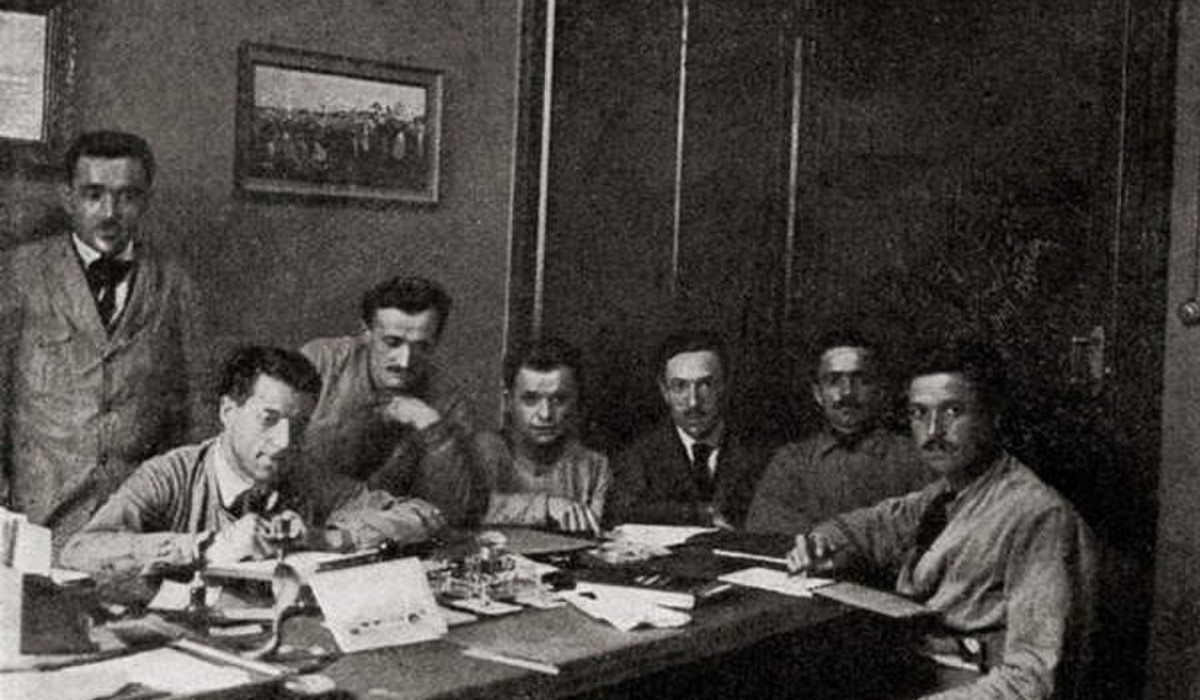
 Workers' occupation of the Fiat factory in Turin during Biennio Rosso, Italy 1920. Unknown author / public domain
The ruling class dominates through a combination of coercion and consent. Building a revolutionary party is crucial to tackling this, explains Chris Bambery
Antonio Gramsci was a committed internationalist, but he was fighting within the confines of a nation state, Italy. The Prison Notebooks examine the terrain on which that fight had to be waged.
For Gramsci Italy was a “bastard” state. National unity had been largely achieved in 1861 not through popular revolution but through the diplomatic and military manouvres of the Kingdom of Piedmont. There was a degree of popular involvement but the Italian peninsula was effectively absorbed into the Piedmontese state.
All of this ensured the Risorgimento (the process of national unity) ended without the new bourgeois state having a mass base. That meant while it tried to rule via consent whenever it faced a challenge from below, as it did often, it turned to coercion.
Gramsci contrasts it with the great French Revolution beginning 1789, describing the Risorgimento a “revolution without revolution,” and a “royal conquest” and not “popular movement.” [i]
Gramsci would then extend the concept of Passive Revolution to explain the process of German Revolution, completed by Bismarck in 1871. Here he argues that the European wide revolutions of 1948 had shown the bourgeoisie to be no longer a revolutionary class. Scared of a growing working class they had sheltered behind the old absolutist states when popular revolution commenced.
Gramsci argued that the Risorgimento included elements of revolution but also the maintenance of many of the old power structures. In many ways the state took the lead in renewing Italian society.
Returning to this, Gramsci wrote:
‘Restoration becomes the first policy whereby social struggles find sufficiently elastic frameworks to allow the bourgeoisie to gain power without dramatic upheavals, without the French machinery of terror. The old feudal classes are demoted from their dominant position to a “governing” one, but are not eliminated, nor is there any attempt to liquidate them as an organic whole; instead of a class they become a ‘caste’ with specific cultural and psychological characteristics but no longer with predominant economic functions.’ [ii]
The process of passive revolution was described by Gramsci as being ‘not so much a question of freeing the advanced economic forces from antiquated legal and political fetters but rather of creating the general conditions that would enable these economic forces to come into existence and grow on the model of other countries.’[iii]
Italy did industrialise in the years around the First World War but it was restricted to the triangle of Turin, Milan and Genoa. The south and the islands remained agricultural with landless labourers working the great estates of an agrarian elite. The result was a stark contrast with dire poverty in the south. That divide remains today.
However, the Italian bourgeoisie was relatively weak and did not hegemonise society. That meant its rule effectively collapsed when faced with the revolutionary crisis of 1919-1920, with fascism filling the vacuum.
For Gramsci, a hegemonic class held state power not only through its coercive power and its economic supremacy but political, moral, and intellectual dominance. Hegemony means that the subordinate classes do not just accept these, but themselves articulate the key elements of the ruling class’s ideological discourse.
These were diffused through civil society (the family, churches, the media, schools, the legal system, trade unions, and cultural and economic associations) so that members of the subordinate classes would accept these discourses as their own.
According to Gramsci’s famous definition:
‘… the State is the entire complex of practical and theoretical activities with which the ruling class not only justifies and maintains its dominance, but manages to win the active consent of those over whom it rules.’ [iv]
Gramsci explains that ‘The supremacy of a social group manifests itself in two ways, as ‘domination” and as ‘intellectual and moral leadership’.[v]
The capitalist ruling class has the capability, ‘of absorbing the entire society, assimilating it to its own cultural and economic level.’ [vi]
Coercion and consent exist together, side by side. The bourgeois state is an ‘integral state, combining both a repressive force and a network of social relations for the production of consent in which both are united and distinct.
In Britain, for example, the ruling class rules largely via consent, but is quick to turn to coercion if challenged. Where the ruling class is weaker and much less rooted it will generally involve greater use of coercion.
For Gramsci a class is leading and dominant; it provides moral and intellectual leadership and domination.
The ‘multiple elements of “conscious leadership”,’ which exist in any spontaneous struggle, need to come together to fight for the new conceptions. The struggle for ideological hegemony therefore also involves the struggle to build a revolutionary party – ‘the modern prince’:
“A human mass does not ‘distinguish’ itself, does not become independent in its own right without, in the widest sense, organising itself; and there is no organisation without intellectuals, that is without organisers and leaders, in other words, without the theoretical aspect of the theory-practice nexus being distinguished concretely by the existence of a group of people ‘specialised’ in conceptual and philosophical elaboration of ideas.” [vii]
He goes on to further explain the role political parties play:
“The political party, for all groups, is precisely the mechanism which carries out in civil society the same function as the State carries out, more synthetically and over a larger scale, in political society. In other words it is responsible for welding together the organic intellectuals of a given group – the dominant one – and the traditional intellectuals. The party carries out this function in strict dependence on its basic function, which is that of elaborating its own component parts – those elements of a social group which has been born and developed as an “economic” group – and of turning them into qualified political intellectuals, leaders [dirigenti] and organisers of all the activities and functions inherent in the organic development of an integral society, both civil and political. Indeed it can be said that within its field the political party accomplishes its function more completely and organically than the State does within its admittedly far larger field. An intellectual who joins the political party of a particular social group is merged with the organic intellectuals of the group itself and is linked tightly with the group. This takes place through participation in the life of the State only to a limited degree and often not at all. Indeed it happens that many intellectuals think that they are the State, a belief which, given the magnitude of the category, occasionally has important consequences and leads to unpleasant complications for the fundamental economic group which really is the State.” [viii]
The working class is capable of developing its own organic intellectuals. The task of a revolutionary party is to direct the activity of these organic intellectuals and to forge a link between the class and certain sections of the traditional intelligentsia.:
“It is through this assumption of conscious responsibility, aided by absorption of ideas and personnel from the more advanced bourgeois intellectual strata, that the proletariat can escape from defensive corporatism and economism and advance towards hegemony.” [ix]
Regarding this Joseph A. Buttigieg notes:
“When he wrote about the Italian intellectuals in “Some Aspects of the Southern Question,” Gramsci was intervening in a very specific polemic about the relationship of his Party to the peasants and he was also arguing for a political alliance between the peasants and the proletariat.” [x]
In conclusion, Gramsci’s described the formation of a “Modern Prince” as an “organization of struggle.” [xi]
Gramsci was writing for his own ends, one of which was the construction of a revolutionary party with a clear strategy for carrying through revolution.
[i] William K. Carroll, The Elgar Companion to Antonio Gramsci, Edward Elgar Publishing, 2024, P87
[ii] Antonio Gramsci, Selections from the Prison Notebooks, (London: Lawrence and Wishart, 1971), P115.
[iii] Antonio Gramsci, Prison Notebooks, Vol 3, ed. Joseph Buttigieg, (New York: Columbia University Press, 2011), P60.
[iv] Antonio Gramsci, Selections from the Prison Notebooks, (London, Lawrence and Wishart, 1971), P244
[v] Antonio Gramsci, Selections from the Prison Notebooks, (London, Lawrence and Wishart, 1971), P57
[vi] Antonio Gramsci, Selections from the Prison Notebooks, (London, Lawrence and Wishart, 1971), P260
[vii] Antonio Gramsci, Selections from the Prison Notebooks, (London, Lawrence and Wishart, 1971), P644
[viii] Antonio Gramsci, Selections from the Prison Notebooks, (London, Lawrence and Wishart, 1971), P15
[ix] Quintin Hoare and Geoffrey Nowell Smith, Introduction, The Intellectuals, in Quintin Hoare and Geoffrey Nowell Smith (editors), Antonio Gramsci, Selections from the Prison Notebooks, Lawrence and Wishart, 1971, P4
[x] Joseph A. Buttigieg, The Legacy of Antonio Gramsci, boundary 2, Vol. 14, No. 3, The Legacy of Antonio Gramsci (Spring, 1986), P14
[xi] Antonio Gramsci, Selections from the Prison Notebooks, Lawrence and Wishart, 1971, P335
Before you go
The ongoing genocide in Gaza, Starmer’s austerity and the danger of a resurgent far right demonstrate the urgent need for socialist organisation and ideas. Counterfire has been central to the Palestine revolt and we are committed to building mass, united movements of resistance. Become a member today and join the fightback.

Chris Bambery
Chris Bambery is an author, political activist and commentator, and a supporter of Rise, the radical left wing coalition in Scotland. His books include A People's History of Scotland and The Second World War: A Marxist Analysis.