
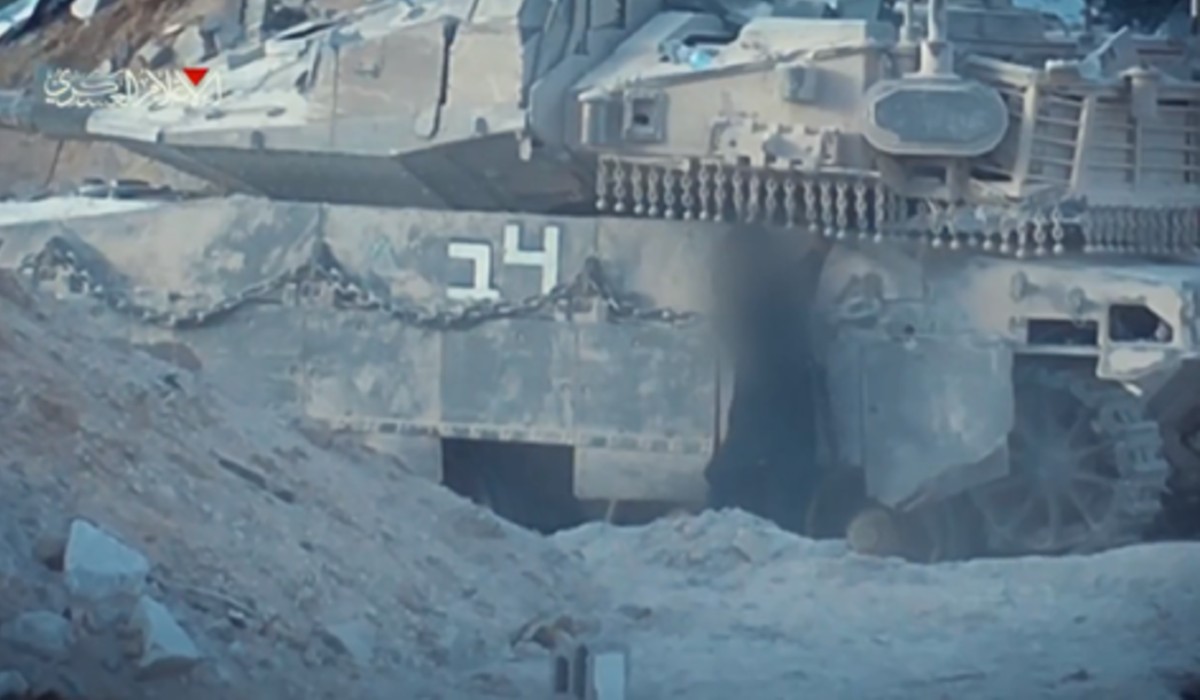
 A Palestinian fighter places an explosive device under the turret of an Israeli Mekava 4 tank, Gaza City, September 2025. Photo: Screenshot from video https://southfront.press/hamas-shares-daring-combat-footage-from-gaza-city/
Although Western media ignore it, other sources make clear that armed resistance in Gaza continues, and is exacting a toll on Israel, explains Robert Dale
Have you ever wondered why the Israeli forces haven’t yet managed to occupy the whole of Gaza? After all, they have bombed the entire place into rubble and dust. If there was a serious insurgency, we’d be hearing about it in the news, surely? If there was footage of Israeli tanks being blown up, they’d show it on the TV news, wouldn’t they?
Well, no. We are being kept in the dark. The resistance is still fighting, two years after 7 October 2023. Information is hard to come by, and even harder to collate into a coherent picture. But the fragments reveal enough.
The Israeli army (IDF) still does not have control of Gaza City. Its latest attempt began in mid-September, and has not been a walk-over. Resistance fighters have evidently survived in the tunnels and ruins, and are inflicting painful losses on the IDF.
One source is Israeli’s own media, which report a good deal more than ours do: ‘Eleven IDF soldiers were wounded in Gaza City on Monday [29 Sept]’ (Jerusalem Post). ‘IDF soldier killed in Hamas sniper attack on Gaza City guard post’ [on 24 Sept] (Times of Israel). The sniper got away. On 27 September, the Jerusalem Post wrote that ‘The IDF now controls several neighborhoods across Gaza City.’ In other words, it does not control most of them.
The fighting is not limited to Gaza City. ‘Five rockets were fired from the northern Gaza Strip at the coastal city of Ashdod on Wednesday evening [1 October] during Yom Kippur’ (Times of Israel). ‘On Thursday [2 October], an officer was seriously injured and two troops were lightly hurt in an attack on an army post in central Gaza’ (Times of Israel).
In fact, it appears Israeli forces are still vulnerable anywhere in Gaza: ‘Four Israeli soldiers were killed and three others were wounded in a roadside bomb attack in southern Gaza’s Rafah on Thursday morning [18 September]’ (Times of Israel). ‘Although the area had been previously checked using various techniques, Hamas has sometimes proven adept at placing IEDs between checks’ (Jerusalem Post).
The ordinary soldiers have noticed: ‘Four Nahal Brigade soldiers were sentenced to 10 days in prison after refusing to travel in an unarmored Humvee in broad daylight along a dangerous route in the Gaza Strip’ (Haaretz, 1 October).
There is a smouldering low-level insurgency in the West Bank too. ‘A soldier in the 890th Paratroopers Battalion fell [on 28 September] during an operation at Jit Junction in the northern West Bank.’ Two Palestinians ‘attempted to run over and shoot at IDF soldiers at the Bell checkpoint in the West Bank on Thursday [2 October]’. A similar combined ramming/stabbing incident happened on 30 September. Tulkarm under lockdown after APC hit by roadside bomb on 9 September (all from Jerusalem Post).
It’s all pretty murky. But one thing is clear if we put the pieces together: two years in, resistance fighters are alive and active. Strong enough to keep the occupying Israeli forces out of much of Gaza City. Active enough to prevent them moving freely throughout the Strip.
Anti-colonial resistance
In the Western public sphere, and in the solidarity movement, the discussion has revolved very much around the suffering, the humanitarian emergency, the dying. We have fought, successfully, to put the genocide on the public agenda. That has achieved results, nudging the dial.
But, I am treading carefully here in view of Britain’s restrictions on freedom of expression, future military historians might one day conclude that what we are witnessing today was also an astonishing episode of anti-colonial resistance. After all, the African National Congress was widely classified as terrorist at the time. The European Center for Constitutional and Human Rights points out:
‘Yesterday’s terrorists can be tomorrow’s heads of state or allies. The clearest example: the case of Nelson Mandela, whose name wasn’t removed from US terrorist lists until just a few days before his 90th birthday in 2013, shortly before his death. The USA had added Mandela and his organization, the African National Congress (ANC), to the lists during the 1980’s. In the intervening period apartheid was abolished, Mandela was democratically elected president of South Africa and went on to be awarded the Nobel Peace Prize.’
Diplomat-turned-dissident Craig Murray has argued: ‘In stark contrast to the illegal acts of the occupying power, the Palestinian people do have the right of armed resistance in international law. This right is founded on the right of self-determination in the UN Charter and is encapsulated in the First Protocol of the Geneva Convention (1977) Article 1 Para 4.’
Such contexts might one day cast the Palestinian armed struggle in a different light. Don’t forget, it was guerrilla armies that kicked the British out of Kenya and Malaya, and much of Ireland; insurgents who drove the French occupiers out of Algeria. This is not to speak of Vietnam of course.
When they launched Operation Al-Aqsa Flood on 7 October 2023, Hamas and its allies knew they had little chance of surviving. Their leaders would die, their members would die, their organisations would be wrecked. In a different place, a different era, Marek Edelman said: ‘All it was about, ultimately, was that we not just let them slaughter us when our turn came. It was only a choice as to the manner of dying.’ Edelman was a leader of the Warsaw Ghetto Uprising in 1943, when about a thousand Jewish leftists staged an armed uprising against the Germans. ‘Victory’ was literally impossible, but their decision to stand and fight reverberates to this day. Edelman’s memoir, The Ghetto Fights, is well worth a read (it’s out of print but available online).
As the aforementioned anti-colonial struggles demonstrate, national liberation cannot be the end of the story. As long as the capitalist system remains, there will be grinding exploitation, gross inequality and all the other forms of oppression.
The struggle in Palestine will be decided by the civil and military resistance on the ground. But by isolating Israel internationally, the Gaza solidarity movement can help to end the genocide and bring about peace. We can make a difference. In that light, I will end with a couple of snippets that caught my eye while researching the above.
The cultural and sporting boycotts are gaining momentum. The discussion has reached the footballing bodies and Eurovision. The Israel-Premier Tech cycling team has been kicked out of the Giro dell’Emilia in Italy, after massive protests at the race in Spain last month. Seeing strike action in Italy in support of the flotilla is electrifying, as is dockers stopping arms shipments. These things are making a difference.
Inbal Rahav, CEO of the Israel-Austria Chamber of Commerce, wrote recently of the ‘ripple effects’: ‘Growing reluctance … is not theoretical – it is lived reality: Multinationals meet with Israeli startups, only to return with a message from headquarters: “We’ve been instructed not to proceed with Israeli stakeholders.” International conferences sideline Israeli speakers, either due to protests or fears of backlash. Academic collaborations are canceled – sometimes with notice, sometimes abruptly. Something has shifted, and Israeli companies feel it.’
That’s from the horse’s mouth. Keep up the good work everyone. Free Palestine!
Robert Dale lives in the Berlin region, where he has been active in socialist politics since the 1980s.
Before you go
The ongoing genocide in Gaza, Starmer’s austerity and the danger of a resurgent far right demonstrate the urgent need for socialist organisation and ideas. Counterfire has been central to the Palestine revolt and we are committed to building mass, united movements of resistance. Become a member today and join the fightback.
