
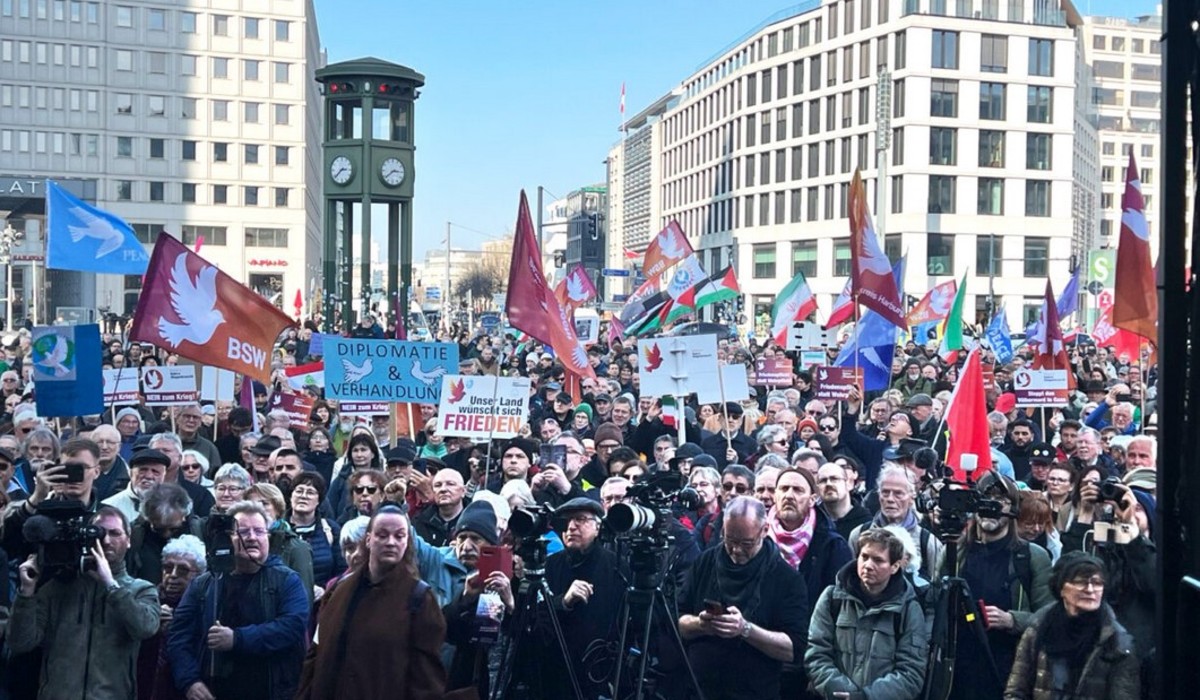
 No to war against Iran, Berlin, 21 March / Photo: BSW, Germany
In a short report Robert Dale gives an update on recent events
Germany held two state elections in March, both in the industrial heartland. The results were no surprise. Turnout was middling (65–70 per cent) and the parties of neoliberal government (which include the Greens here) shared 70 percent of the vote between them. In other words, half the electorate could not bring themselves to vote for the respectable parties. Christian democrats, social democrats and greens will govern both states in one combination or another.
The far-right AfD took around 20 per cent of the vote, polling best among workers. In fact, it won nearly 40 per cent of manual workers in both states (40 per cent of those who could be bothered to vote, that is). The social democrats scraped 20 per cent in the one state – and a shocking 5 percent in the other. Again, all that simply confirms what we’ve been seeing for a couple of years now.
Union matters
The second of two very large public pay rounds concluded in March. Covering 2.5 million workers, it began with good short strikes and a lot of noise from the union high-ups – and ended with a whimper and a sell-out: a 27-month deal with pay rises failing to match inflation. A non-binding vote was held, in which only 52 per cent of members approved the deal.
Same story for nearly 600,000 workers in the chemicals sector. An agreement lasting 27 months, with no pay rise at all until January. After that small increases that barely match current inflation, let alone the war-driven price shocks that are already starting.
Those two deals are symptomatic. Here in Germany big sectoral agreements are still a thing. Strength in numbers is an argument of course. But in recent years all the settlements have been miserable: the post, the rail, engineering, construction and public services, all of them. One important issue, I think, is the union bosses’ preference for strictly percent-based pay rises. The alternative of a flat rate element is particularly popular among those at the bottom of the pay scales. Recently, it has often been demanded at the start of the campaign, but dropped by union bosses at the end. It is those lower-paid groups that have been most dissatisfied with the outcomes. There’s pent-up anger building there.
Poor pay settlements and a complete lack of push-back on the jobs bloodbath in manufacturing form the backdrop to some less than ideal developments in the works council elections held this month. Works councils play a role in representing and defending workers, and the unions are usually well represented. This year a far-right yellow union – Zentrum – increased its representation in a string of car plants. Overall, though, the IG Metall still holds sway.
One important detail: however I look at the figures, it is pretty obvious that significant numbers of workers who backed their unions in the works council elections are voting for the far right AfD in parliamentary elections.
German bosses are generally more or less tolerant of the works council system, it’s what they are used to. The clever ones buy off the union reps, for which Volkswagen is notorious but far from alone. At the relatively new Tesla plant east of Berlin, management is fighting hard to supress the union, IG Metall. The bits and pieces I catch wind of look very much like old-fashioned gloves-off organising. The union did pretty well in the works council election at Tesla, but fell short of a majority.
Peace matters
Tens of thousands of school pupils demonstrated on 6 March against the reintroduction of military service. The demonstrations, which took place across the country, were held during school hours. In most cases disciplinary measures seem to have been minimal. This was the second national action, after December last year. The next is planned for 8 May, the anniversary of liberation in 1945.
The activity around military service is striking – and very welcome – considering the rather minor nature of the change. On turning 18, young men are now required to register their details with the armed forces. That’s all. If voluntary recruitment numbers are too low, the government suggests a lottery could be used to make up the numbers. But that would require further legislation.
A demonstration against the Iran war in Berlin on 21 March attracted a couple of thousand. It was the first of any size, and was organised by Sahra Wagenknecht’s BSW. The BSW, which is ostracised by the ‘identity left’, now has quite a track record as the only parliamentary party prepared to stand up against militarism with no ifs or buts.
Robert Dale lives in the Berlin region, where he has been active in socialist politics since the 1980s.
Before you go
The ongoing genocide in Gaza, Starmer’s austerity and the danger of a resurgent far right demonstrate the urgent need for socialist organisation and ideas. Counterfire has been central to the Palestine revolt and we are committed to building mass, united movements of resistance. Become a member today and join the fightback.
