
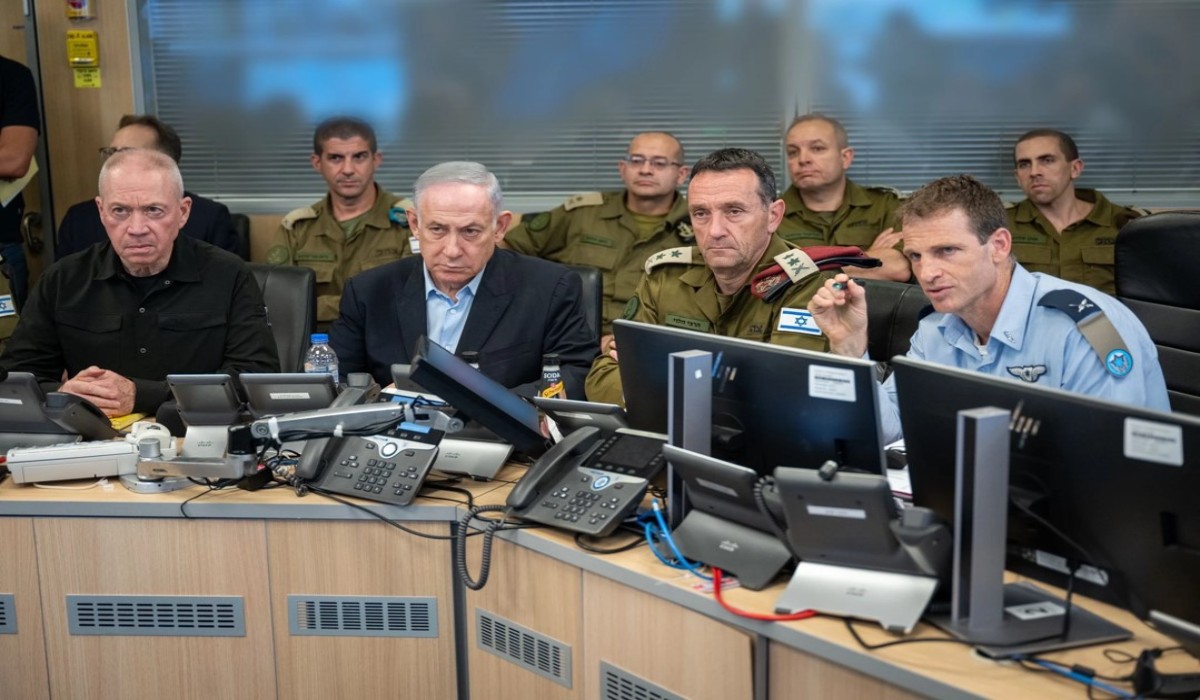
 Netanyahu sitting with former defence minister Yoav Gallant and senior IDF commanders. Photo: IDF Spokespersons' Unit / Wikimedia Commons / CC by 3.0
The continuing genocidal war against Palestinians is putting a strain on relations between the army and the Israeli government, which weakens it, argues Chris Bambery
Last week, the Israeli prime minister pledged to take over Gaza City ‘quickly’ and, after that, the whole territory. He promised to remove Hamas and to reject any idea of the Palestinian Authority running Gaza, but spoke about creating some other administration. Any democratic wishes of the people of Gaza will, of course, simply be ignored.
However, for this to happen, the Israeli Defence Force (IDF) would be required to occupy and control Gaza for an indefinite time. The idea is not to the taste of its command.
In the build up to the crucial meeting of Israel’s security cabinet at which the plan was approved, the IDF’s chief of staff, Lieutenant General Eyal Zamir, repeatedly and publicly aired his misgivings over the operation, warning that taking over Gaza would plunge Israel into a ‘black hole’ of prolonged insurgency, humanitarian responsibility and heightened risk to hostages.
This sent the right into mighty wrath, with the son of prime minister, Benjamin Netanyahu, accusing the army’s chief of staff of mutiny. Israel’s far-right national security minister, Itamar Ben-Gvir, demanded Zamir ‘clearly state he will fully comply with the political leadership’s instructions, even if the decision is to occupy Gaza’.
Professor Yagil Levy, the head of the Institute for the Study of Civil-Military Relations at the Open University of Israel, told the Guardian: ‘This is the most severe crisis in the history of relations between the political echelon and the military since the 1948 war.’ He continued, ‘Never before has the political leadership compelled the military to execute an operation it adamantly opposed.’
The article notes: ‘Over the course of the war, Israel’s military and intelligence leadership has already been shaken by a series of high-profile departures: Zamir’s predecessor as chief of staff, Herzi Halevi, and the former head of the Shin Bet security service, Ronen Bar, were both manoeuvred into resigning. Senior commanders including Aharon Haliva, Yaron Finkelman, Oded Basyuk and Eliezer Toledano have also stepped down, alongside top figures in military intelligence and the Shin Bet.’
In June, 41 officers and reservists, identified as members of the IDF’s intelligence directorate, responsible for the selection of bombing targets, issued an open letter to Netanyahu, the defence minister, Israel Katz, and the head of the military. It said the government was issuing ‘clearly illegal’ orders that should not be obeyed, and that it was waging an ‘unnecessary, eternal war’ in Gaza. The signatories said they would refuse to take part in a ‘war designed to preserve the rule of Netanyahu’ and appease ‘anti-democratic and messianic elements in [his] government’.
The New Yorker interviewed Eran Tamir, an infantryman who had served four tours of duty in eighteen months, who had issued an open letter to Netanyahu on the news site Walla, after the prime minister announced an ‘intensive’ ground offensive in Gaza. In it he stated, ‘They will say that this is an effort to free the hostages, that this is a war of survival or resurrection, and that this time Hamas will truly be defeated—It’s a deception. It’s legitimate to refuse a war whose stated goals are a complete lie. It’s legitimate to refuse a war that is our moral low point as a country.’
Addressing potential critics he argued, ‘They will say that you are strengthening Hamas, encouraging the next massacre.’ Tamir said that may have been true at the beginning of the war but now such statements are ‘deranged’. Tamar returned to Israel and to the IDF within 24 hours after the October 2023 Hamas attack, when he was on holiday in the USA.
Divisions are growing
The New Yorker reports in the same interview with Tamir that: ‘In unit after unit, the Israeli military is seeing the attendance rates of reservists plummet. Among the resisters is a small but growing group of veterans, like Tamir, who openly express dissent and outrage. In March, a former intelligence officer named Michael Majer wrote on social media that he had “joined the Army to protect my people” but found that the current war was “in total contradiction to the interests of the Israeli people.” Nearly a thousand current and former pilots and airmen signed a petition last month [April 2025] calling for the release of the remaining hostages, “even at the cost of ending the war.” (The signatories stopped short of forthrightly calling for their peers to refuse call-ups, but the Air Force said that petition’s endorsers could no longer serve in the reserves.) Hundreds of current and former intelligence soldiers from the élite Unit 8200 and doctors in the Army reserves have signed similar letters.’
In April, +972 reported: ‘In recent weeks, the media has reported a significant decline in soldiers showing up to reserve duty. Although the exact numbers are a closely guarded secret, the army informed Defense Minister Israel Katz in mid-March that the attendance rate stood at 80 percent, compared to around 120 percent immediately after October 7. According to Kan, Israel’s national broadcaster, that number was a fudge: the true rate is closer to 60 percent. Other reports speak of attendance rates of 50 percent or lower, with some reserve units resorting to trying to recruit soldiers via social media.’
Discontent in the IDF is not about concern for the Palestinians whom they have butchered on an industrial scale. It is easy to dismiss it but it reflects deep and fundamental divisions within Israel, including its elite, which could benefit the Palestinians.
A majority of IDF members are reservists, called up from their day-to-day jobs. Apart from the impact on the economy, they have faced multiple tours of duties. I am not asking for pity for them but the IDF is being pushed to the limit; operating in Gaza, the West Bank, Lebanon and Syria and on a war footing with Iran.
The IDF faces overstretch. The idea of occupying Gaza raises memories of the US and Nato occupation of Afghanistan, and the way that ended is not reassuring. The IDF’s chief military advocate warned in closed forums that expanding the fighting in the Gaza Strip would have far-reaching implications under international law. Again, this is not out of concern for Gaza’s population but reflects a growing realisation that cases relating to this genocide loom at the International Criminal Court and the International Court of Justice. Already, travel beyond Israel’s borders, except to the USA, might mean arrest.
Despite the Army’s discontent with the war, the Netanyahu government is dominated by religious fanatics and supporters and members of the illegal settlers in the West Bank, who want it and Gaza to be part of Israel with the Palestinians removed. Last month, the Nachala settler organisation led thousands of Israelis to the borders of Gaza, demanding the settlement of areas of the northern Gaza Strip currently occupied by the IDF. Operational plans to establish settlements have been drawn up and 1,000 families have signed up to establish a Jewish community in Gaza.
Polls within Irael show a majority for ending the war and getting the remaining hostages home but also bigger ones for removing all Palestinians. Even so, the divisions within Israel are growing, and while that does not equate to sympathy for the Palestinians, far from it, it weakens a besieged and economically vulnerable state. This makes Israel’s war ever more dependent upon support from its Western allies, who themselves are showing signs of buckling under the pressure of the Palestine solidarity movements in their own countries.
Before you go
The ongoing genocide in Gaza, Starmer’s austerity and the danger of a resurgent far right demonstrate the urgent need for socialist organisation and ideas. Counterfire has been central to the Palestine revolt and we are committed to building mass, united movements of resistance. Become a member today and join the fightback.

Chris Bambery
Chris Bambery is an author, political activist and commentator, and a supporter of Rise, the radical left wing coalition in Scotland. His books include A People's History of Scotland and The Second World War: A Marxist Analysis.