
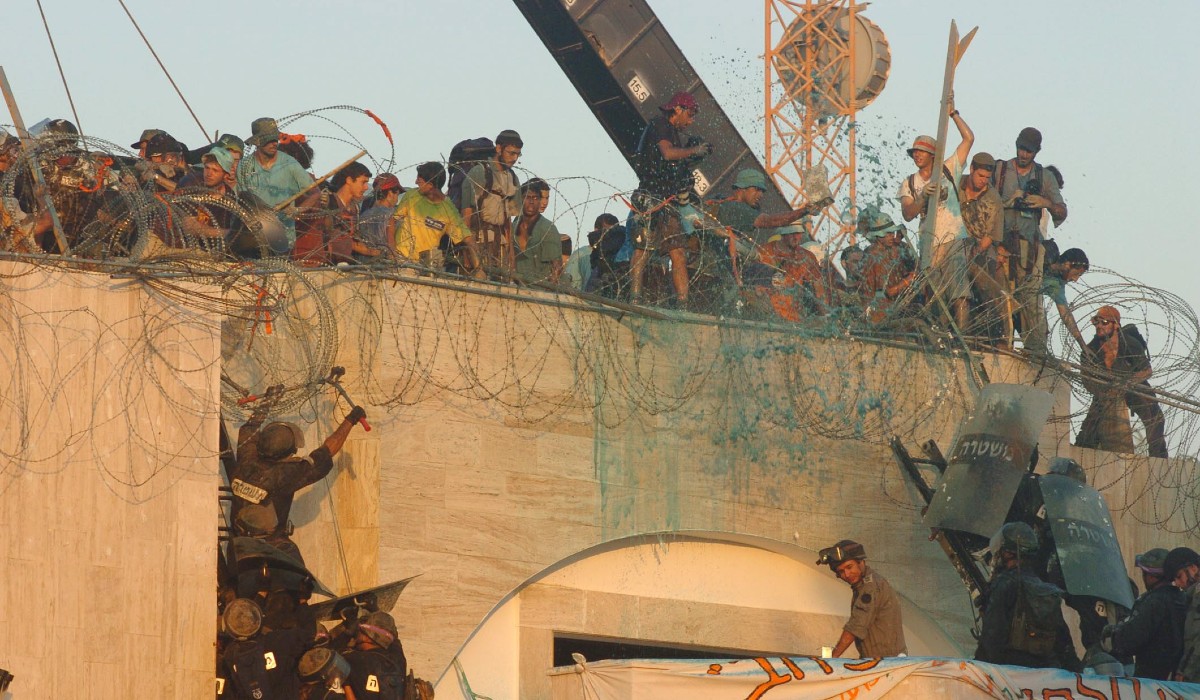
 The evacuation of Kfar Darom, 2005. Photo: IDF / CC BY-SA 2.0
Zahid Rahman explains how Israel has been destroying Gaza for twenty years
August marks twenty years since Israel ‘disengaged’ from Gaza in 2005. Over 8,000 Israeli settlers were removed, some forcibly, from the 21 illegal settlements in Gaza, while thousands of soldiers were withdrawn under the guise of a peace gesture. The mainstream narrative frames this episode as an altruistic offering of peace by the Israeli government of the time led by Ariel Sharon, (the butcher of Sabra and Shatila) It was anything but.
Gaza made up only 1.3% of historic Palestine, and it was far too costly for Israel to occupy and subdue. Each individual settler cost hundreds of thousands of dollars, because of the constant risk of confrontation in a dense, urban environment with 1.5 million Palestinians. Maintaining such an occupation was becoming economically burdensome.
Moreover, there was a cynical political calculation involved in carrying out the withdrawal. The disengagement allowed Israel to change the realities on the ground without consulting any Palestinians. Western journalists accepted and reinforced the narrative of Israeli generosity when the question that should have been asked was, ‘why does Ariel Sharon, who always opposed Palestinian statehood suddenly want to give up Gaza?’
Sharon’s adviser, Dov Weisglas, was quite candid in suggesting that the withdrawal from Gaza would ‘freeze’ the 1993 Oslo peace process: ‘When you freeze that process, you prevent the establishment of a Palestinian state…’ The withdrawal allowed the important issues such as the borders in a ‘two-state solution’, Jerusalem, and, importantly, the refugees, to be marginalised, with Palestinians no closer to self-determination.
This combined narrative of Israel’s great ‘sacrifice’ and the images of tearful Israeli settlers being removed was aired globally. It masked the reality that in that year (2005) while 8,000 Israeli settlers were evacuated from Gaza, 12,000 were established in the West Bank.
Over time the picture is starker. In 2005, there was a settler population of 400,000-500,000 in the West Bank and East Jerusalem, by 2024 this has risen to well over 700,000. Israel sacrificed tiny Gaza to increase settlements in the West Bank and East Jerusalem. The evacuation of settlers from Gaza was a smokescreen.
Economic strangulation
Israel’s occupation of Gaza continued. After the declaration of Gaza as a ‘hostile territory’ by Israel’s security council, a military blockade was established with the cooperation of Egypt. Israel controlled all the people and goods that flowed in and out of Gaza. The strip’s electricity, water, and even its communications remained under Israeli control. There were lists of banned goods that weren’t allowed to enter Gaza, the excuse being those items were ‘dual use’: able to be used for military purposes. Some of these included, from 2007 to 2010, notebooks, pasta, toys, toilet paper and biscuits. Items were added and removed arbitrarily.
Before the blockade, Gazan fishermen could catch 3,000 tons of fish annually. In 2008, a year into the blockade, this was drastically reduced to 500 tons as the Israeli navy began limiting boats to six nautical miles off the coast, even firing on some at three miles.
The blockade helped shape the political landscape of Gaza. Hamas was able to strengthen its grip on power through its network of tunnels running across borders. They were regulated and taxed by Hamas, providing a reliable source of revenue and a base of its political authority.
The human cost of the siege was crushing. A 2012 UN report predicted Gaza would be unliveable by 2020. In the months leading up to October 2023, it had an unemployment rate of 45% (mainly women and youth), 65% were deemed poor and 80% relied on international aid. GDP per capita shrunk by 37% in the years between 2006 and 2022.
Although the IDF were no longer present inside Gaza, the levers of control were still in Israeli hands. What was presented to the world as a withdrawal of military personnel was actually only a redeployment to areas outside of Gaza’s perimeter and the creation of an ‘open-air prison’ with every aspect of life subjected to control from the outside.
Mowing the lawn
Perhaps the most devastating factor in Gaza’s reality was the frequency of Israeli assaults, a cycle so routine that it has been given the grim euphemism of ‘mowing the lawn’ in Israeli military doctrine. The object of Israel’s actions was to degrade the capacity of Palestinian resistance within the strip. The policy didn’t seek any political settlement but to indefinitely maintain the siege on Gaza.
This brutal cycle began less than a year after the 2006 evacuation. In 2006, following the kidnapping of two civilians from Rafah on 24 June, Palestinian militants launched a raid that killed two Israeli soldiers and captured another. Instead of a prisoner swap involving any of the thousands of Palestinians in Israeli jails, Israel launched its first airstrikes and ground assault on the besieged territory on 28 June 2006. That five-month operation killed over 400 Palestinians.
More followed including the 22-day 2008-2009 war that left over 1,000 Palestinians dead. In the summer of 2014, over 2,100 Palestinians were killed including over 500 children in Operation Protective Edge. In 2021, 256 Palestinians were killed within eleven days. In each case, civilians bore the brunt of the deaths in Gaza.
‘Mowing the lawn’ served multiple purposes for the Israeli state. It maintained deterrence through the staggering use of disproportionate force. It did enough damage to degrade the military capacity of Hamas and other groups significantly. The logic of the blockade was reinforced by the demonisation of Gaza as a perpetual security threat.
After the cross-attacks by Hamas and Palestinian Islamic Jihad on 7 October 2023, Israel escalated its doctrine of ‘mowing the lawn’. Its plan has evolved into something genocidal in scale and intent, determined to uproot the Palestinian population from Gaza entirely. This genocide that is being waged in full display is a part of settler-colonialism; a process aimed towards the erasure, dispossession and annihilation of a people from their homeland.
Tens of thousands of people have been killed in almost two years of bombardment, the pro-rata equivalent of six times the atomic bomb dropped on Hiroshima. A man-made famine orchestrated by the Israeli state has taken hold across the territory whilst the only ‘aid’ available can only be got at the risk of being shot at. Ethnic cleansing is being suggested in front of the world’s press, not only by Netanyahu but the White House.
Israel’s disengagement from Gaza in 2005 wasn’t a move towards coexistence, but containment. The withdrawal wasn’t a gesture of peace, but a means to manage a population in a less costly and more distant manner. It gave the illusion of an experiment in Palestinian freedom. It became a staging ground of a slow process of strangulation that has now erupted into genocide. Twenty years on, Gaza’s occupation has been rebranded and reshaped but it had never ended.
Before you go
The ongoing genocide in Gaza, Starmer’s austerity and the danger of a resurgent far right demonstrate the urgent need for socialist organisation and ideas. Counterfire has been central to the Palestine revolt and we are committed to building mass, united movements of resistance. Become a member today and join the fightback.
