
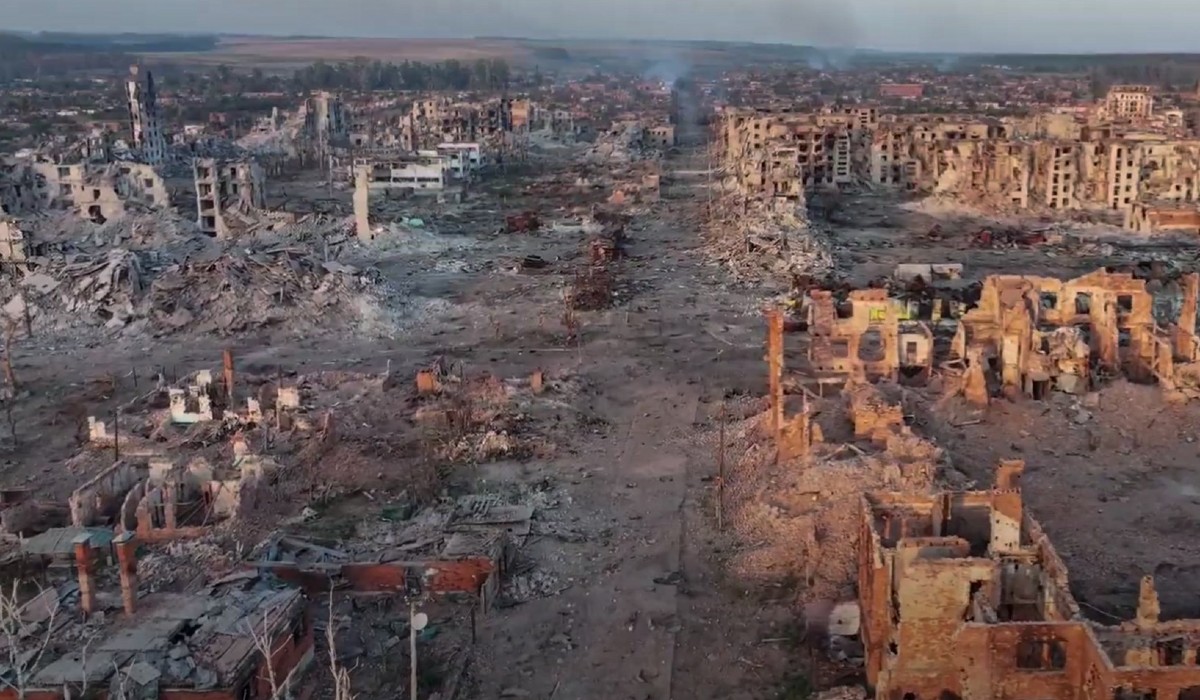
 Vovchansk, Ukraine, September 2024. Photo: Separate Presidential Brigade of Ukrainian Armed Forces / CC BY 4.0
The Ukraine war resulted from, and accelerated, the emergence of multipolarity in world affairs, argues Vladimir Unkovski-Korica
It may sound counter-intuitive, but Russia’s full-scale invasion of Ukraine four years ago marked the end of the unipolar moment in recent world history. When the Cold War ended and the Soviet Union dissolved, the US stood supreme in international relations.
As the world’s only superpower, Washington appeared free to shape global institutions, promote neoliberalism as an international form of governance, and use its vast military superiority over its rivals to shore up its position as world capitalism’s hegemon.
But beneath the surface, the US-led collective West was in decline. Washington’s sprawling imperial presence in the world belied its economic decline. In fact, neoliberal globalisation spurred on the rise of rivals, most obviously China.
Origins of Russia’s invasion
After the economic crash of 2008, the export-to-GDP ratio globally stalled, as global trade slowed and fragmented. Simultaneously, geopolitical competition mounted, protectionism spread, and domestic political regimes polarised.
The collective West was in visible decline. The G7 (the US, Canada, the UK, Germany, France, Italy and Japan) saw its proportion of global GDP drop from around two thirds in 1994 to around 44 per cent in 2022.
It followed that rivals felt more confident to take on the US and its allies in a variety of fields. Russia did so more dramatically than others. Following decades of Western humiliation as the defeated Cold War rival, most obviously through the eastward expansion of NATO up to Russia’s borders, Moscow decided to draw a line.
It is unsurprising that it did so in Ukraine, the mineral rich and geopolitically most important of the former republics of the USSR. Zbigniew Brzezinski, the former National Security Advisor of the United States, famously argued that, ‘without Ukraine, Russia ceases to be a Eurasian empire’.
The ruling elites in Moscow resented the soft power competition with the West that saw Ukraine tilt between East and West repeatedly in the 2000s and 2010s, as they identified Ukraine as central to the renewal of Russia’s great power status.
When a street movement toppled the pro-Russian president in 2014, Moscow annexed Crimea and fuelled separatism in the eastern Donbas region. Then, following the West’s difficulties in dealing with the Covid pandemic, the chaotic US withdrawal from Afghanistan, and a decade of apparently successful Russian military interventions in Georgia, Ukraine and the Middle East, Russian president Vladimir Putin gambled on a quick war to re-capture Ukraine.
Inter-imperialist proxy war
Putin’s gamble proved in many ways to be a miscalculation. Rather than folding, Ukrainians resisted more forcefully and widely than faulty Russian intelligence had led Putin and his circle to believe would occur. Kyiv turned to the West for support, and Washington quickly realised that it could maul Moscow at the expense of Ukrainian lives.
In that sense, Ukraine became a victim of both Russian and Western imperialism. Peace negotiations in April 2022, with Russian unexpectedly on the back foot, appeared close to a deal to end the war. This would have involved continuing Ukrainian neutrality, as Russia demanded, but also the possibility of EU membership for Ukraine. However, hawks in the West, like the then UK Prime Minister Boris Johnson, discouraged Volodymyr Zelenskyy from closing the deal.
The West poured massive aid to Ukraine, totalling over $370 billion in military and economic assistance. A successful counter-offensive in the autumn of 2022 raised hopes in Kyiv that the country could prevail against Russian aggression. Despite creeping escalation from the West, which provided Ukraine with more and more powerful weapons, the failure of Ukraine’s summer 2023 offensive dashed expectations that Ukraine could recover its lost territories.
Despite Western propaganda glorifying limited Ukrainian successes, the grim reality of the war ever since was that Russia has a major manpower advantage and is largely fighting the war on foreign soil. The vast scale of destruction in Ukraine by Russian firepower, like long-range missiles and increasingly sophisticated fleets of drones, always meant that Ukraine would remain at a significant disadvantage. Russia now controls around a fifth of Ukrainian territory and continues to advance.
While numbers of those killed and wounded remain cloaked by the fog of war, the most recent estimates suggest that there have been up to two million military casualties so far. The number of refugees abroad is currently at 5.9 million according to the UN High Commissioner for Refugees. Opinion polling in mid-2025 suggested that a only minority of 43 percent of Ukrainians were optimistic about the country’s future.
War weariness gripped Ukraine, with around two million evading conscription and a further 200,000 having deserted according to the country’s defence minister in January 2026. But war weariness also spread to Western publics, and contributed to Kamala Harris’s defeat to Donald Trump in the US presidential election in November 2024. Trump falsely paraded himself as a peacenik, but his election suggested that Ukraine’s wager on the West to defeat Russia was a bad miscalculation.
Trump’s first year in office underlined how far Kyiv had ceded sovereignty to the Western alliance to maintain its defensive war. Humiliated in the White House, for showing insufficient gratitude to the US, Zelenskyy signed up to a version of what pundits dubbed the ‘minerals for peace’ deal with Trump. Namely, Ukraine would agree to cede control of much of its rare earth minerals to gain funding and security guarantees from the US in looming peace negotiations with Russia.
Multipolarity is preventing peace
Beyond the obvious neo-colonial and transactional character of this arrangement, it became clear that Washington wanted to cut a deal with Moscow – to move from an imperialist proxy war to an imperialist peace or carve-up. Indeed, the US Secretary of State Marco Rubio explained that the US wanted to do a Nixon in reverse. If the US under Richard Nixon had achieved a major diplomatic victory in the Cold War by prising China away from the Soviet Union in the 1970s, now it would seek to do something similar, by prising Russia away from an increasingly subordinate alliance with China.
But, as Trump’s recent National Security Strategy makes clear, Washington has identified a major spanner in the works: the European Union. The NSS notes that Europe has declined in world affairs faster than the US, with Europe’s share of global GDP falling from 25 percent in 1990 to 14 percent today.
Its importance to the US has therefore declined from the early days of the Cold War, when the continent was the main front in the rivalry with the USSR. Now, as the US pivots to East Asia and the Pacific, it seeks a changed and diminished role for its trans-Atlantic, European allies.
The NSS duly lambasts Europe’s ‘lack of self-confidence’, which it says, ‘is most evident in Europe’s relationship with Russia’, arguing that US diplomacy will be needed to secure a deal in Ukraine and stability across the Eurasian landmass.
This tirade reflects US frustration with the EU’s frantic efforts, ever since the election of Trump, to prevent a deal in Ukraine that it deems too advantageous to Russia. Fearful that an overly rapid withdrawal of the US from Europe would leave Russia a bigger player in European affairs, European capitals are hoping to buy themselves more time.
But more time to do what? Certainly, they’re not saving Ukrainian lives by prolonging the war. Western officials believe Russia can sustain current rates of attrition for another twelve months, while Ukraine is outmatched in personnel and equipment across most of the front line. Moreover, although Russia is experiencing economic difficulties, the West has failed to break its links with China, India and much of the Global South, suggesting there is no imminent likelihood of Moscow being forced to make major concessions from a position of weakness.
So, no, the European elites are not preoccupied with Ukraine as such. By magnifying the Russian threat for as long as possible, they are papering over divisions in Europe. As recent Franco-German tensions over defence and trade demonstrate, Europe remains divided between those (led by France) who wish to push for deeper European integration to secure strategic autonomy from the US and those (led by Germany) who see more prospect in fending Russia off by retaining an Atlantic orientation.
Warfare or welfare
What is evident, then, is that just as the end of the unipolar moment gave Washington’s rivals more confidence to challenge its interests, prompting Russia’s invasion of Ukraine, so it has fuelled divisions with and among its allies, preventing the US from cutting a deal with Russia in Ukraine.
And if European elites are united over anything, it is by their determination to shore up the continent’s place in world affairs by replacing welfare states with warfare states. In doing so, they are ironically following Trump’s demands that US allies must spend more on arms, even as Trump himself increases military spending to $1.5 trillion and continues to pursue or threaten military intervention abroad, as in Iran, Nigeria, Venezuela, and most recently in Greenland.
As the push towards militarisation intensifies, moreover, popular discontent with Europe’s elites will deepen. How that lands politically is an open question. With the opposition to Europe’s establishment currently being expressed by the far right, leading the polls in both Germany and France, and supported by Trump, the prospects for peace in a multipolar world remain as bleak as they did during the unipolar moment.
Unfortunately, mainstream social-democratic parties and many trade unions remain wedded to militarism, and appear to be paying the price with continued loss of popular support. It is enough to observe the Labour Party’s dive in the polls since its election in the summer of 2024, amid its support for austerity for the most vulnerable at the same time as its commitment to rising military spending, to understand why the likes of Reform UK are hoovering up support in many abandoned working class areas.
Political alternative
We desperately need an alternative. And the most likely catalyst for a new left are the mass anti-war movements that have so powerfully opposed US-EU support for Israeli genocide in Gaza since October 2023.
From the millions marching on the streets of the UK to the general strike that brought Italy to a halt, significant sections of the population have shown that they are opposed to the imperialist agendas of the establishments of their countries. In some small, but notable ways, we are seeing the expression of this discontent via the ballot box, such as the election of the independent Gaza MPs in the UK or the progressive Zohran Mamdani becoming the new mayor of New York.
But we need more of that. We need to fight across the labour movement for an orientation that says we should spend on welfare, not warfare. And we must not underestimate the challenges. When even left union leaders like Sharon Graham of the UK’s biggest union in the private sector, Unite, support more military spending, as she did after the Munich Security Conference in February, we have to place political organising at the centre of what we do in the unions.
The European anti-war conference in October 2025 showed what is possible. Thousands of delegates from across the trade union movement congregated in Paris to oppose the genocide in Gaza, and to oppose war and re-armament.
Similarly, the second conference due to take place in June 2026 in London could see the labour movement in this country begin to turn the vote at the British TUC in September 2025 for ‘Wages not weapons’ from words to action. The sooner that spirit spreads across borders, the more we stand a chance of pressing our leaders to negotiate an end not just to the war in Ukraine, but wars across the globe.
Before you go
The ongoing genocide in Gaza, Starmer’s austerity and the danger of a resurgent far right demonstrate the urgent need for socialist organisation and ideas. Counterfire has been central to the Palestine revolt and we are committed to building mass, united movements of resistance. Become a member today and join the fightback.

Vladimir Unkovski-Korica
Vladimir Unkovski-Korica is a member of Marks21 in Serbia and a supporter of Counterfire. He is on the editorial board of LeftEast and teaches at the University of Glasgow.