
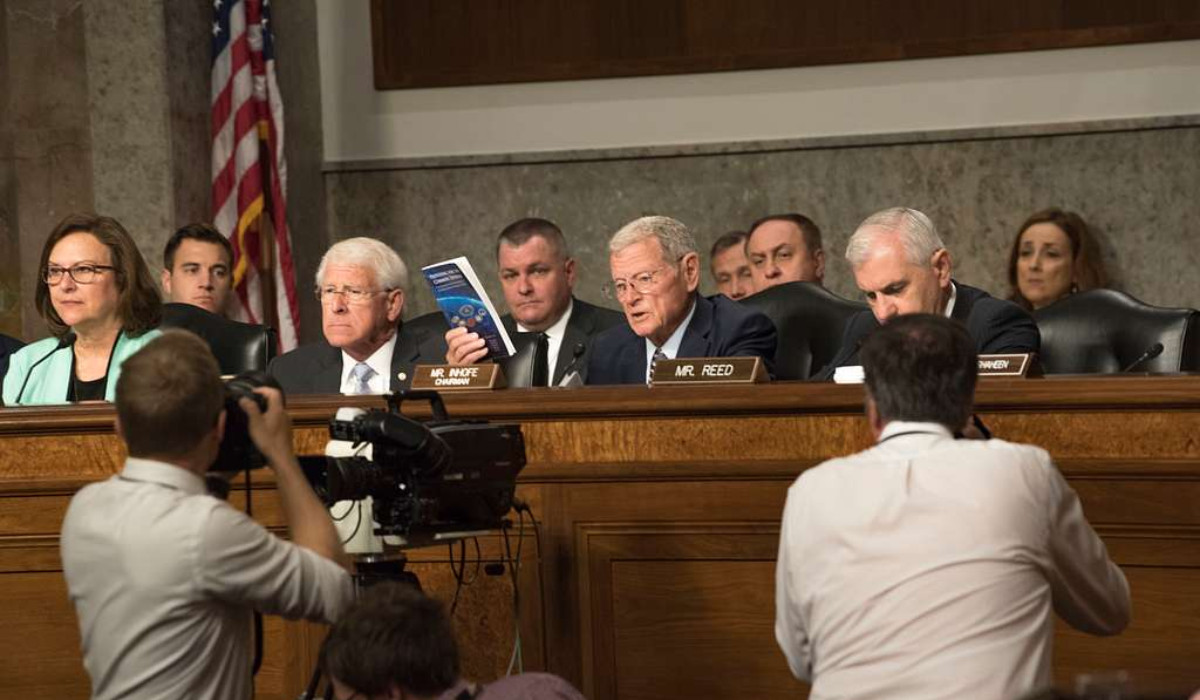
 U.S. Senate Armed Services Committee. Photo: PDM 1.0
The contradictions between the US role in the Pacific and its war in Iran are coming to the fore, argues Chris Bambery
I apologise but it’s taken me a wee while to catch up with a very interesting event in Washington. At the beginning of last month the Undersecretary of Defense for Policy, Elbridge Colby, the author of the Pentagon’s latest National Defense Strategy (NDS), appeared before the Senate’s Armed Services Committee to face questions on the Trump administration’s strategic thinking.
Colby described the thinking behind the NDS as ‘flexible realism,’ arguing that the US military cannot operate everywhere, and the US will need to make choices as to what it prioritises and how it shares deterrence and defence responsibilities with allies and partners across the world.
The latter must, therefore, up their defence spending and become more active participants in their alliance with Washington.
Colby stated that the US has a stake in the Indo-Pacific due to its market share in the region and China’s ongoing military buildup. ‘We make clear that our interests with respect to China are scoped and reasonable – we do not seek to strangle China nor compel a change in its form of government.’
He then added:
‘Rather we seek to prevent China from becoming the hegemon of the Indo-Pacific. In particular, this requires – as the NSS clearly states – being able to deny the feasibility of successful aggression along the first island chain,’ he continued. ‘Because of its significance and the central importance of the military role in meeting this requirement, meeting this standard of an effective denial defense along the first island chain is the primary focus of the US armed forces.’
The chair of the Armed Services Committee, the Republican Senator for Mississippi, Roger Wicker, expressed his unease that the Pentagon’s guidance on its top strategic concerns does not mention Taiwan. The NDS outlines the need for a ‘denial defense’ of the first island chain, a string of archipelagos that stretches from Okinawa, Japan, down through Taiwan and to the Philippines. This is aimed at thwarting any Chinese invasion of Taiwan.
Wicker went on to state:
‘I don’t think anybody can mistake that … the focus of this strategy on preparing for a denial defense along the first island chain, that is elaborated on in the National Security Strategy, which includes a reference to Taiwan. That has been very clear to all of our audiences.’
Colby responded to this, saying:
‘Our approach is strong and clear, but quiet… ‘We are really focused on delivering military hard power readiness, not only to our own forces, but to our allies and partners, and less focused on making significant rhetorical statements. That obviously is a topic of debate, as to whether that’s the right mix.’
Colby outlined how Washington wants Israel and the Gulf states to assume primary responsibility for policing West Asia, saying that this would: ‘Allow us to enable this focus on the first island chain.’
As someone who has argued for a strategic pivot towards East Asia, Colby must be frustrated that the focus is now on Iran, but he’s not expressing that. When asked about Trump’s attack on Iran, Colby pointed out that the new NDS says that the US ‘obliterated Iran’s nuclear program’ during Operation Midnight Hammer, in which US forces struck three nuclear sites inside Iran in June 2025.
The document states that the Defense Department:
‘Will empower regional allies and partners to take primary responsibility for deterring and defending against Iran and its proxies, including by strongly backing Israel’s efforts to defend itself; deepening cooperation with our Arabian Gulf partners; and enabling integration between Israel and our Arabian Gulf partners, building on President Trump’s historic initiative, the Abraham Accords.’
Colby, who has previously argued the US should move away from focusing on the Middle East to countering China, told the senators that it’s inaccurate to suggest the NDS did not account for Trump’s ability to use military force against Iran. Asked by the Democrat Senator for Illinois, Jack Reed, about the objectives of the Iran campaign, Colby replied:
‘I would say America first and peace through strength are served by rolling back, as the military campaign is designed to do, the threats posed by Iran’s very large and growing missile and one-way attack drone program, its navy and of course ensuring that it doesn’t have a nuclear weapon.’
He went on to say: ‘I do think those are scoped and reasonable objectives that can be attained.’
Under continued questions about the objectives of the Iran war, Colby said: ‘This is not another Iraq War. This is not nation building’. He added: ‘We understand from [President Donald Trump] and the goals of the military campaign, this is certainly not nation building. This is not going to be endless.’
All of this has proved to be bunkum.
Later in March Colby paid an official visit to India where he stated that peace and stability in the Indo-Pacific would not be ‘founded in naivete or gauzy abstractions like the rules-based international order, but in strength, reason and hard-nosed collaboration.’
He claimed that the US was not in decline but ‘rising under President Trump’s leadership.’
More bunkum. But it’s clear there is a war plan for a confrontation with China over Taiwan.
What then is going on in Washington? Where is the clear thinking?
Lawrence Freedman is Emeritus Professor of War Studies, King’s College London. and author of a number of books on military strategy. He’s just returned from the US and writes:
‘It is hard to convey the gloom that has overtaken Washington. All the structures that are vital to crisis management have either been attenuated or disbanded. There is hardly anyone left on the National Security Council staff. A friend described an empty State Department where you could hear your own footsteps. Marco Rubio is involved in the decision-making but he has neglected to acquire the professional staff assessments that should inform such decisions…The military part of the Pentagon still functions, but the civilian part has been purged. At its head is Pete Hegseth who puts effort into looking charismatic and brings the perspective of a disgruntled junior officer to everything he does, waging his own war on “woke” which in its latest version involves striking out the names of two black men and two women for promotion to general. Some satisfaction is taken that figures such as Eldridge Colby, who were supposed to be providing the intellectual heft to security policy, are now stuck defending exactly the interventions they were pledged to avoid.’
That sounds pretty accurate to me. It does not bode well for the US.
Before you go
The ongoing genocide in Gaza, Starmer’s austerity and the danger of a resurgent far right demonstrate the urgent need for socialist organisation and ideas. Counterfire has been central to the Palestine revolt and we are committed to building mass, united movements of resistance. Become a member today and join the fightback.

Chris Bambery
Chris Bambery is an author, political activist and commentator, and a supporter of Rise, the radical left wing coalition in Scotland. His books include A People's History of Scotland and The Second World War: A Marxist Analysis.