
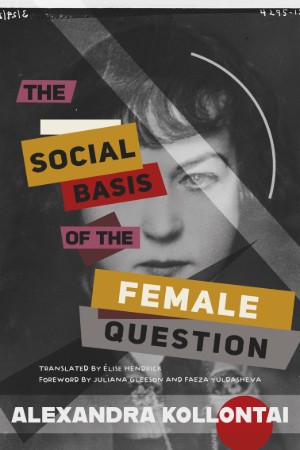
 Alexandra Kollontai, The Social Basis of the Woman Question, trans. Elise Kendrick (Chicago: Haymarket 2026), 364pp.
Kollontai’s writings on women’s oppression and their struggle for liberation are as clarifying and brilliantly relevant today as they have always been, finds Lindsey German
‘The female question is ultimately a question of bread. It is deeply rooted in economics. In order to decide to demand equality with men, above all, women had to become economically independent’ (p.25).
So opens Alexandra Kollontai’s first chapter of her work on the state of women’s lives in the opening decade of the twentieth century. Kollontai was a Russian revolutionary socialist, living as many of them did in exile at various times, in contact with her counterparts across Europe, engaging in debate and discussion about how to achieve change and how to emancipate women. She worked closely with women like the German socialist Clara Zetkin. She was from a middle-class background, led an unconventional life, and photos show her to be well dressed and good looking. Her major contribution to women’s history came after the 1917 Bolshevik revolution, when she organised the Zhenotdel or women’s department, which played an exemplary role in introducing egalitarian marriage and divorce laws, socialisation of many of the functions of housework and childcare and encouraging women to play a full role in society.
This book dates from before that time, however, in 1909, and this is its first full English translation, for which we should be very grateful to Elise Kendrick and to Haymarket Books for publishing. Kollontai’s report takes the form of an introduction and three major chapters, on women’s struggle for economic independence, on marriage and the family, and on the struggle for political rights. This is the Marxist theory of women’s liberation laid out clearly and for all to see. It is a polemic about class, about the centrality of working-class women to revolution, and about the oppressive structures which prevent it from happening.
What struck me about the whole work is the clarity and decisiveness with which she argues. She sees her politics as following from the ideas of Marx and Engels, and as centrally grounded in the Second International Marxism of which she was a part. So they are rooted in a materialist view of women’s equality and how that leads to different expressions of what it means and how to organise. She links the ideas of women’s liberation to social change and references the impact of the recent 1905 Russian Revolution on women’s politics.
‘In 1905, it seems, there was no corner of Russian life where the voices of women could not be heard, making their presence known and demanding new civil rights for themselves as well’ (p.15).
Class and progressive ideas
It is a commonly held view that egalitarian ideas originate among enlightened intellectuals of the middle and upper classes, and eventually filter down to the working class, which is supposedly most resistant to them. The ‘culture wars’ so beloved of the right are predicated on the idea that such views are of little concern to the working class. Kollontai stands this idea on its head. She argues that bourgeois feminism in fact results from earlier forms of class struggle and indeed cannot function effectively until the working class has come on the scene as an actor. Women have suffered various forms of oppression for thousands of years, but it is only when they have the opportunity to work for a wage and have economic independence that the nature of their oppression becomes unbearable to them. She continues: ‘For women of the bourgeois classes, the female question arose significantly later than proletarian women’s entry into the path of labour, approximately in the mid-nineteenth century’ (p.31).
It was then that sections of middle-class women had to to find paid work due to the economic upheaval of capitalism and sought employment in various professions. It ‘is impossible to claim seriously that the feminists “made way” for women to enter the workforce, when, in every country, the bourgeois women’s movement has come into being at a time when proletarian women were already flooding the factories and workshops in their hundreds of thousands’ (p.32).
The working-class women of England were involved in trade-union and political struggle through the early trade-union movement and Chartism from the beginning of the nineteenth century. ‘Only in the 1860s did the bourgeois women’s movement [in England] take any serious measures, that is, at a time when the proletarian women’s movement, closely linked to the class struggle of the proletariat, could already look back on an entire history’ (p.33).
A lot of the book is about the class differences between women. Sometimes the arguments bring you up short because they are either unfamiliar or they reflect the different concerns of over a century ago. Kollontai devotes space to the arguments about protective legislation in factories, which she favours. She argues that women need protection over heavy work, maternity and childbirth. They needed maternity leave and bans on work which might injure women’s bodies. The social democrats in many countries opposed women’s night working. She says that many feminists opposed such legislation because they believe it weakens women’s full equality.
Diverging interests
The argument over protective legislation has long been a part of feminist discussion, including arguments about who benefits from such laws and whether they gave women a historic disadvantage in the labour market. Kollontai is very firm that it should be supported. She says that the bourgeois feminists do not have the same interests because they do very different sorts of work, and only reluctantly came to accepting the need for it.
She also polemicises against both wings of the women’s suffrage movement in Britain in the sense that they want the vote on the same basis as men, which at the time was restricted and excluded most unskilled working-class men as well as all women. Kollontai believed the fight for universal suffrage for both men and women regardless of class or income was the only position that socialists could or should take on this. Again, it has been the subject of much study and debate by socialists and feminists since, and when you look at the contemporary debates it is quite a complex issue. But here it is put very clearly in class terms.
The whole study uses contemporary statistics to demonstrate how class divisions affect every area of women’s oppression: obviously in incomes, but also infant mortality, prostitution, and how the family is organised. She writes about the scale of prostitution in the big cities of Europe and how working-class women are forced into such work, sometimes seasonally or in addition to their employment, given the low wages. She rages against this situation but also against the hypocrisy of those decrying prostitution while ignoring the horrors of ordinary working lives.
‘The dark picture of the lives of prostitutes chills the heart … What horrors they have occasion to see!’ However she continues: ‘But is the life of a female craft worker, a domestic servant, or even a female factory worker any better, particularly here in Russia, where the working conditions, even in large-scale operations, are repugnant?’ (p.114).
To Kollontai, a ‘hypocritical, two-faced attitude to prostitution is characteristic of the bourgeoisie, and brings their class position in what would seem to be a shared human concern into sharp relief. Indeed, prostitution, that inevitable concomitant of present-day class society, this corrective for the obsolete, compulsory family form of our time, is the exclusive burden of the unpropertied classes’ (p.115).
Her approach to the question, controversial and still highly relevant today, is far superior to the two main strands among current feminist thinking which tends either to regard sex work as no different from other work, or to stress the ‘Nordic model’ of regulating it. Instead, Kollontai places the phenomenon within class society as women are forced to sell their bodies as commodities, and as the other side of supposed ‘family values’, which requires the abolition of class society to end.
Perennial relevance
I first read Kollontai in the 1970s, thanks to translations of her work mainly by Alix Holt, and the biography by Cathy Porter. Sheila Rowbotham’s first books, published in the early 1970s, also talked about Kollontai and the achievements of the Russian Revolution for women. This rediscovered history engendered real enthusiasm from socialist women, demonstrating that their ideas of equality did not spring from nowhere but were part of a long and remarkable tradition. Kollontai also had much to say about personal relationships and love, again a revelation to those of my generation, to whom sexual independence and freedom were so important.
Reading this book meant falling in love with Kollontai and those ideas all over again. It is important when considering what is now a historical work to look at it in context: to avoid the ‘enormous condescension of posterity’ that EP Thompson described of those seeing the actions of the past through the lens of their own experience. She was a product of her time and place, but a remarkable one. Her Marxist politics and practical experience in exile also gave her an overview of class relations. And Marxism can be a guide to current and future struggles. This is something alien to much of current left feminism. The writers of the foreword to this book obviously admire Kollontai, but don’t appear to understand her criticism of feminism. They seem to think that a supposedly more inclusive feminism that exists today, which recognises race and class as factors in oppression, would have been more amenable to her, rather than the white middle-class feminism with which she was confronted in 1909.
But Kollontai’s opposition to what she called ‘bourgeois feminism’ was not because its adherents were middle class – this was consequence, not cause – it was because the ideology wanted to blur or ignore class divisions. It therefore subordinated working-class women’s demands to those of the middle and upper classes and feared change which challenged the class basis of society. Indeed, she wrote about how many such women saw more equality as a means of becoming fully members of a ruling class:
‘Political equality is a means of sharing with the men of their class the class privileges and benefits of life that currently are exclusively enjoyed by the latter; more accurately, it is a way to consolidate the advantages that currently are the exclusive province of the men of the bourgeoisie. Where, for proletarian women, political rights are merely a tool in the struggle with the existing capitalist system, for bourgeois women, on the other hand, they are a new way of affirming their class dominance’ (p.172).
Even those who sympathise with working-class women, or who call themselves socialists, draw back when it comes to challenging whole systems of inequality. ‘Whilst declaring themselves supporters of social reforms and even of socialism – in an immeasurably distant future, of course – the feminists do not intend to fight in the ranks of the working class in order to realise this coveted objective of the proletariat’ (p.172).
For her, the battle for women’s equality was inseparable from that against capital, and she was implacable in this cause. Within every ‘wave’ of feminism, similar arguments have occurred, and socialist women have linked specific ‘women’s issues’ with the wider fight against exploitation. This book is a valuable weapon in reasserting the socialist tradition of women’s liberation. On this International Women’s Day, I cannot recommend it enough.
Before you go
The ongoing genocide in Gaza, Starmer’s austerity and the danger of a resurgent far right demonstrate the urgent need for socialist organisation and ideas. Counterfire has been central to the Palestine revolt and we are committed to building mass, united movements of resistance. Become a member today and join the fightback.

Lindsey German
As national convenor of the Stop the War Coalition, Lindsey was a key organiser of the largest demonstration, and one of the largest mass movements, in British history.
Her books include ‘Material Girls: Women, Men and Work’, ‘Sex, Class and Socialism’, ‘A People’s History of London’ (with John Rees) and ‘How a Century of War Changed the Lives of Women’.