
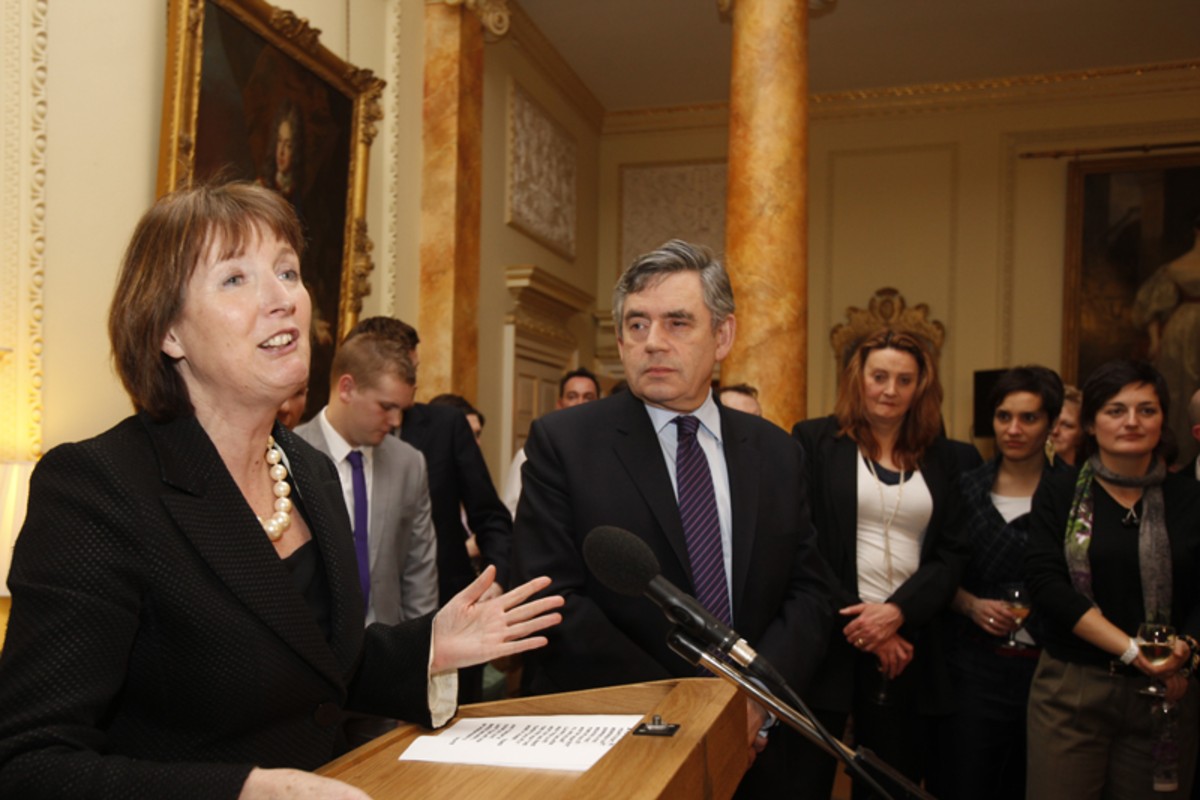
 Harriet Harman and Gordon Brown, Downing Street, 24 Feb 2010. Photo: 10 Downing Street / CC BY-NC-ND 2.0
The election results have reduced the Labour Party to a bizarre performance of pretending there is any life left in British social democracy, argues Kevin Crane
After a woeful English local elections last year, Keir Starmer was notably very slow to respond much at all, able to say little immediately beyond “I get it” rather late in the day after the scale of the damage was exposed. What he was claiming to have got was revealed sometime afterwards, when he attempted to head off the challenge from the far-right Reform party with his infamous “Island of Strangers” speech, a crazy proclamation that conceded entirely to racist arguments and that he ultimately had to walk back when it was inescapable that it made everyone even angrier with him than they already were.
No repeat of that tardiness this year though. In 2026, Starmer had already responded to a set of godawful election results before they’d even been announced, making clear he knew Labour had done appallingly again… but also that there was absolutely no way that he was going to resign. It’s probably likely that, in his own mind, this was an exercise in expectation management, and he’d be able to laugh off discussions about his continuing premiership once things turn out not to be all that bad. However, they really, really were that bad, so it was off to The Guardian to put out one of the most vacuous articles ever written by a politician (summary: “Bad things are bad. I’m still in charge, mind. Deal with it.”) which has been followed by some announcements that crossed the line from cringe into the downright weird. Come Saturday, Starmer set the tone for the latest relaunch (by my count, probably the tenth) of his leadership by publicly appointing two exciting new members of his government: Gordon Brown and Harriet Harman.
No, really.
The sight of these two clapped-out has-beens from the New Labour era, drafted in at what seems to be short notice, to prop up Sir Keir’s imploding administration is a previously unseen level of desperate. This two-year-old Parliamentary Labour Party has a vast number of new MPs and they are all such nonentities, they are all so uninspiring, they are all so lacking in basic political talent, that the government has brought back from retirement two people that public wrote off as failures in a previous decade.
Living Fossils
Harman, who has been given some vaguely defined role on women’s issues, has been bigged up as a former acting leader. She is indeed one of only two women who ever sort-of lead the party (Labour has the non-honour of being the only major party that a woman has never actually been leader of, amazingly), but this incident was frankly rather embarrassing. She took up the post on a caretaker basis after Ed Miliband was bullied out of the leadership following his defeat in the 2015 general election and proceeded to be spectacularly useless. She casually let slip in one communication that “some of us are quietly pleased we didn’t win”, which was letting the cat out of the bag that the right-wing of the party had essentially sabotaged Miliband’s campaign for being too hostile to austerity. Her vacant leadership, which refused to confront any aspect of the Tories’ agenda, produced a backlash from Labour members, supporters and trade union affiliates that contributed to Jeremy Corbyn becoming the full-time leader shortly thereafter.
So, that’s a baffling pick, but it as nothing to dredging Brown up from the abyss. Gordy has been designated, of all the things, a “special envoy on global finance”, which probably sounds clever provided you do not think about it for even a few seconds. This man spent ten years being kept out of Number 10 by Tony Blair, only for Blair to leave the job open for him mere months before Western capitalism got clobbered by the global financial crisis of 2007. Part of Brown’s panicked response to that emergency was also to bring someone back out of retirement. That someone was Peter Mandelson, already a discredited shady figure even then, and it was being brought back into government at this time that facilitated Mandelson’s illegal release of secret financial information to Geoffrey Epstein that subsequently blew up as a massive scandal this year! Starmer has somehow decided that the solution to his problems is to rehabilitate the man who rehabilitated the man who caused the biggest single scandal of this government so far: you have to be well into your seven-dimensional chess games to find the logic in there.
Brown lost the 2010 general election – not least because of the economic woes that Mandelson had been secretly causing in the background – having become a deeply unpopular prime minister. Both he and Harman are essentially relics of a bygone time in Labour Party history, who Starmer seems to have brought back to try and recapture the spirit of a past age.
There’s only so far back in the past he’s able to go, of course, because he’s limiting himself to people who are, in the strictly biological sense, still alive. This whole idea is so daft and irrational, I suggest he could get a better class of ancestral spirit by dropping that criteria. Why not dig up Clement Atlee’s bones and make them Health Minister? Perhaps they could summon the ghost of Harold Wilson via séance and get him to draft technology policy?
The Machinery of Politics
The explanation for this craziness lies in the fundamental nature of the of the decline that the Labour Party has undergone, and that has been exposed by this election. The defeat the party has suffered is not a simple or typical backlash to an unpopular government; it is the breakdown of the party’s fundamental premise. Social democracy is over, and we need to talk about what that means.
Social democracy was not simply a set of ideas or policies. It can’t simply be understood as wanting to have a National Health Service or council housing: other types of political movements can deliver these, even though they historically tended to so under pressure from social democracy. What it was a set of mass political institutions that arose when the leaderships of the twentieth-century trade union movement compromised with the political systems of capitalist states. These union leaders rejecting revolutionary change to deliver socialist goals for the working class – whom they claimed to speak for – and instead sought to achieve their goals by forming governments that would work entirely within the constraints of the capitalist state.
While many of the demands raised by social democrats were regarded as unacceptable by capitalists, there was always a wing of the ruling class that recognised that trade union leaders were actually the ‘friendliest’ expression of organised workers. This was particularly crucial during the period between the World Wars when examples of massive workers’ organisations taking revolutionary action, as had happened Russia, felt like a genuine threat. Better to concede some welfare and housing, than be overthrown entirely, was the theory. After WWII, most of Europe re-stabilised capitalism, and firmly saw off the risk of revolution, by establishing modern welfare states under the stewardship of social democratic governments. Britain’s post-war Labour government was a prime example.
The compromise the heart of all this worked two-ways, however. Social democratic parties could be allowed to argue for deliver some gains for workers, but only within constraints that capitalist interests would allow, and they could not challenge the power of the state. This mean that parties of this type were as much focused on corralling workers into consenting to the states’ policies as they were raising demands on the state. The worst expression of this has always been seen during wartime, when social democratic politicians almost always act as pro-war propagandists.
In day-to-day life, what this used to mean was that for most working-class people, voting for the ‘the’ party of the working class was a non-negotiable act, for both class-interest and patriotic reasons. This was extremely true in Britain throughout the twentieth century, with most large cities being ultra-safe centres of Labour voting. A common joke was that you could put a red rosette on a donkey, and the donkey would become an MP in almost any Northern town.
Red Dusk
No one is telling that joke anymore, because we simply no longer live with such a political arrangement. The exact point at which it came to an end is highly debatable, though I would say the single most crucial moment was probably the 2019 general election.
Political systems don’t end overnight: Labour’s status as a party tied by strong to links to the trade union movement had already been in decline since the 1990s, because the trade union movement was itself in decline due to their defeats in the shift away from social democracy to neoliberalism.
Although the party was electorally successful during the Tony Blair years, it was actually losing votes consistently during that period, something masked by the dysfunction of the Tories post-Thatcher and the high support for the Lib Dems among middle class voters in the period. That loss of voters was a long-term outcome (a particularly successful one) of a Thatcher policy. Her housing policies had encouraged ever-increasing numbers of people to see themselves more as homeowners than as workers, and this was causing a quiet drift of support into the arms of the Tory Party, that Labour would struggle to reverse in 2010s.
Attempts by the left within both the Labour Party and the trade union movement to revitalise social democratic ideology – first gently via Miliband and then more radically with Corbyn – were met with ferocious campaigns of infighting by the party’s right-wing establishment (much of it led by Peter Mandelson) for whom deference to capitalists and the state was ‘the point’ of the party. This reached it’s absolute crescendo in 2019, when a series of cross-party plots and smear campaigns severely damaged Corbyn’s brand through manufactured antisemitism scares. Even more seriously, from an electoral point of view, they lumbered the party with an extremely damaging policy of trying to keep Britain within the EU via a convoluted second referendum process.
Going anti-Brexit dropped a toxic bomb on Labour’s election campaign and was the absolute breaking point for many voters. Lifelong Labour supporters switched in droves and, for the first time in any general election, previous non-voters went majority Tory. This was the point at which social class finally stopped being any real indicator of party preference. The rupture wasn’t even mitigated for the now-minority of workers still in trade unions: both Unite and GMB have reliable data showing that their members are no more likely to vote Labour than the population at large.
Few of us could have imagined then that Boris Johnson’s triumphant Tories would then spectacularly implode just a few years later. It certainly quite likely that the right-wing factionalists inside Labour who installed Keir Starmer as leader didn’t imagine it, as it is not at all clear they ever actually intended him to become prime minister. Nevertheless, collapse the Tories did, and the 2024 general election saw them absolutely implode. Labour benefited, but it did not reverse the fundamental changes that had occurred to it’s voter base. Neither social class nor previous party affiliation played a real role in deciding which party people were going for. The strongest correlation to party preference was quite simply age, with older voters favouring skewing right and younger ones skewing left.
Down Comes the Sandcastle
All of this is to say that when Starmer got elected with a huge parliamentary majority, it had the superficial appearance, but not the functional robustness, of a social democratic government. That is what is revealed for the world to see right now.
Labour’s decay has not been uniform across Britain. Scotland got a two-decade head start when the Nationalists took over the devolved government in Holyrood in the late 2000s, and that’s the underlying reason why the Scottish election results were pretty boring. While the SNP is also looking like a bit of a spent force these days, it has been able to rely on widespread antipathy to UK governments from south of the border to keep it in office, and that just played out yet again.
In stark contrast, Wales’ election was absolutely spectacular. The difference there is that the devolved government had been kept in Labour’s hands for a very long time by an unusually popular and competent First Minister, Mark Drakeford, who combined a version of the SNP’s “hey, at least it’s not London” schtick with just enough economic radicalism to look more progressive next to successive Tory governments. His retirement, coinciding with Starmer’s catastrophe of a UK government, caused this once-sturdy output to be destroyed from both inside and out, as his initial successor immediately got embroiled in a messy corruption scandal. The loss of Wales to Labour is a particularly symbolic blow, as the country played an outsize role in the development on the British working-class movement historically.
England continued it’s pattern of long-in-the-tooth council administrations suddenly falling apart from last year. The added dimension, of course, is that this year’s round includes all the London councils and large cities like Birmingham and Manchester, which were also absolutely core hubs for Labour’s internal infrastructure. Technically, Labour’s London result is not the worst it’s ever had – that was the near total wipeout of 1968 – but the statistics mask a serious structural crisis that is hitting the party much harder than that event did.
Labour could dust itself off from a nasty shock like the ’68 defeat because even with the loss of council seats, the infrastructure of the party rested on solid foundations of social democracy. The trade unions, the strong local party structures, the loyal support of working-class communities were all still there. London Labour actually renewed itself very successfully after that defeat and a new generation of leaders, such as Ken Livingston, emerged to revitalise the party with ideas brought in from the New Left of the 1960s.
Scotland has already shown us that Labour cannot do this now. Scottish Labour has never once come out of a Scottish Parliament election with more members in Holyrood that in went with, and that trend has not bucked. The party’s internal machinery was shattered well over ten years ago, and we can see that it is not reassembling.
Labour’s Scottish problem is now going to spread to Wales, and also to major English cities. There isn’t a mass popular base invested in keeping Labour going in any of these places anymore, so once the local politicians lose their seats and the facilities and opportunities that go with them, there’s really nothing much left to keep ambitious and career-minded people in place. Labour will hollow-out, and struggle to maintain consistent organisation in increasingly wide areas of Britain.
Labour’s era is at an end, and even an absolute thicko like Keir Starmer can see this on some level. He is determined to stay in office for as long as he can, loyal as ever to the interests of the British state and the rich elites (who are literally the only people who genuinely like him). He has no vision of any future to show either his party or its voters, which is why he’s resorted to wheeling out Harman and Brown for the purposes of tacky nostalgia-baiting.
Life after Labour
One of the other things we can learn from Scotland is that, alas, social democracy’s passing doesn’t instantly clear the way for so new more radical expression of socialism. Nationalist Scotland is trapped in just as much of an austerity doom-loop as everywhere else in the UK (which it still had no functional plan to escape from, by the by). As great as it was seeing Plaid Cymru win a shock victory against Reform in Wales, prospects are not good if they just reproduce the SNP experience.
As for Reform, it remains depressingly true that a large number of working-class voters, most of who would have been solid Labour supporters during the social democratic era, are still turning to them, as witnessed in many provincial English localities where they are still coming from nowhere to win significant numbers of seats. Since last year, it has become something of a national pastime in the liberal press in this country to point out that Reform councillors are frequently utterly political clueless, or unreconstructed fascists, or a combination of both, but frankly such sneering isn’t going to solve the problem that the radical right is able to reach out to workers in a lot of places where the left absolutely can’t.
Obviously, there are arguments from many of the left that either the English Greens or various types of localist parties present a way forward, and it is true that both of these did also make gains (albeit much smaller and geographically specific than Reform) in a range of council seats. It’s certainly true that socialists can vote for these parties, and work with their members and politicians on campaigns wherever possible, but we also need to be clear about the limitations inherent in working with fundamentally non-socialist parties.
It’s not just social democratic politics that has machinery behind it: they all do. A lot of people in Scotland were very excited about the SNP’s potential as a ‘radical’ party ten years ago. A lot of austerity, corruption and rightward drift later, and they are basically unthinkable as a vehicle for socialism today. The English Greens have already begun processes of disciplining and limiting the horizons of their new members, such as by circulating social media memes reassuring the world that claims that they are anticapitalist are “a myth”. There will be hard limits placed internally by these parties to limit their capacity to go too far leftwards, or to challenge the interests of the state. As in previous eras, that becomes particularly critical over any question relating to war. Ultimately, socialists should view the passing of social democracy simply as a new terrain in which we are going to have to operate. It is one in which reformist politics looks and acts quite differently. And it is one in which class-orientated organisations have to be significantly rebuilt after decades of demolition and vandalism by the Labour right.
Before you go
The ongoing genocide in Gaza, Starmer’s austerity and the danger of a resurgent far right demonstrate the urgent need for socialist organisation and ideas. Counterfire has been central to the Palestine revolt and we are committed to building mass, united movements of resistance. Become a member today and join the fightback.
