
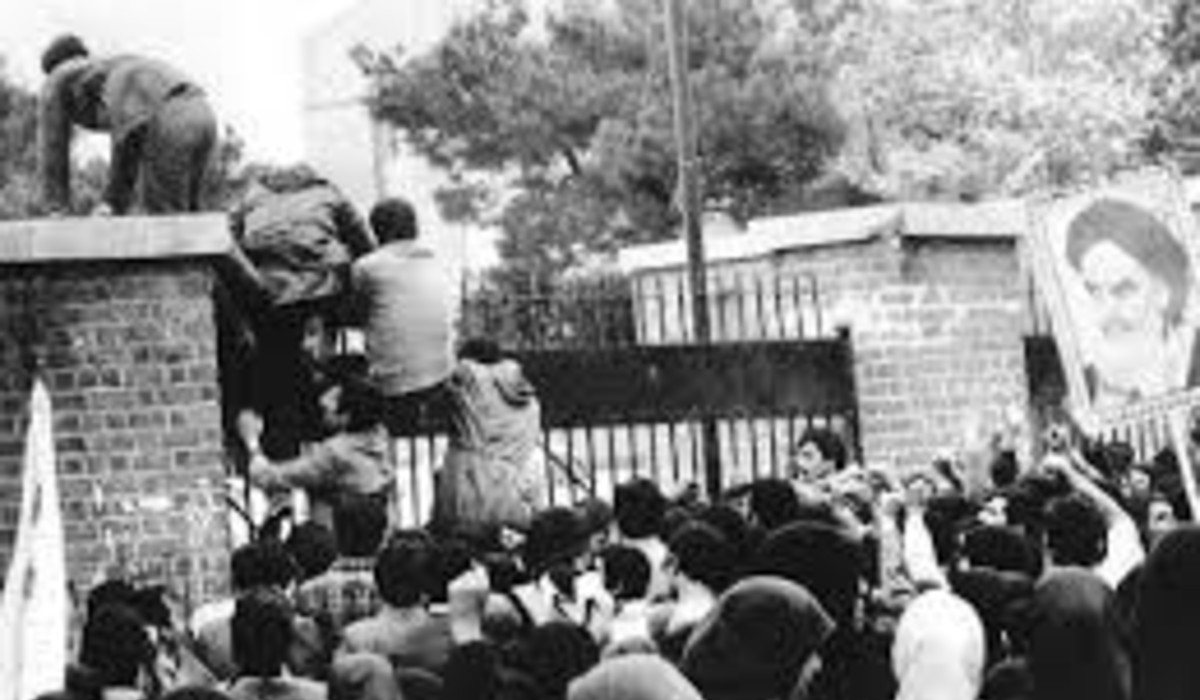
 Iranian students climb up U.S. embassy gates in Tehran 04 Nov 1979. Photo: Public Domain
Some corners site the influence of the Israel lobby over American politics as the real cause of the Iran War, but there is much more at play here, argues Chris Bambery
The common-sense answer would seem to be yes. Iran offers no threat to America; it is seen as a very real threat by Israel. The decision to launch a war with Iran was decided during Benjamin Netanyahu’s recent visit to the White House.
Pro-Israel lobbying groups spend some $3.8 million annually lobbying on behalf of Israel. Washington regularly uses its veto on the Security Council to protect Israel from criticism or sanction at the United Nations.
There are numerous lobbies operating on Capitol Hill, many bigger than AIPAC and the pro-Zionist groups – the National Rifle Association (NRA) for instance or the fossil fuel and big pharma lobbies.
None of these groups control the U.S. government. None made Trump bomb Iran. They are part of the machinery through which corporate interests and imperial objectives are negotiated and maintained.
John Mearsheimer and Stephen Walt have written extensively on the Israeli lobby:
“Jewish Americans have set up an impressive array of organisations to influence American foreign policy, of which AIPAC is the most powerful and best known.”
They argue that the power of the lobby is now so great that it has orchestrated the US war on Iraq in 2003, wars against Iran and Syria and ensured that there can never be a balanced US foreign policy on Israel and Palestine. They ask:
“So, if neither strategic nor moral arguments can account for America’s support for Israel, how are we to explain it?”
Their answer:
“The explanation is the unmatched power of the Israel Lobby.” [1]
But Saudi Arabia is also of enormous importance to the US, and it spends billions lobbying in Washington.
If you start to look at the Middle East through the lens of Saudi-US ties things look rather different than a simplified view of Washington jumping to Tel Aviv’s command.
The US involvement in the Middle East developed after WW2 due to Gulf oil. It decided that it could not remain isolated any longer and began policy formulation and manoeuvring in the region.
The State Department in 1944 described the Arabian Peninsula as constituting:
‘A stupendous source of strategic power and the greatest material prize in the world’s history’.[2]
The US was aware that controlling the region’s oil would allow it significant control over other countries. George Kennan, the influential planner of the containment of the Soviet Union, commented in 1949:
‘If the US controlled the oil, it would have veto power over the potential actions in the future of rivals like Germany and Japan’.[3]
The alliance between Saudi Arabia and the US dates back to 1945 when President Franklin Roosevelt signed an agreement with King Abdul Aziz in which the US would provide the newly born Kingdom of Saudi Arabia with security, in exchange for oil. The 70 plus years agreement still stands under Trump, and Crown Prince Mohammed Bin Salman.
During the Cold War, the US intervened in the Arabian Gulf to prevent Soviet expansion, secure oil supplies for allies, and maintain regional stability. Following Britain’s 1971 withdrawal from east of Suez, the US adopted a strategy of supporting conservative monarchies, such as Saudi Arabia, to counter Soviet influence and radical ideologies.
Fawaz Gerges, author of What Really Went Wrong: The West and the failure of democracy in the Middle East, explains:
“Obsessed with Soviet Communism, Washington protected repressive Middle Eastern regimes in return for compliance with American hegemonic designs and uninterrupted flows of cheap oil and gas. And all this while preaching ‘freedom and democracy’ at home”
In May 1972, President Nixon and his chief foreign policy advisor, Henry Kissinger, visited Tehran to seal a deal with the autocratic Shah of Iran, enabling him to become the key power in the Gulf. Iran’s payoff for “policing” the Gulf was virtually unlimited access to American military hardware, technical advisors and industrial support, with the exception of nuclear weapons.[4]
The 1979 revolution which overthrew the Shah was a massive blow to the US, followed by the humiliation of the hostage crisis when revolutionary students seized the US embassy and its staff.
The US responded by unleashing Iraq on Iran in a vicious 8 year war and by switching to using Saudi as its policeman in the Gulf. At this time the US and the West relied on Gulf oil.
In January 1980 President Jimmy Carter stated:
“Any attempt by any outside force to gain control of the Persian Gulf region will be regarded as an assault on the vital interests of the United States of America, and such an assault will be repelled by any means necessary, including military force.” [5]
On October 2,1981, President Reagan enunciated what would soon become known as the Reagan Corollary to the Carter Doctrine saying Saudi Arabia would not be allowed to become another Iran:
“There is no way, as long as Saudi Arabia and the OPEC nations there in the East – and Saudi Arabia’s the most important – provide industry the bulk of the energy that is needed to turn the wheels of industry in the Western world [sic]. There’s no way that we could stand by and see that taken over by anyone that would shut off that oil.”[6]
In recent years the Palestinian conflict increasingly is seen in both Jerusalem and Washington as part of the broader contest between China and Russia on the one hand, and the United States, NATO, and Israel on the other. Their objective has been to draw the United Arab Emirates and Saudi Arabia into an axis with Israel, India and the United States.
The First Gulf War left the US seemingly invulnerable as the guarantor of the Gulf and its oil wealth. Then came 9/11 and the subsequent drive to assert US dominance globally, including a list of countries requiring regime change. Iran is the one where that has not yet occurred.
Meanwhile, Israel had come to be seen in Washington as, “a capable, reliable and technologically sophisticated strategic partner — not a ward of American policy, but a pillar of regional equilibrium.”
Israel is America’s unsinkable aircraft carrier in a region which is crucial to global capitalism and therefore the US.
Prior to the 7 October attack on Israel by Hamas, the conflict in Palestine seemed to have settled down to an acceptable level of violence; Iran had agreed a bargain with the US to limit the advancement of its nuclear program and had normalized ties with Saudi Arabia and other Gulf countries; Saudi and the Gulf States seemed set to enter the Abraham Accords with Israel. The US seemed able to pivot its attention to the Pacific and the South China Sea. But Washington had overestimated the stability of that situation.
Everything changed after 7 October.
Whatever its verbal statements Washington recognised the two state solution was dead. That ruled out any concessions to the Palestinians or to those in the so-called “Axis of Resistance (Iran, Hamas, Hezbollah, the Houthis and the Shia Iraqi militias), indeed the goal was now to destroy it.
That meant the destruction of not just Hamas but all of Gaza as a demonstration of Israeli determination, armed and funded by the US; the crippling of Hezbollah’s
position in Lebanon, and demonstrating to all that Iran could not defend itself while neither China nor Russia would come to its aid.
The United States seeks to confront Iran not because it sees Iran as a Russian or Chinese satellite but rather because they see Iran as a threat to U.S. interests in the region. In recent weeks Washington’s concerns have become less about the Iranian nuclear programme and more about its missile arsenal and its support for Hezbollah, the Houthis and the Palestinians.
Saudi Arabia is of great importance to the USA:
“CIA estimates of Real GDP (purchasing power) and GDP/Capita in Saudi Arabia ($1.831 trillion, $49,600) and in the U.A.E. ($720 billion, $75,600) dwarf those in Iraq ($573 billion, $12,600), Syria ($62 billion, $2,900), and Lebanon ($66 billion, $12,300). Iran is on par in terms of GDP ($1.44 trillion) but not GDP per capita ($16,200)… the International Institute for Strategic Studies (IISS) estimates that Saudi Arabia’s defense expenditures account for 36.7% of all those in the Middle East and North Africa with the U.A.E. and Qatar accounting for an additional 11% and 4.8% of the total. By way of comparison, Iran accounts for 3.9%, Iraq 5.5%, and Israel 11.9%… IISS concludes that Iran’s most important leverage comes from its allegiances with mostly non-state actors in Lebanon, Iraq, and Yemen, and the (then standing) Assad government in Syria.”
By hobbling Iran Washington would get the Saudis back on board for the Abraham Accords. The re-imposition of US dominance of the region, with Israel as the dominant sub-imperialist, was primary but a secondary goal was to get Saudi and the Gulf States to close ranks with the US in the emerging cold war with China.
China depends on Middle East oil, 50 percent comes from the region; Saudi Arabia provides 15 percent, and Iraq, the U.A.E, Oman, and Kuwait the rest. China’s primary interest in the Middle East is ensuring the flow of oil. Russia is fully occupied in Ukraine so both states will do nothing to aid Iran in this war. Washington grasps this and sees it as providing an opportunity.
Let’s return to Saudi Arabia and Trump’s decision to attack Iran.
Despite Saudi Arabia reaching a Chinese brokered accord with Iran the tensions between the two states run deep. The Washington Post reported on 28 February, 2026:
“Saudi Crown Prince Mohammed bin Salman made multiple private phone calls to Trump over the past month advocating a U.S. attack, despite his public support for a diplomatic solution…
In his discussions with U.S. officials, however, the Saudi leader warned that Iran would come away stronger and more dangerous if the United States did not strike now.”
There is another reason why the USA wants to strike Iran. This dates back half a century:
“In explaining his decision, Trump on Saturday reached all the way back to Iran’s 1979 revolution. He described the U.S. attacks as payback for decades of conflict with Iran. He cited the 52 Americans held hostage for more than a year after the 1979 takeover of the American Embassy in Tehran; the deaths of 241 U.S. service members in 1983 bombing of their barracks in Beirut by Iran-backed Hezbollah during a Lebanese civil war; and the 2000 attack on the USS Cole, a naval destroyer docked in a Yemen, which Trump said Iran “probably” was involved in, although the United States has long attributed the suicide bombing to al-Qaeda.”
America has never had its revenge for 1979 and the hostage crisis in particular. Its waited but not forgotten or forgiven.
Let’s end by returning to the joint US-Israeli decision to launch this war.
Khalil E. Jahshan points to Netanyahu’s role in getting Trump to attack Iran:
“Netanyahu played a principal role in trying to derail those talks and for months coordinated with an eager Trump administration to get the green light and political cover to proceed with the February 28, 2026, attack on Iran. Like Washington, Israel saw a rare opportunity to resume war with Iran and decided to opt for a war of choice disguised as a preemptive act of self-defense to destroy Iran’s nuclear capabilities, whether real or imagined.”
Rather than simply dictating to Trump his administration was “eager” to attack Iran and both governments saw a “rare opportunity” they grabbed with both hands.
This view offers a more sophisticated and realistic one than Netanyahu simply telling Trump what to do and Trump jumping to it. Trump, Vance, Hegseth, Rubbio et al see this war, rightly or wrongly, as being in the US’s national interests. That’s why the US goes to war.
US imperialism rests on its ideological/political, economic, financial and military power.
“The reserve currency status of US dollar and the expansion of finance capital in a liberalized and deregulated market allowed finance capital, mainly from the West, free rein to engage in speculative activities in almost any economy. The United States can externalize its deficit problems to the world through quantitative easing at times of its choosing, and has been able to maintain its primacy through political and military domination despite entering relative economic decline from the 1960s.”
According to a Lowy Institute report, by 2023 around 70 percent of economies (145 out of 205) traded with China more than with the United States, and 112 economies had more than twice as much trade with China than with the United States (Rajah and Albayrak 2025, 8).
The United States will have to rely more on extra-economic coercion to maintain its power.
Back in 2014 the then US Secretary of State John Kerry responded to Russia’s takeover of Crimea by saying:
“You just don’t in the 21st century behave in 19th century fashion by invading another country.”
[1] John Mearsheimer and Stephen Walt, The Israel Lobby, in Eugene R. Wittkopf and James M. McCormick (editors), The Domestic Sources of American Foreign Policy: Insights and Evidence, Rowman & Littlefield Publishers, 2007, P86-87
[2] Larry Everest, Oil, Power, & Empire: Iraq and the U.S. Global Agenda, Common Courage Press, P56
[3] Adnan Khan, 100 Years of the Middle East – The Struggle for the Post Sykes-Picot Middle East, Maktaba Islamica, 2018, P61
[4] Stephen Brannon, Pillars, Petroleum and Power: The United States in the Gulf, The Arab Studies Journal, Vol. 2, No. 1 (Spring 1994), P4
[5] Stephen Brannon, Pillars, Petroleum and Power: The United States in the Gulf, The Arab Studies Journal, Vol. 2, No. 1 (Spring 1994), P7
[6] Leila Meo, United States Strategy in the Gulf: Intervention Against Liberation, Associaton of Arab-American University Graduates,1981, P128
Before you go
The ongoing genocide in Gaza, Starmer’s austerity and the danger of a resurgent far right demonstrate the urgent need for socialist organisation and ideas. Counterfire has been central to the Palestine revolt and we are committed to building mass, united movements of resistance. Become a member today and join the fightback.

Chris Bambery
Chris Bambery is an author, political activist and commentator, and a supporter of Rise, the radical left wing coalition in Scotland. His books include A People's History of Scotland and The Second World War: A Marxist Analysis.