
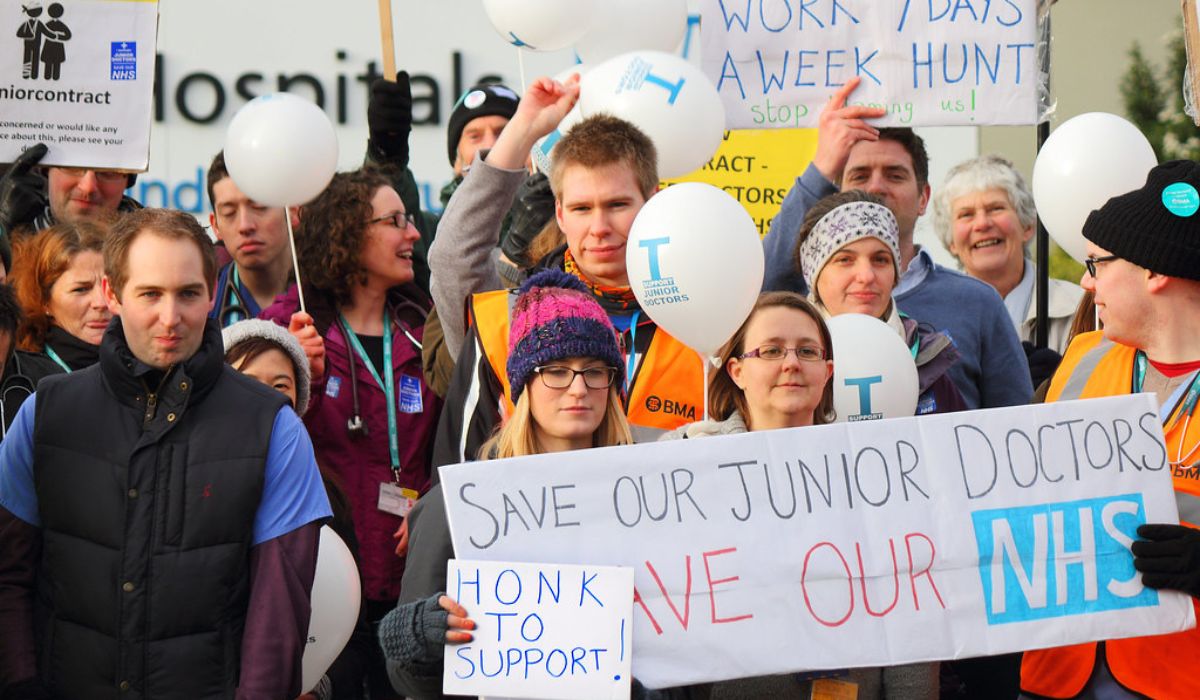
 Old Image: Junior Doctors Strike Picket outside Norwich University Hospital. Source: Roger Blackwell - Flickr / cropped from original / CC BY 2.0
With the government and the media attacking the resident doctors, Simon Midgley explains why they are wrong and we should all support the strikes
Resident doctors voted overwhelmingly for strike action to reverse fourteen years of erosion in the value of their pay. Wes Streeting and the establishment media are trying to paint them as greedy and unrealistic. What’s the reality?
Resident doctors voted decisively for industrial action. On a turnout of 55%, 90% voted ‘Yes’, and just 10% voted ‘No’. The BMA lost no time in announcing five consecutive days of strike action, from 7am Friday 25 to 7am Wednesday 30 July. The co-chairs of the BMA Resident Doctors Committee, Melissa Ryan and Ross Nieuwoudt, said: ‘Doctors have spoken and spoken clearly: they won’t accept that they are worth a fifth less than they were in 2008. Our pay may have declined, but our will to fight remains strong.’
In his letter to the BMA, responding to the announcement of strike dates, Wes Streeting stated that fewer than half of the 53,766 resident doctors who were eligible to take part in the ballot voted ‘Yes’. An unnamed Downing Street spokesperson also said: ‘We’re disappointed at this move, despite the majority of BMA resident doctors not voting for strikes.’
Let’s get something straight here. Out of the total of 53,766 Resident Doctors who were entitled to vote in the ballot, 50% (26,766) voted ‘Yes’, and just 5.5% (2,956) voted ‘No’. That’s a resounding 9 to 1 majority in favour of strike action.
In the 2024 general election, Streeting was elected by just 20% of his constituency electorate, with 40% voting for other candidates. He got just 15,647 votes out of a possible 77,835, with 31,241 voting for his rivals. Independent challenger Leanne Mohamad nearly beat him with 15,119 votes, just 528 fewer than Streeting. Those in glass houses…
Streeting also stated: ‘Ultimately, we are all public servants. The public won’t see why, after a 28.9% pay rise, you would still walk out on strike, and neither do I.’ And also: ‘No trade union in British history has seen its members receive a 28.9% pay rise only to immediately respond with strikes,’ he said. ‘This is completely unreasonable. The NHS recovery is hanging by a thread, and the BMA are threatening to pull it.’
Knowing that the BMA has the solid backing of its resident doctors, Streeting is trying to paint their campaign for pay restoration as greedy and unrealistic. And on the face of it, a 28.9% pay rise sounds huge. But where does this figure come from?
The actual pay situation
After the general election, resident doctors accepted a two-year deal with Wes Streeting which was an additional 4.05% for the pay year 2023/24 on top of the 8.8% offered by the Tory government, making the average total 13.2% for the first year of the deal. For 2024-25, the second year of the deal, they got 8%. Overall, this deal works out as an average rise of 22.3% over the two years. Streeting is now adding onto this the 5.4% he is wanting them to accept for 2025-26. All this works out as being equivalent to a 28.9% pay rise over the full three years.
Why did the BMA go on strike on eleven occasions, for a total of 44 days, in its last dispute? Not because they are greedy, but because they are fighting to restore the real-terms value of their wages, which has significantly shrunk since 2008. Between 2008 and 2022, the BMA calculates that doctors’ pay was eroded in real terms, due to the combined effect of high inflation and low pay rises and pay freezes, by a massive 35% over those fourteen years.
For the BMA and the Resident Doctors, last year’s two-year pay deal was ‘merely a step forward rather than the end of the journey to full pay restoration.’ This latest resident doctors’ strike ballot was held because the BMA is still fighting for pay restoration. They have calculated that even if they got a pay rise of 5.4% every year from 2025-26, and inflation was just 3.2% each year, then it would take another twelve years for their pay to get back to the real-terms level it was in 2008. They aren’t prepared to wait that long, and nor should they.
The BMA has worked out that they would need a rise equivalent to 29% on top of current pay to achieve full pay restoration (FPR), because even after the 22.3% they won last year, in real terms, their pay is still 21% below what it was in 2008.
The establishment press has seized on this figure of 29%, as if the BMA is demanding the full 29% for their 2025-26 pay rise. This is a deliberate distortion, which is being wielded as a stick with which to beat the doctors.
What the BMA is actually fighting for, and what resident doctors have been balloted on, is a deal that includes ‘… a credible path to pay restoration. All we need is a credible pay offer and nobody need strike.’ The aim of the BMA is to ‘negotiate a path to full pay restoration and the restoration of doctors’ confidence in our profession’s future.’
Reasonable and achievable
On Channel 4 News, on the eve of the first day of strike action, Co-Chair of the BMA Resident Doctors’ Committee, Melissa Ryan, stated clearly that ‘No one has ever said that we want our pay to be restored all in one go. We are willing to be flexible.’
A multi-year agreement that guarantees step-by-step full pay restoration could be agreed as part of the government’s plans for NHS reform. In terms of overall cost, the Chair of the BMA, Dr Tom Dolphin, has stated that the resident doctors’ claim is reasonable and achievable for the NHS.
In an interview with the Guardian on 11 July, he explained that while the gross cost of delivering the 29% full pay restoration is £1.73bn, this drops to £920m net once money returned to the Treasury through the tax system is taken into account. He added that £920m is less than half of 1% of the NHS’s £190.8bn budget for this year. ‘It’s a small proportion of the budget. It [29%] sounds like a large number, but actually, put into the context of the whole NHS, it’s not a large sum compared to that,’ he said.
However, Wes Streeting and Keir Starmer have other priorities. They recently promised Donald Trump and NATO that they will increase government spending on arms, warfare and ‘defence’ from 2% to 3.5% of GDP, and then to 5% of GDP by 2035. Clearly, there is money available, but for warfare, not for healthcare.
The resident doctors’ fight for pay restoration is important for NHS workers and public-sector workers more widely. It is resident doctors who are making their stand right now, but all NHS workers, including nurses, clinicians, paramedics, porters, health-care assistants, and cleaners, plus everyone else working in the public sector, have experienced the self-same erosion of real-terms pay.
Nurses in the RCN and other NHS workers in Unison are already being consulted on whether they are prepared to take industrial action to win more than the measly 3.6% they have been given. This is why the resident doctors’ dispute is so important. A win for them could encourage other NHS staff to take a stand.
With Consumer Price Index (CPI) inflation now standing at 3.6% for the year to June, a 3.6% pay rise would at best be standing still. Compared with the more realistic Retail Price Index (RPI) inflation figure of 4.4% for June, 3.6% is actually a pay cut in real terms. With the average private-sector pay rise having been 5.4% over the last year, such a paltry pay rise would mean NHS workers falling still further behind.
Everyone should back the Resident Doctors in their fight. Everyone in the public sector should follow their lead. A victory for one is a victory for all!
Simon Midgley,
International Officer
Bradford Calderdale and Huddersfield Health Unison
(In a personal capacity)
Before you go
The ongoing genocide in Gaza, Starmer’s austerity and the danger of a resurgent far right demonstrate the urgent need for socialist organisation and ideas. Counterfire has been central to the Palestine revolt and we are committed to building mass, united movements of resistance. Become a member today and join the fightback.
