
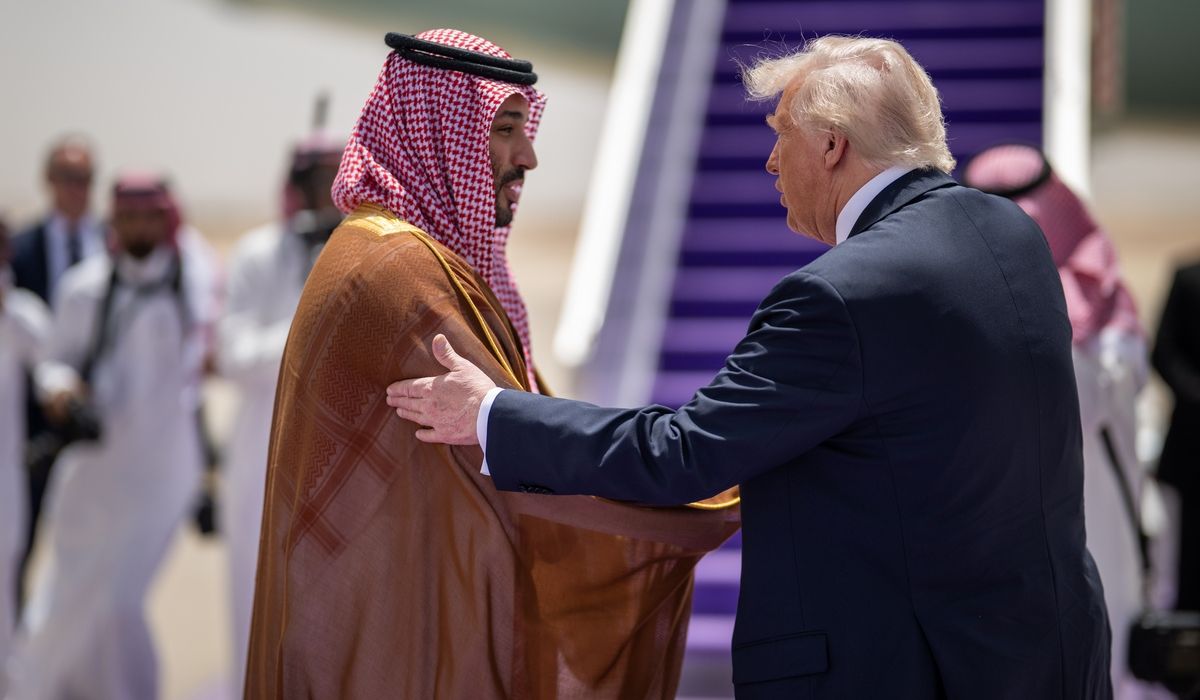
 Donald Trump bids farewell to Saudi Crown Prince Mohammed bin Salman al Saud at King Khalid International Airport in Riyadh, May 2025. Source:
United States government work - Flickr / cropped from original / Public domain
Donald Trump bids farewell to Saudi Crown Prince Mohammed bin Salman al Saud at King Khalid International Airport in Riyadh, May 2025. Source:
United States government work - Flickr / cropped from original / Public domain
As Trump vacillates between threats to restart the illegal war against Iran or negotiate a meaningful settlement, Chris Bambery examines the options and impacts of the conflict
President Donald Trump has now paused Project Freedom but maintains the blockade of the Straits of Hormuz – saying a peace deal is now in the offing.
US Secretary of State Marco Rubio says the offensive stage of the Iran war is ‘over’. US warships were supposedly escorting tankers through the Straits – but they were hundreds of miles away from it in reality. Iran retains control of this vital waterway.
In the standoff which developed, Trump blinked first.
The US and Iran now seem to be inching towards negotiations. Washington now has a one-page memorandum from Tehran, which reportedly sets 30 days to negotiate, including opening the Strait of Hormuz and sanctions relief.
Washington still wants to begin negotiations with Iran’s nuclear programme. Iran says that it can only be discussed after a comprehensive deal is reached, which guarantees its sovereignty and excludes any further military attacks on it.
Almost immediately, Israeli Prime Minister Benjamin Netanyahu ordered fresh attacks on Lebanon, knowing that an end to the war there is part of Tehran’s demands.
Iran’s Revolutionary Guards (IRGC) has issued a statement thanking vessel owners for their ‘cooperation in transiting through the Strait of Hormuz in accordance with Iranian regulations’.
The statement adds: ‘With the end of the aggressors’ threats and in the shadow of new procedures, the possibility of safe and sustainable passage through the Strait will be provided.’
‘Iranian regulations’ means paying a toll of $1 per barrel, payable in Chinese currency.
Iran seems set to maintain this, in large part because it provides funding for rebuilding its economy and infrastructure.
Trump’s dilemma
Trump had a clear choice regarding the Straits of Hormuz; he could either climb the escalation ladder or take the off-ramp. There were two problems with escalation. The first is that the leaders of the American armed forces plans to force the Straits, or to seize Kharg Island, or to seize Iranian stocks in enriched uranium were not feasible.
The second problem was that Iran could escalate – and it had the better cards. First, it could completely shut the Straits, and second, together with the Houthis, they could block the Red Sea, which would deliver a crushing blow to a tottering world economy.
Whatever the outcome of the US-Iranian negotiations, which seem set to resume in Islamabad, the US has taken a big knock in this war. It has failed to deliver victory. Indeed, if anyone is victorious, it’s the Iranians.
That’s bad news for Trump. It’s worse news for Netanyahu, who is under major criticism in Israel for not having removed the supposed existential threat Iran poses to Israel’s survival.
Tensions in the Gulf
The politics of the Gulf have changed in a big way, with Qatar and Oman working with Iran and Saudi Arabia and the United Arab Emirates resuming a vicious feud.
There is another change which has been little reported in the West.
China has ordered its companies to ignore US sanctions, an unprecedented act of defiance because so far, Beijing has accepted, however reluctantly, Washington’s diktats.
Saturday’s announcement specifically referred to US sanctions on private oil refiners linked to the Iranian oil trade, including heavyweight Hengli Petrochemical (Dalian) Refinery Co., which was sanctioned last month.
The People’s Daily has called this ‘a pivotal step’ in using the legal instrument to restrain what it called the ‘long-arm jurisdiction’ of the US.
Last week, Beijing blocked Meta Platforms Inc.’s agreed $2 billion purchase of AI startup Manus. All of this comes before an expected and long-awaited meeting between Trump and the Chinese leader, Xi Jinping, scheduled for later this month.
America remains the world’s number one military and financial power, but the Iran war has weakened it. A more assertive China, along with a Russia that has grown closer to its neighbour Iran, are chipping away at that power.
Before you go
The ongoing genocide in Gaza, Starmer’s austerity and the danger of a resurgent far right demonstrate the urgent need for socialist organisation and ideas. Counterfire has been central to the Palestine revolt and we are committed to building mass, united movements of resistance. Become a member today and join the fightback.

Chris Bambery
Chris Bambery is an author, political activist and commentator, and a supporter of Rise, the radical left wing coalition in Scotland. His books include A People's History of Scotland and The Second World War: A Marxist Analysis.