
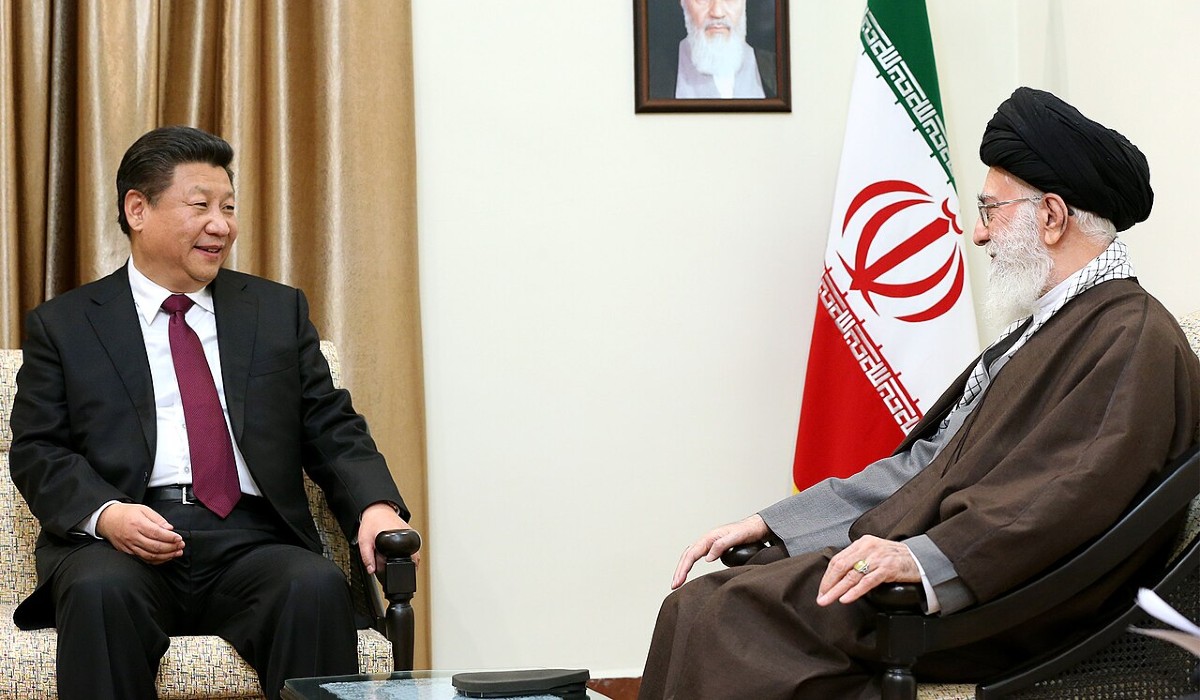
 Xi Jinping meeting Ali Khamenei. Photo: Khamenei.ir / Wikimedia Commons / CC BY 4.0
China and the US are two imperialist powers jockeying for position, but the Iran War proves that Beijing is not in the same league as Washington, writes Chris Bambery
Next month Donald Trump is set to visit Beijing for a summit with President Xi. Many might expect Trump to get a flea in his ear over his war with Iran, a Chinese ally.
That will not happen. It will not happen because China, and the US, will put their own self-interests first. Iran is an ally of China, as was Venezuela, but it is not of great economic importance to Beijing. Trade with the US is of far, far greater import.
For Beijing the relationship with the U.S. to be more critical than that with Iran, including trade, the economy, and Taiwan. In general, it balances its relationship with Iran with its relationships with the Gulf states, Israel, and the United States.
One report on Sino-Iranian economic ties notes:
“…. since the 25-Year agreement signed in 2021, Chinese yearly investment in Iran has been measured in the millions, not billions. By 2023, investment reached a cumulative total of $3.9 billion, but many of these projects have historically been cancelled or never materialized. By contrast, China has over $50 billion worth of investment deals with Saudi Arabia alone.
Across the Gulf, Chinese investment in Iran’s neighbors is several orders of magnitude greater than its investment in Iran.”
“Iran was a recipient of Chinese development financing to construct the recently launched Qom-Yiwu rail freight train, which will connect the central Iranian city of Qom to Yiwu, China. The train will increase trade between China, Iran, and Central Asia by standardizing the rail corridor through the region. Overall, however, Iran does not stand out as a major recipient of Chinese development financing. It falls within the middle tier of Beijing’s overseas lending recipients.”
China is the biggest customer for Iranian oil but around 50% of China’s oil comes from Arab nations such as Saudi Arabia, and only roughly 17% is imported from Iran.
The gap militarily between the US and China is substantial. China has limited military resources and its priority is Taiwan and the South China Sea. That is where its military and naval build up has been focused in response to the presence of the USA and its allies:
“Beijing’s preference is therefore neither peace nor war, but managed tension — enough to constrain US influence, not enough to fracture the system… This is why China’s measured response should not be read as passivity. It reflects a careful effort to keep the situation from tipping too far in either direction.”
Craig Singleton, a senior China fellow at the Foundation for Defense of Democracies, noted that China’s limited involvement underscores the constraints on its global geopolitical influence.
Singleton said, “Beijing’s response has been predictably restrained, underscoring China’s limited ability to shape events once hard power is in motion. Beijing can signal unease; however, it cannot meaningfully deter or influence U.S.-Israeli military action.”
A comparison is with China’s stand on Ukraine – Russia is after all a more important ally for China than Iran:
“… China believes that while significant US military action in Iran could inflict losses, regime change would be difficult to achieve. Under such circumstances, Beijing can adopt a model similar to its approach to the Ukraine conflict: refraining from direct participation while maintaining normal state-to-state relations with the party under attack, providing political and diplomatic support at the UN, and continuing economic engagement that doesn’t violate international law.”
The same article concludes:
“For those asking whether China will “rescue” Iran, the answer depends on definition. If rescue means troops and battleships, the answer is no. If rescue means ensuring that Iran can survive, resist, and eventually negotiate from strength, the answer is quietly, persistently and strategically yes.”
In other words, while the war lasts China will sit on its hands. If the Islamic Republic survives it will supply weaponry and technology, but it is very unlikely to supply it with J-17 aircraft, which Pakistan used to shoot down at least six Indian planes, including the newly-acquired French-made Rafale fighter jets, in the war over Kasmir last Spring.
Pakistan is a far more important ally of Beijing, one that can be used to checkmate India.
Returning to the possible summit between Xi and Trump that does not mean China will lie down. It stood up to Trump over tariffs and forced a rapid retreat on him.
China has plenty of weapons it can deploy. America has used a lot of munitions and weaponry in Iran so far and badly needs to re-arm. China has leverage there:
“Launching a new offensive in Iran will deplete stockpiles of American weapons for both the US and Israel. Last year, the Pentagon halted weapons shipments to Ukraine because of concerns about dwindling stockpiles. The Guardian reported that the Pentagon has only 25% of the Patriot missile systems needed for its military plans.
And yet, the US has deployed much of its most powerful weaponry for Operation Epic Fury in the Middle East, including Patriot and Thaad missile defence systems, as well as F-35 fighter jets and other advanced kit.
These weapons are all reliant on semiconductors and radars made with gallium, a critical mineral whose supply chain China controls. During last year’s US-China trade war, Beijing cut off the export of gallium and other rare earths, nearly crippling global industrial supply chains and forcing Washington’s hand in trade negotiations.”
It will also be aware the war in Iran will be seized on by Washington to promote US dominance in the region at the expense of Beijing.
In February 2024, the Lowy Institute noted that US actions in Iran, Syria and Gaza, were evidence of a strategy aimed at weakening rivals China and Russia by targeting their “international partners” and depriving them of “any major means of external support.”
The membership of a number of Middle Eastern states in the BRICS group is seen by Washington as a gross intrusion into a region long central to the US global strategy. It views growing trade links with those states and China with similar concern.
But China does not have the military power to act as a guarantor for the security of the Gulf States, only the US can do that (with whatever problems revealed in recent days).
The US’s primary concern is reducing Iran to a satrap, thus guaranteeing its overall dominance and that of its ally, Israel, as the regional power.
But a secondary aim will be to use this war to reinforce the dependence of Saudi and the Gulf States on US military protection. The cost will be a reduction in links and trade with China. Beijing is very aware of that.
China is the world’s largest or second largest economy and a leader in key sectors, including renewable energy, AI, robotics, and electronic vehicles.
It is an imperialist rival to the US because it is part of a global capitalist system in which its priority is the advancement of the interests of its own ruling class. In regard to the war on Iran it is following what it believes are its own best interests.
As over Gaza and Venezuela, China will issue words decrying US attacks on Iran but it does not want to get dragged into a conflict there. For those who see China as acting as a counter to US imperialism this should be a wake up call. These are two imperialist powers, jockeying for position but with Beijing aware that for the foreseeable future it is not in the same league as America militarily.
Before you go
The ongoing genocide in Gaza, Starmer’s austerity and the danger of a resurgent far right demonstrate the urgent need for socialist organisation and ideas. Counterfire has been central to the Palestine revolt and we are committed to building mass, united movements of resistance. Become a member today and join the fightback.

Chris Bambery
Chris Bambery is an author, political activist and commentator, and a supporter of Rise, the radical left wing coalition in Scotland. His books include A People's History of Scotland and The Second World War: A Marxist Analysis.