
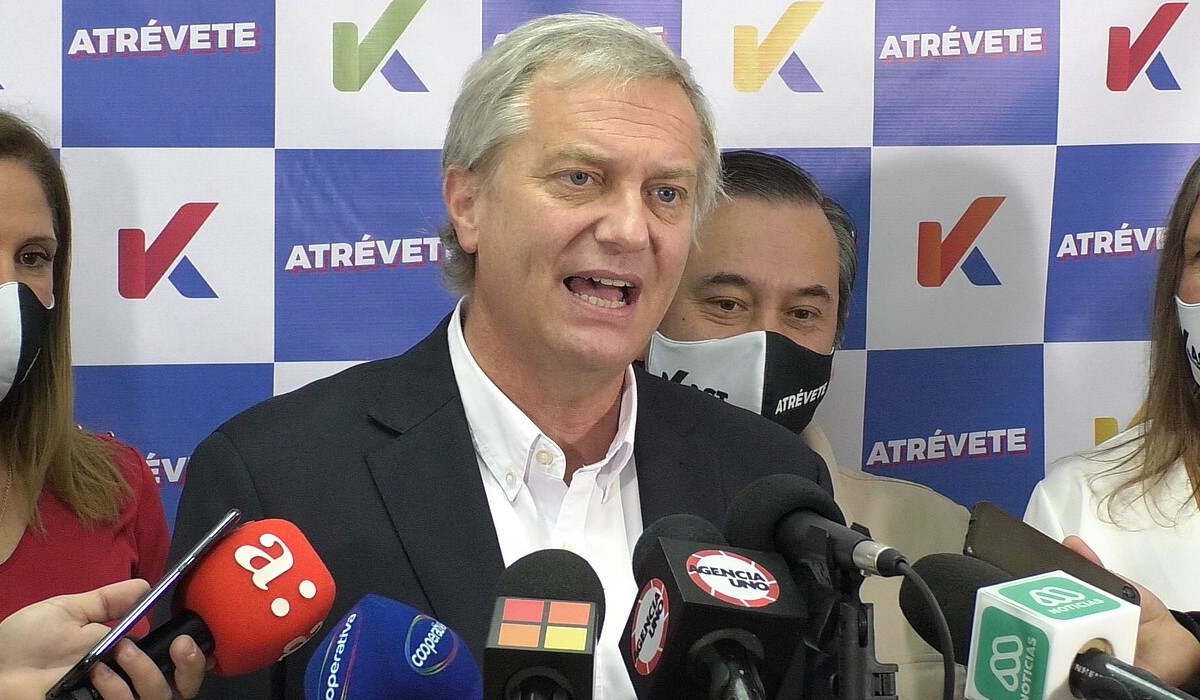
 José Antonio Kast. Photo: Mediabanco Agencia / Wikimedia Commons / CC BY 2.0
Following the inauguration of the new president, Jonathan Maunders outlines key elements aimed at ‘Making Chile Great Again’.
Chile has entered a dangerous new phase. On 11th March, José Antonio Kast took office as president, the country’s sharpest shift to the right since the end of Augusto Pinochet’s dictatorship in 1990.
Kast won the runoff in December with 58 percent of the vote, riding a wave of fear over crime and economic frustration. Now in office, he has cast himself as the head of an “emergency government”, dressing up authoritarianism as common sense and repression as realism.
Kast is no ordinary conservative. He has long admired Augusto Pinochet and campaigned for the dictatorship in his youth. Kast has built his career around ultra-reactionary politics: hardline nationalism, attacks on migrants, hostility to abortion and LGBTQ rights, and a law-and-order agenda heavily influenced by Trumpism.
His rise is a reminder that the far right does not need to wear a military uniform to reheat the legacy of past regimes. It can arrive through elections, draped in the language of “security”, “order” and “national recovery”.
Within days of taking office, Kast moved to turn that rhetoric into policy. He personally oversaw the start of trench-digging on Chile’s northern border with Peru as part of a “Border Shield” plan involving barriers, drones and a large military presence.
He has also issued decrees tightening border controls and accelerating deportations. Migrants are being turned into scapegoats for a deeper social crisis created not by the poor and displaced, but by the failure of neoliberalism to provide public services, housing and jobs.
Kast’s government is also a threat to the environment and Indigenous communities. Activists in the north are warning that his programme of “fewer permits, more investment” will mean intensified mining, weaker protections, and greater pressure on already scarce water supplies.
Recent reports confirm his administration has suspended 43 environmental measures concerning pollution, emissions and national parks. In a country already scarred by privatisation and exploitation, the far right offers more plunder veiled as growth.
There is a bitter irony here. Chile was once the testing ground for neoliberalism under Pinochet. Decades later, after the great revolt of 2019 and the hopes it unleashed, the system has produced not a decisive break with that model but a far-right revival.
The government of Kast’s predecessor, Gabriel Boric, raised expectations but proved unable to deliver the scale of transformation needed. Constitutional defeats, economic strain and growing instability allowed Kast to pose as the man who would restore control. Where the left fails to break with the system, the right feeds on disillusionment with it.
But Kast’s victory is not the end of the story. He does not command unlimited power, and Chilean society remains marked by traditions of mass struggle. Students, workers, feminists, indigenous movements and neighbourhood campaigns have all shaken the state before.
The task now is not despair, but resistance: to oppose every racist crackdown, every attack on democratic rights, every rollback of environmental protection and every attempt to rehabilitate Pinochet’s legacy. The far right has taken the presidency. It must not be allowed to take the future.
Before you go
The ongoing genocide in Gaza, Starmer’s austerity and the danger of a resurgent far right demonstrate the urgent need for socialist organisation and ideas. Counterfire has been central to the Palestine revolt and we are committed to building mass, united movements of resistance. Become a member today and join the fightback.
