
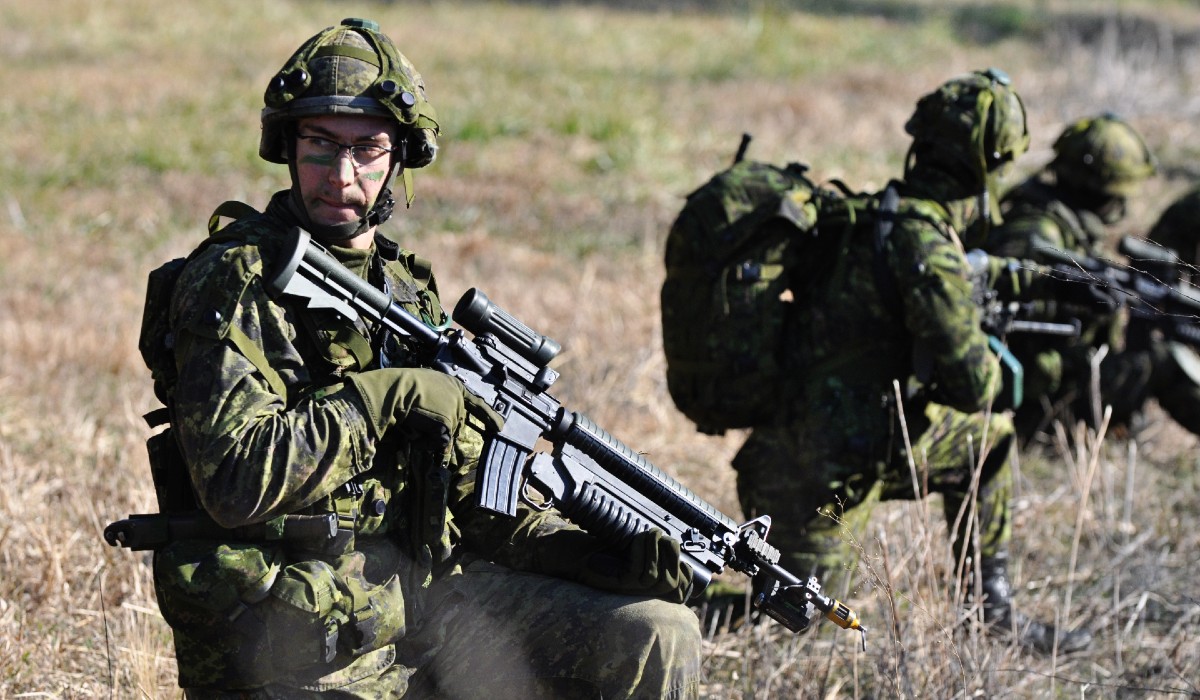
 Canadian Army reservists conduct large-scale exercise. Photo: Virginia Guard Public Affairs, Flickr, CC BY 2.0
Mark Carney’s massive militarisation drive, alongside brutal austerity measures, follows and confirms the new priorities of Nato countries, argues John Clarke
It has been clear for some time that Mark Carney’s Liberal government would be placing a priority on major increases in Canada’s military spending. We now learn, however, that the intention is not only massively to increase war-making capacities but to do so at a truly breakneck speed.
In 2024/25, the Department of National Defence estimated military spending in Canada to be ‘$30.58 billion, representing approximately 6.8% of the Government of Canada’s total main estimates of approximately $449.18 billion.’ This meant that Canada was allocating 1.7% of its gross domestic product to military spending, below the 2% goal that has been set by Nato. Carney now intends to close this gap in the space of a few months.
The CBC reports that an ‘extra $8.7 billion is earmarked for defence spending by the Department of National Defence (DND) or other government departments, and $370 million for the Communications Security Establishment (CSE).’ So rapidly has this very major initiative been adopted and with so little preparation that it ‘will be an uphill — nearly impossible — battle, say experts and critics’ to allocate the funds in an effective manner.
Well before Carney took office, it was clear that there would be substantial moves to divert resources to increase Canada’s military capacities but the tactical shift that the present Liberal government has made is nonetheless remarkable. Global Government Forum notes that Canada ‘was on course to increase this to 2% of GDP by 2032 under former prime minister Justin Trudeau. During last year’s election campaign, Carney pledged to meet that target by 2030 – but has now announced the government will aim to hit the 2% target (by next spring).’
For his part, Carney leaves no doubt that this initiative represents a major priority for his government. ‘Our military equipment and infrastructure have aged … we’re too reliant on the United States, so … Canada will achieve NATO’s target half a decade ahead of schedule,’ he declared emphatically.
Under pressure
A number of factors are driving this huge change in the priorities of the Canadian government. Unquestionably, the Carney Liberals, like their counterparts in Europe, are dealing with a great deal of arm twisting by the Trump administration and they wish to appease Washington to the extent that this is possible.
In April, Global News reported that ‘U.S. President Donald Trump has said he wants NATO members to spend at least five per cent of their GDP on defence.’ Secretary of State Marco Rubio repeated this demand at the time and stressed that Nato ‘has to be a real alliance. And that means that our alliance partners have to increase their own capabilities.’
It becomes clear that Carney’s haste in increasing military spending to the 2% mark is driven by the need to prepare the conditions for a far more dramatic increase in the capacity to wage war over the next few years. In June, the prime minister’s office announced that ‘Canada and its North Atlantic Treaty Organization (NATO) Allies have agreed to a new Defence Investment Pledge of investing 5% of annual GDP by 2035 to ensure our individual and collective security. The commitment aligns with Canada’s own strategic defence and security goals.’
Beyond massively increasing direct military spending, the Liberals have also pledged to integrate other investments into a plan to boost military capacities. The statement informs us that an ‘additional 1.5% of GDP will be dedicated to investments in critical defence and security-related expenditure, such as new airports, ports, telecommunication, emergency preparedness systems, and other dual-use investments which serve defence as well as civilian readiness. Importantly, the progress of this pledge will be reviewed in 2029 to ensure Allies’ expenditures align with the global security landscape.’
This approach is in line with Carney’s view that the ‘world is increasingly dangerous and divided, with the rules-based international system under unprecedented pressure and global conflict becoming more frequent and volatile. To meet this moment, Canada and its Allies are building their defence capabilities to strengthen our collective security.’
Undoubtedly, there is a strong element of bowing to Trump’s dictates in all this, in the hopes of calming his protectionist fury and easing harsh trade measures, but that is by no means the whole story. The America First approach that Trump has taken renders the leading role of the US, in military matters and much else, far less certain and dependable. Junior partners like Canada are aware that their independent capacity to bring ‘hard power’ into the game of global rivalry is now a far more important consideration.
Business lobby
In charting his militaristic course, Carney has not only been pushed forward by Trump’s dictates and social-media outbursts. The institutions that represent Canada’s capitalist class have also made their wishes abundantly clear in this matter.
As early as December of last year, months before the Liberal Party elected Mark Carney as its leader, the Maple reported that, in a report entitled ‘“Security & Prosperity: The Economic Case for a Defence Industrial Base Strategy,” the Business Council of Canada (BCC) called on the federal government to invest ‘in a strong and sovereign defence industrial base,” and to increase military spending toward three per cent of Canada’s GDP after 2034/2035.’
The BCC’s aspirations at that time have now been overshadowed by even more extreme measures but they are revealing nonetheless. The above-mentioned statement by Carney’s office reveals exactly the same reasoning as that engaged in by the leading voice of Canada’s ‘business lobby.’
The BCC report stressed that ‘Canada’s military rivals are investing heavily in their armed forces’ and emphasises the need to respond to a ‘new, more tumultuous geopolitical reality.’ It noted that its ‘recommendation of hitting the two per cent target two years earlier would require $75 billion of annual military spending by 2030.’
The question leaps out of just how the BCC imagined such an expenditure, which has now been greatly exceeded, would be paid for. Their answer was that the ‘Government of Canada can immediately commit to a comprehensive review of its current programming … This program review would ensure that the lion’s share of new investments in Canada’s defence industrial base are offset by a decrease in government spending elsewhere.’
There is no doubt that Carney, with his considerable experience as a technocratic representative of major capitalist institutions, has taken this friendly advice to heart. The scale of his turn to militarism has exceeded the hopes of the BCC and their call for intensified austerity has not gone unanswered either.
In an article I wrote for Counterfire on 16 July, I noted that ‘Finance Minister François-Philippe Champagne [had] launched a “comprehensive expenditure review” and asked his cabinet colleagues to identify potential operational and program cuts.’ For his part, Carney had ‘ordered a whole-of-government review through the new Red Tape Reduction Office to target potential regulatory cuts.’
Overall, the government is ‘planning to reduce spending between now and 2029, beginning with a 7.5 percent cut in the coming year, rising to 10 percent, and then 15 percent cumulatively by 2029.’ As I also pointed out, austerity measures on this scale rival or even exceed the massive round of social cutbacks that Liberal governments imposed in the 1990s, marking the point at which Canada fully embraced neoliberal austerity.
The Carney government is charting a course of class war domestically in order to increase greatly the capacity to wage war internationally. In the context of Canada, this development expresses the dangerous uncertainties and harsh realities of Trump’s new disordered world order.
Any serious parliamentary opposition to Carney’s intensifying onslaught is lacking and only mass action by unions and social movements can provide an effective challenge. We must oppose the turn to militarism and the preparations for war on which the Liberals are embarked. In doing this, we must challenge and prevent the decimation of the already weakened social infrastructure. Mark Carney’s war machine must be stopped in its tracks.
Before you go
The ongoing genocide in Gaza, Starmer’s austerity and the danger of a resurgent far right demonstrate the urgent need for socialist organisation and ideas. Counterfire has been central to the Palestine revolt and we are committed to building mass, united movements of resistance. Become a member today and join the fightback.

John Clarke
John Clarke became an organiser with the Ontario Coalition Against Poverty when it was formed in 1990 and has been involved in mobilising poor communities under attack ever since.