
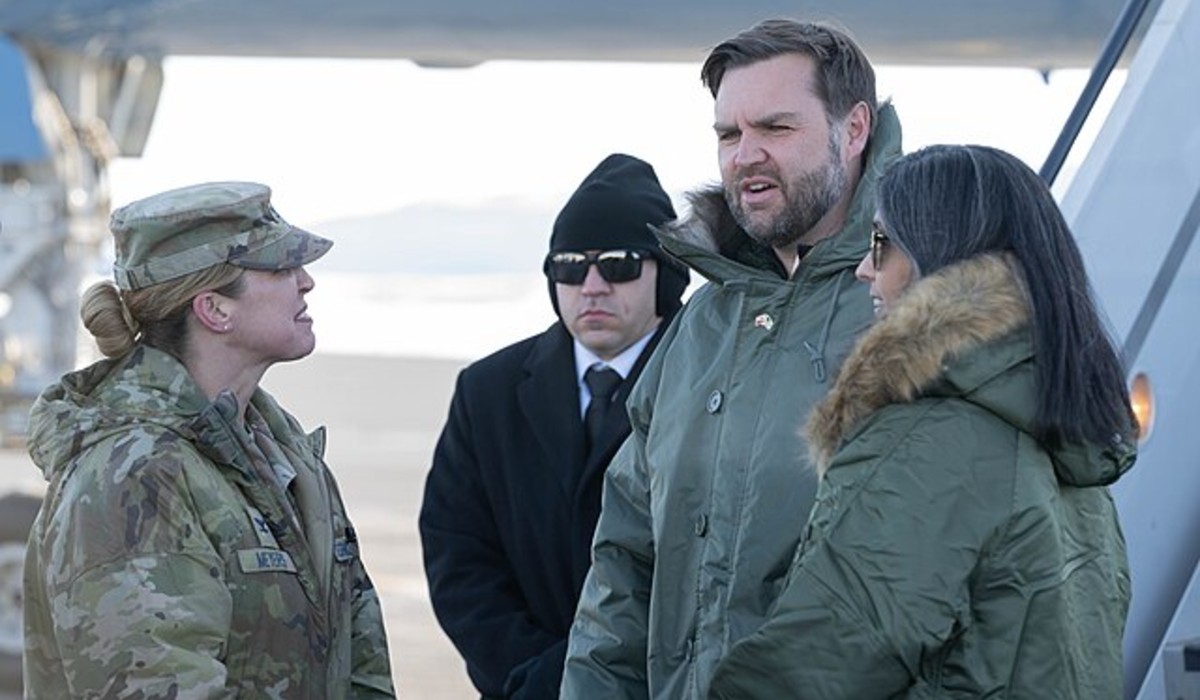
 USA Vice President JD Vance and Second Lady Usha Vance at Pituffik Space Base, Greenland, March 28, 2025. Photo: Jaime Sanchez / Wikimedia Commons / Public Domain
The US’s kidnapping, piracy and other threats have shocked many, and the anti-war movement must build on the widespread popular outrage, argues Chris Nineham
Since Trump’s kidnap of Maduro, most commentators have focussed on the geopolitical impact of his gangsterism and his threatening behaviour since. This is as it should be. It was one thing to read about the new ‘America first’ doctrine in the US National Security Strategy document last year, it is quite another to see it enacted in all its naked brutality in the real world.
The shockwaves are still reverberating. Trump’s next targets are scrambling their defences. Russia and China will be considering their options, including striking out in their own spheres of influence. Everywhere, hawks and ultra-nationalists are emboldened, and countries around the world are rushing to rearm.
European governments are in a state of panic, terrified that Trump will trash Nato by invading Greenland, while on the whole too cowardly to call him out, although Macron has broken ranks by criticising Trump for ‘turning away’ from allies. Their main practical response is to join the march to militarism by ramping up arms spending and promising troops to Ukraine. In the words of the head of the French army, ‘we must be ready to sacrifice our children’. The world feels closer than ever to war.
Defending freedom
There is, however, another side to the situation which we should register. In the process of smashing up what was laughably called the rules-based order, Trump’s lurch back to the Monroe Doctrine is stripping imperialism of all ideological cover.
This has two aspects. Since World War Two, US imperialism has mainly operated by leading coalitions. First there was the ‘alliance of the free world’ during the Cold War, encapsulated, but not limited to Nato, and given soft power underwritten by the UN. The Vietnam War marked a moment of unilateralism, but it didn’t end well for the US. After the end of the Cold War, ‘a coalition of the willing’ has operated sometimes through, sometimes outside Nato to impose US interests in the former Yugoslavia, Afghanistan, Iraq, Libya and elsewhere. Military alliances operated alongside international financial institutions like the IMF and G8 which set terms of trade favourable to the US and other Western powers.
Faced with growing threats to US hegemony, Trump is downgrading these partnerships in favour of brazen ‘America first’ power plays. This has alienated and appalled many of the US’s allies. Trump’s open support for Israel’s genocide has created unheard of levels of opposition in the UN. This doesn’t have immediate practical consequences – the US controls UN decisions through its veto at the security council – but it is turning governments against the US around the world. The attack on Venezuela has divided Latin American governments but has hardened many states against the US. This both pushes them closer to the US’s main competitor, China, and helps spread popular opposition to the US.
Trump’s bullying of European governments and his threats to Denmark may not have immediate consequences either, given EU leaders’ cowardice. It does however make it almost impossible for them to continue pushing the big lie of the last one hundred years: that the West’s role is to spread democracy, civilisation and freedom.
The Second World War was presented as a crusade against fascism, although competition for colonies was at its heart. Post-war repression of anti-colonial movements was justified as defending the free world against communism. More recently, Tony Blair helped the neoconservatives brand their post-cold war interventions as ‘humanitarian wars’ against tyrants, Islamists and terrorist supporters. Millions saw through these lies and understood the real dynamic. ‘No war for oil’ was one of the main slogans of the great anti-Iraq war movement. The idea of the West as the repository of democratic values, however, ran deep and lingered on.
Blow-up
Trump has abandoned any such pretences. As he causes consternation in Western capitals by threatening his core alliance, his combination of naked violence and Make America Great Again rhetoric is blowing up the intellectual foundations of liberal imperialism.
There are a variety of responses in the establishment. Starmer’s government is channelling a head-in-the-sand denial which amounts to appeasement. Starmer literally had no answer to the question of how to respond to the Maduro kidnap, but he has loyally participated in the recent piracy in the North Sea. Reform and the far right in Britain are openly pro-Trump, with Reform voters the one group who back Trump’s action and Tommy Robinson bizarrely calling for Trump to invade Britain.
Meanwhile, the mainstream view of the British ruling class was best summed up in the cynical realism of former MI6 head Alex Younger who told the BBC, ‘I defer to others on legal matters, but we need to understand that we now live a world of might is right, and if want a vote we need to muscle up.’
There is another widespread and important response though. Many MPs in the Labour Party, most if not all in the LibDems and other smaller parties – even some Tories – are concerned at what is happening and at least partially understand the dangers of the direction of travel. Foreign Secretary Yvette Cooper was challenged repeatedly during Tuesday’s foreign-policy debate in the Commons about the advisability of letting Trump’s actions go unopposed.
The media’s response to the current crisis is also very different from its support or shoulder shrugging during the Gaza genocide. The Guardian, the Financial Times, the Daily Mail, Sky News, even initially the BBC, have carried a good deal of openly critical coverage of Trump’s latest moves.
Meanwhile, many national trade unions have responded quickly and clearly by denouncing Trump’s attack. None of this is surprising given the popular response. Polling suggests 51% of the British public disapprove of US actions in Venezuela with 21% approving, and only 8% ‘completely approving’. This is against a recent background of majorities of between 70 and 80% of Britons disapproving of Trump in general. Even in the US the biggest number oppose what Trump has done in Venezuela.
Destabilisation
All this is helping to create disorientation in a ruling class already destabilised by Trump’s antics. It is also causing headaches for the radical right. Having posed as opponents of war in Ukraine and applauded Trump’s opposition to forever wars, they are now having to back blatant and extremely unpopular interventionism.
This is important when it comes to the potential for anti-war organising in the days and weeks ahead. Opposition to Trump’s wars, to Starmer’s militarism and Europe’s rush to rearm can strike a chord with millions if pursued in a popular and energetic way. We can construct a much broader alliance than over the Gaza genocide, pulling in scores of MPs, commentators and other public figures well beyond what is an already impressive list of so-called usual suspects. We can appeal to trade unionists on a mass scale, especially by linking spiralling military spending with continued austerity. We must act decisively. If we don’t, we risk disaster but if we do, we can throw the government further into crisis and humiliate the hard right.
Before you go
The ongoing genocide in Gaza, Starmer’s austerity and the danger of a resurgent far right demonstrate the urgent need for socialist organisation and ideas. Counterfire has been central to the Palestine revolt and we are committed to building mass, united movements of resistance. Become a member today and join the fightback.

Chris Nineham
Chris Nineham is a founder member of Stop the War and Counterfire, speaking regularly around the country on behalf of both. He is author of The People Versus Tony Blair and Capitalism and Class Consciousness: the ideas of Georg Lukacs.