
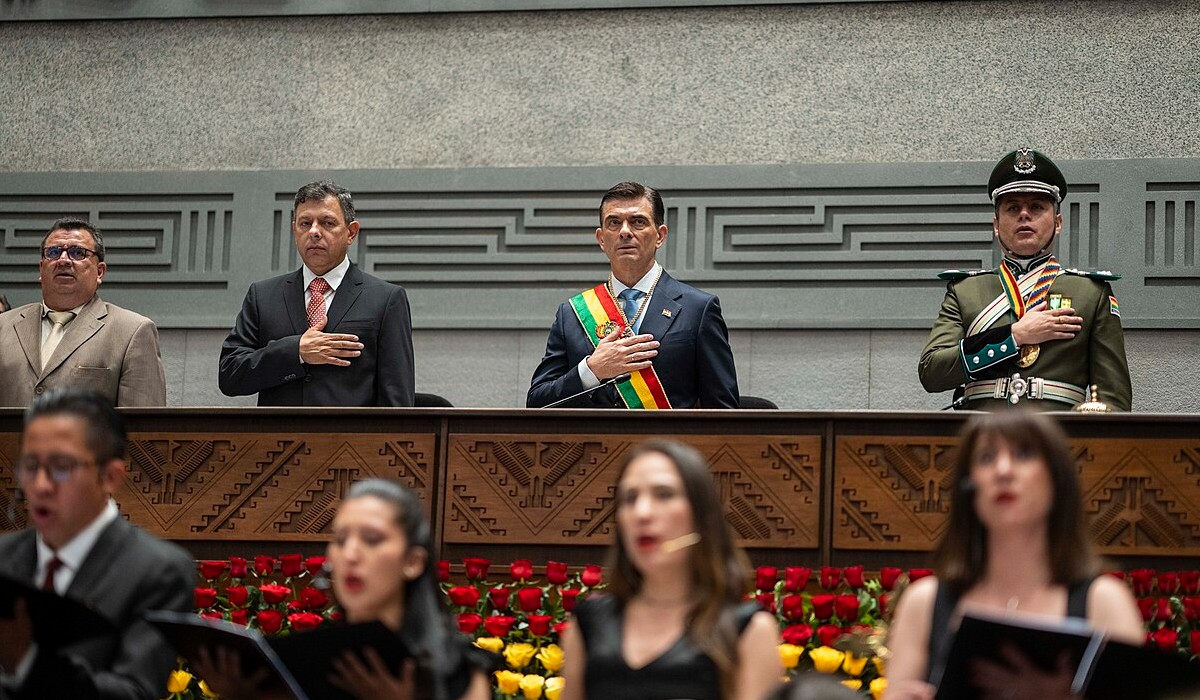
 Rodrigo Paz Pereira, president of Bolivia. Photo: Estado de Chile / Wikimedia Commons / CC BY 3.0 CL
Barely six months after taking office, Bolivia’s right-wing president Rodrigo Paz Pereira is facing widespread resistance and a general strike, writes Jonathan Maunders
Bolivia’s revolt is spreading. What began with rural and peasant organisations marching to protect land rights has grown into a general strike involving miners, teachers, transport workers and other sections of the working class.
Roads have been blockaded, the capital La Paz has seen clashes with riot police, and miners have marched with dynamite towards government buildings. Barely six months after taking office, right-wing president Rodrigo Paz Pereira is facing widespread resistance.
As the protest wave has grown, so have its demands. Bolivians want cheaper fuel, higher wages, land rights, an end to austerity and privatisation, and increasingly: Paz’s resignation.
This escalation began after peasant and farming organisations led a 20-day march against a law threatening indigenous and peasant rights to land. The government was forced to retreat and repeal the law, but the movement did not stop there.
Paz came to power in November 2025. This was after a bitter split in the Movement for Socialism Party between then president Luis Arce and his predecessor Evo Morales torpedoed the party’s hopes of two decades of electoral success.
Paz’s victory was celebrated by the right as the start of a new pro-market era. He promised “capitalism for all” and national renewal. But the substance has been familiar: reassuring markets, appeasing Washington and imposing austerity. Six months on, his promise of stability is colliding with reality.
Bolivia is facing its worst economic crisis in decades. A country that was once a major exporter of natural gas is now struggling with fuel shortages, inflation and international pressure to introduce spending cuts.
For ordinary people, this means spiralling costs, shortages of diesel and food, and wages that cannot keep up. Protesters are demanding a 20 percent pay rise as a response to collapsing living standards.
Paz’s government has answered with a mixture of retreat and repression. It dropped the land law, but deployed thousands of soldiers and police as roadblocks spread. Paz has offered limited concessions, while presenting the protests as a threat to democracy. Washington has gone further, describing the unrest as an attempted coup.
That is a cynical inversion of reality. When workers, peasants and Indigenous communities resist austerity, they are accused of destabilising democracy. When a government backed by the US and foreign business interests pushes austerity onto the poor, it is called responsibility.
That is why this protest wave matters. Bolivians have not united in reaction to one policy. Together, they are resisting an entire political direction: the return of neoliberal dogma in a country where memories of privatisation, US interference and state violence remain raw.
Bolivia’s great popular struggles, from the Cochabamba water war to the gas war and the movements that brought Evo Morales to power, were never just about prices. They were about who controls the country’s resources and whether Indigenous and working-class Bolivians have the right to shape the future.
None of this means romanticising the crisis. The movement contains different forces, including supporters of Morales, trade unions, miners, rural organisations and transport workers.
They do not all share the same politics or strategy. But the central fact is clear: Bolivian workers are refusing to absorb the costs of a crisis they did not create.
For the international left, the lesson is clear. The election of a right-wing president did not mean the defeat of Bolivia’s social movements.
Bolivia is not facing an anti-democratic coup. It is facing the predictable consequences of a government trying to impose austerity on people with a long memory of resistance.
Before you go
The ongoing genocide in Gaza, Starmer’s austerity and the danger of a resurgent far right demonstrate the urgent need for socialist organisation and ideas. Counterfire has been central to the Palestine revolt and we are committed to building mass, united movements of resistance. Become a member today and join the fightback.
