
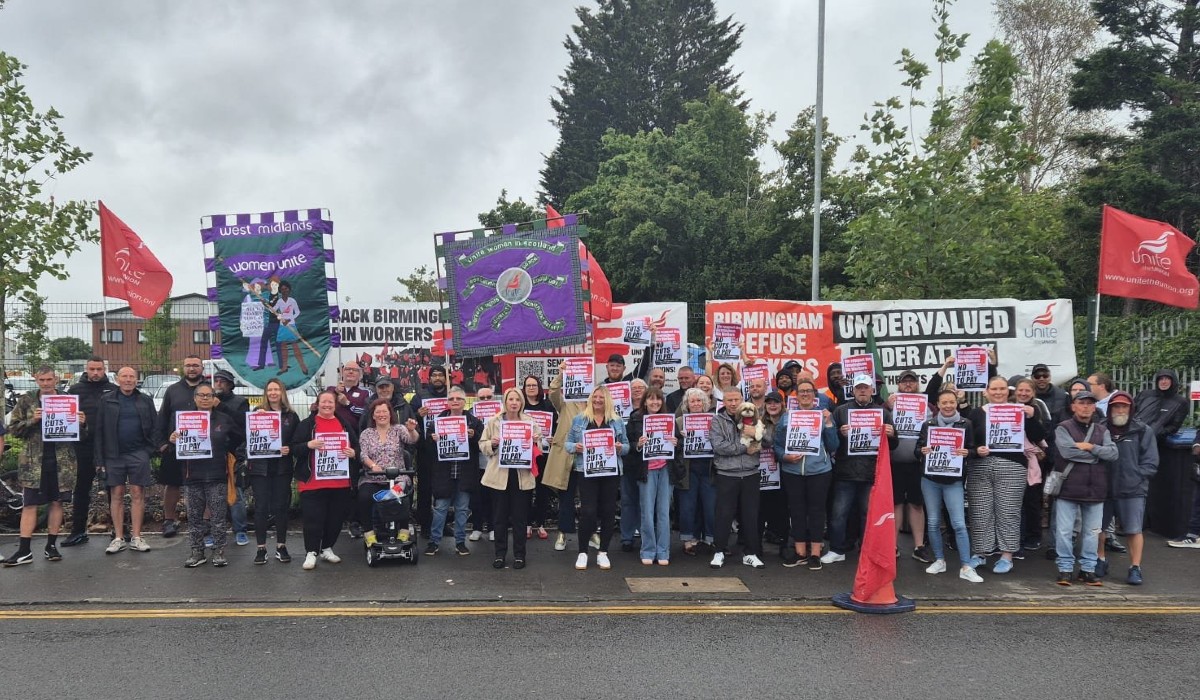
 National Women’s Committee join Birmingham bin workers picket line. Photo: @unitewestmids / X
Michael Lavalette spoke with Matthew Reid, Unite Convenor at Birmingham City Council whose members in refuse collection have been on strike for over twelve months
Can you give us the background to the dispute?
The dispute has its roots in the failings of Birmingham City Council. In 2023, the council effectively declared that they were bankrupt. They had installed a new IT system which original estimates suggested would cost £20m, but it ended up costing £140m. And there was the cost to the council of their long-standing failure to meet pay equality claims, resulting in a potential pay liability, they claimed, of £760m.
Michael Gove sent in commissioners to run the council, or at least, to have oversight of council decision making. The commissioners demanded the reorganisation of the council with a view to making savings in all council budget areas and all service directorates.
In mid-2024, we, as a union, were given a ‘108 notice’ which informed us that the refuse-collector job was going to be ‘removed’. This is a crucially important job. It’s the person who works at the back of the truck and has, what a High Court Judge in 2017 determined, a ‘critical safety role’, making sure other workers are safe from traffic and that traffic is passing the trucks safely. Now the council were saying this job would go and we were facing redundancies via a voluntary redundancy scheme. Anyone who didn’t lose their job would be downgraded to a ‘loader’ and that meant a pay cut of £8,000 per year.
So, effectively, we were facing three issues: redundancies, regrading/wage cuts and increased workload for those who stayed in job.
The council launched their 45-day ‘consultation’. But it was a complete sham. We put multiple options forward that would have avoided the need for redundancies and stopped them removing the key, ‘safety-critical’ role. But they simply didn’t listen to us. They’d made their mind up from the start that they were going to force through redundancies and wage cuts.
In December 2024, we balloted for strike action. I think the council thought we wouldn’t reach the legal threshold to instigate strike action and they could just do what they wanted. But we got the threshold and we had our first strike on 6 January 2024.
The day of the first strike, the council suddenly approached us to negotiate!
We then spent six months in discussions with them, via ACAS. We eventually got to a place, we thought, where we had more or less agreed a compensation package and were close to a settlement.
The council told us they were taking this away to the commissioners and we thought we had an agreement.
But the commissioners responded by rejecting the proposals and basically said all negotiations over the previous six months were unacceptable! What a waste of time!
But even worse, they then said that the drivers were now going to be regraded and they would also lose £8,000 a year! In others words, they came back and upped the ante.
Clearly the on-going dispute is on the council! How have you tried to build support in the local community?
The council has used anti-trade-union legislation against us and we have had the police using public-order legislation against us. We have had to think about how we conduct our campaign. We have had rallies, meetings and three mega-pickets, all of which have been fantastic. But we have also had to think about how we take this into the community.
The council has responded by cutting garden waste and recycling services and focus on household waste. Ironically, this has created a space for us to engage with the community and explain our case.
Unite organisers have been in the community, knocking on doors and getting a very positive response. We estimate that close to nine out of ten people we speak to are supportive.
When people know that workers are facing job losses and £8,000 pay cuts because of the failings of the council, they are really supportive. Most people are appalled that the council want to take a quarter of people’s salary when it’s clearly not their fault or doing. It’s Birmingham council mismanagement that’s at the heart of the issue and they want hard-working, low-paid bin workers to pay the price: most people in the community recognise that and are very supportive.
What solidarity have you received from the wider movement?
It’s been brilliant!
We have had messages of support from across the movement. We have had donations to the strike fund from across the country. The meetings, marches and mega-pickets have been well-supported and amazing events.
There are support groups who regularly turn up to offer support in various ways.
Jeremy Corbyn and Zarah Sultana have been to our picket lines, but unfortunately they have been the only MPs who have joined us. None of the Labour MPs in Birmingham have bothered to come along.
In fact, early on in the strike, Angela Rayner, when she was still Deputy PM, came to Birmingham and I thought, ‘great’, she’s coming to support us. But I couldn’t have been more wrong. She actually went out to meet and greet the scabs and tell them what a great job they were doing!
What needs to happen to bring this to a positive end?
The workers are on £70 a day strike pay, and that is less than their wage, obviously. But we have been able to say: ‘if we don’t fight, if we don’t win … that will be our wage from now on! So let’s have a hard, solid fight now to ensure proper pay going forward.’
As the strike has gone on, the more determined people have become. We are absolutely determined to fight until we win; the workers’ resilience has been amazing.
We need as much support as we can get. Messages of support, financial support, come and join our marches and rallies. But we also need to increase the political pressure on the council to demand that they get back round the table and sort this out.
Donations to the strike fund to:
Unite West Midlands region 1% fund
Account number: 20174000
Sort code: 60-83-01
(Please include reference BCC)
Before you go
The ongoing genocide in Gaza, Starmer’s austerity and the danger of a resurgent far right demonstrate the urgent need for socialist organisation and ideas. Counterfire has been central to the Palestine revolt and we are committed to building mass, united movements of resistance. Become a member today and join the fightback.
